

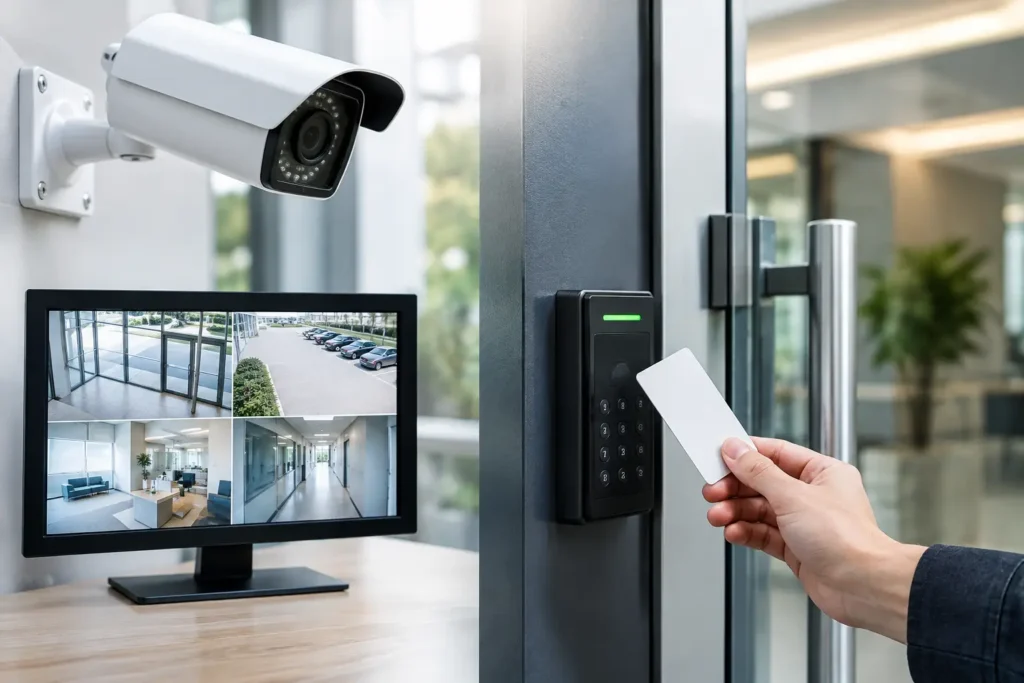
A warehouse handover can be delayed by one missing cable route. A retail fit-out can fail inspection because the CCTV layout does not meet authority requirements. A commercial building can face avoidable security gaps when access control, intercom, and surveillance are installed as separate systems instead of one coordinated infrastructure.
When facility managers ask, what are ELV systems? (CCTV, access control, structured cabling, intercom, fire alarm), they are usually asking a bigger operational question: how do these systems work together to protect a site, support daily operations, and meet approval requirements?
ELV stands for Extra-Low Voltage. It describes the low-voltage technologies that carry data, communication, monitoring, and control signals throughout a property. Unlike main electrical power systems, ELV systems are designed to manage security, communications, safety notifications, and network connectivity. For commercial and industrial projects, proper ELV planning is not an optional add-on. It is part of building a site that can operate securely and pass required inspections.
What Are ELV Systems in a Commercial Property?
ELV systems connect the technologies that allow a facility to see, communicate, control entry, transmit information, and respond to incidents. The term can cover many solutions, but the core systems for most UAE commercial properties are CCTV surveillance, access control, structured cabling, intercom systems, and fire alarm systems.
These systems often share pathways, network cabinets, power arrangements, and control rooms. That is why design coordination matters. Installing each system through a different contractor without an overall ELV plan can create cable congestion, poor camera coverage, incompatible equipment, incomplete documentation, and approval delays.
The right design depends on the type of facility. A logistics yard may need perimeter cameras, gate barriers, vehicle access records, and fiber connectivity across a large site. A clinic may prioritize controlled entry to staff areas, clear intercom communication, and reliable fire alarm coverage. A residential tower requires a different balance of visitor management, common-area surveillance, and emergency communication.
The Main ELV Systems and Their Roles
CCTV surveillance
CCTV is the visual monitoring layer of an ELV system. Cameras record activity at entrances, cash-handling points, loading bays, corridors, parking areas, perimeter boundaries, and other risk-sensitive locations. Modern IP camera systems can support remote monitoring, event alerts, video analytics, and centralized storage.
However, camera quantity alone does not create a compliant or effective system. Camera placement, image quality, lighting conditions, storage duration, network bandwidth, and recorder capacity all affect performance. In Dubai, Abu Dhabi, and Sharjah, the relevant authority requirements can also influence camera coverage, retention periods, equipment specifications, and documentation. A compliant design should be approved right the first time, not corrected after installation.
Access control
Access control manages who can enter a door, gate, floor, server room, warehouse zone, or restricted facility area. It may use cards, PIN codes, mobile credentials, biometric readers, or a combination of methods. The system records entry events and can apply different permissions by employee role, schedule, or location.
For property managers, access control replaces the uncertainty of physical keys with traceable activity. If an employee leaves, credentials can be removed without changing locks across the building. For industrial and logistics operations, it can restrict access to high-value inventory, control rooms, fuel areas, and dispatch zones.
There are trade-offs. Biometric systems can provide stronger identity verification but require careful privacy, enrollment, and maintenance planning. Card-based access is simple to manage but cards can be lost or shared. The best choice depends on the site risk level, user volume, and operating procedures.
Structured cabling
Structured cabling is the physical backbone of the ELV infrastructure. It includes the organized copper and fiber cabling, patch panels, racks, outlets, containment, labeling, and termination points that connect cameras, access readers, intercoms, computers, Wi-Fi access points, and other networked equipment.
Poor cabling causes problems that are expensive to diagnose later: unstable camera feeds, slow network performance, disconnected door controllers, difficult maintenance, and unattractive exposed wiring. A properly designed structured cabling system gives the facility room to expand without repeatedly opening ceilings or installing temporary cable runs.
The difference is especially clear during maintenance or a future fit-out. When every cable is labeled, tested, documented, and routed correctly, the next contractor can identify and service the system without guesswork.
Intercom systems
An intercom allows visitors, delivery drivers, tenants, security teams, and reception staff to communicate before granting access. It may be audio-only or video-enabled and can connect to door release functions, mobile applications, reception stations, or centralized security desks.
For offices, residential developments, schools, clinics, and warehouses, an intercom adds a practical verification step at the entrance. Rather than opening a gate based on a phone call or visual assumption, authorized staff can identify the visitor and release the door remotely where appropriate.
Intercom design should account for noise, weather exposure, visitor traffic, accessibility, and the distance between entry points and response staff. A system that is difficult to hear at a busy loading entrance will not perform when it matters.
Fire alarm systems
Fire alarm systems detect and report fire-related events so occupants can be alerted and emergency response procedures can begin. Depending on the building design and applicable code, the system may include smoke detectors, heat detectors, manual call points, sounders, strobes, control panels, interface modules, and monitoring connections.
Fire alarm is a life-safety system, not simply another security device. It must be designed, installed, tested, commissioned, and maintained in line with the applicable civil defense and local authority requirements. Integration with access control may be required so designated doors release during an alarm event, while CCTV can help security teams assess affected areas. These integrations must be engineered carefully and tested as part of the full emergency response sequence.
Why Integrated ELV Design Matters
The value of ELV systems is not just in the individual components. It is in how they support a controlled response.
For example, a door forced open after hours can trigger an access control event. The security team can immediately check the nearby CCTV camera, communicate through an intercom if needed, and review a clear audit trail. In a larger facility, structured cabling and network design ensure that these signals reach the control point reliably.
Integration should be purposeful, not excessive. Connecting every system to every other system can add cost and complexity without improving operations. The right approach is to identify the risks that matter most: unauthorized access, theft, visitor management, emergency evacuation, perimeter control, or operational visibility. Then build an ELV design around those outcomes.
Compliance Is Part of the Installation
For many businesses, the most expensive problem is not equipment failure. It is a failed inspection, rejected documentation, or delayed opening because the system does not meet authority expectations.
Compliance-driven projects require more than supplying cameras or readers. They require accurate site surveys, authority-aware system design, approved equipment where applicable, correct installation methods, testing, commissioning records, user training, and maintenance support. Requirements can vary by emirate, project category, and facility use, so assumptions made on a previous project may not apply to the next one.
ALNAJAH ALAWAL SECURITY SYSTEMS & EQUIPMENT TRADING L.L.C. manages this process from survey through commissioning, including compliance-focused CCTV installations for SIRA, Abu Dhabi monitoring and control requirements, and Sharjah Police requirements where applicable. This single-vendor responsibility helps reduce gaps between design, installation, approvals, and after-sales support.
Planning an ELV System Before Construction or Renovation
The best time to plan ELV infrastructure is before ceilings close, walls are finished, and critical equipment rooms are fixed. Early planning allows cable containment, rack locations, power points, network capacity, camera mounting positions, and access-controlled doors to be coordinated with architectural, electrical, and fire-life-safety works.
Start with a site survey and a clear operational brief. Identify entry and exit points, vulnerable areas, visitor routes, asset locations, security staffing, future expansion plans, and approval obligations. A competent contractor should then translate those needs into drawings, equipment schedules, cable routes, and a practical installation sequence.
Do not select a system based only on the lowest equipment price. A lower upfront quote can become costly if it excludes testing, documentation, authority coordination, adequate storage, proper cable containment, or ongoing support. The goal is a system that works reliably on day one and remains manageable after handover.
A well-planned ELV system gives your facility control without adding unnecessary operational burden. Before your next fit-out, expansion, or security upgrade, arrange a site assessment that considers compliance, infrastructure, and real daily use from the beginning.