

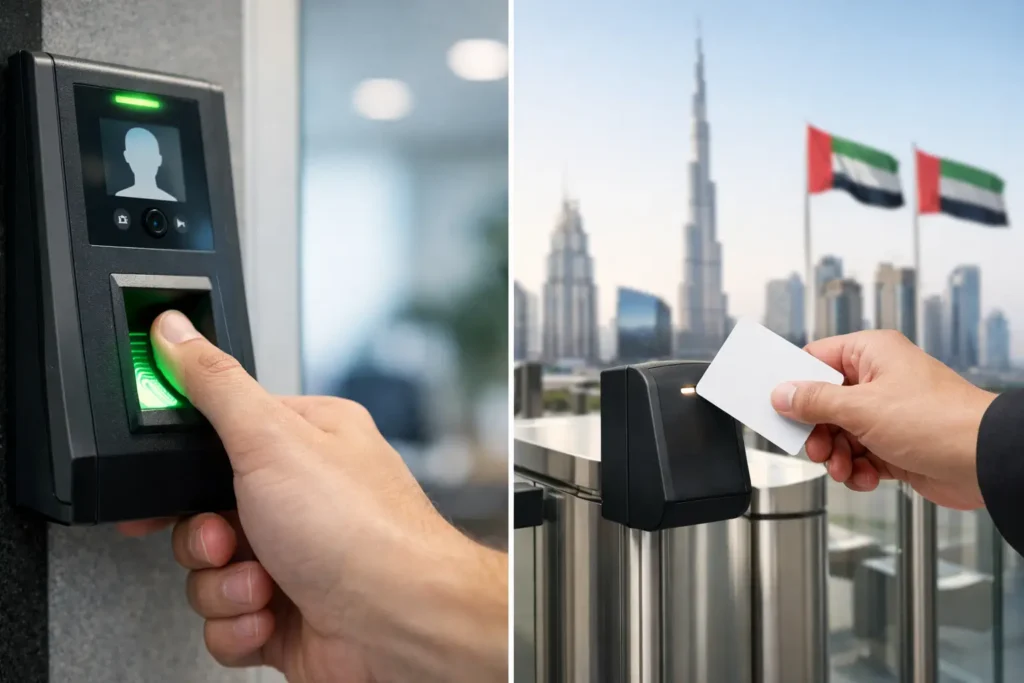
A lost access card can be canceled in seconds. A compromised fingerprint cannot. That single difference changes the biometric vs card access decision for warehouses, offices, retail sites, labor accommodation, healthcare facilities, and high-value operations.
The right answer is rarely about choosing the newest device. It is about matching identity assurance, site risk, user volume, local requirements, and operational continuity. A system that is difficult to manage at shift change or creates privacy concerns can become a liability, even if its security specification looks impressive on paper.
Biometric vs Card Access: The Core Difference
Card access verifies possession. The system grants entry because a person presents an authorized credential such as a proximity card, smart card, key fob, or mobile credential. It is quick, familiar, and easy to deploy across large teams.
Biometric access verifies a physical characteristic. Depending on the reader, this may be a fingerprint, face, palm, or iris. The credential is tied to the individual, so it cannot normally be loaned to a colleague, forgotten at home, or copied as easily as a basic card.
That distinction matters most where the identity of the person entering is as important as the door being opened. Server rooms, cash offices, pharmaceutical storage, control rooms, restricted industrial areas, and sensitive records rooms often need higher assurance than a general office entrance.
Where Card Access Is the Better Operational Choice
Card systems remain the practical choice for many commercial properties. They support fast enrollment, simple replacement, and clear access administration. When an employee joins, changes role, or leaves, a credential can be issued, reprogrammed, or disabled without collecting sensitive biometric data.
For large sites with contractors, visitors, temporary staff, or frequent workforce turnover, this flexibility is significant. A warehouse operator may need to issue short-term credentials to drivers, maintenance teams, and seasonal workers. A hotel or retail operation may need staff access profiles that change by shift, department, or location. Card access handles these cases efficiently.
Cards also work well in harsh or high-throughput environments. A well-positioned reader can process users quickly without requiring a precise presentation angle. In industrial settings, gloves, dust, moisture, damaged fingerprints, and poor lighting can reduce the practical performance of some biometric methods.
The main weakness is credential sharing. If one employee hands a card to another, the audit trail shows the cardholder, not necessarily the person who entered. Anti-passback rules, turnstiles, CCTV verification, and security supervision can reduce this risk, but they do not eliminate it.
When Biometric Access Justifies the Investment
Biometric access is strongest when preventing credential misuse is a priority. It creates tighter accountability because the access event is connected to the enrolled individual rather than to an item they carry.
This is particularly valuable for attendance-sensitive operations, restricted zones, high-value inventory, regulated records, and areas where unauthorized access could cause financial loss, safety incidents, or compliance exposure. A biometric reader can also reduce disputes around buddy punching where employees use another person’s card for attendance or access.
However, biometric technology should not be specified simply because it appears more secure. Reader selection matters. Fingerprint readers may be unsuitable for workers with worn fingerprints or gloves. Facial recognition devices need suitable lighting, camera placement, and enrollment quality. Liveness detection should be considered where spoofing risk is relevant.
The best biometric deployment includes a controlled fallback process. A reader can fail, a user may be unable to authenticate, or an emergency route may need immediate release. Facilities should define who can authorize an alternative entry method, how the event is recorded, and how access is restored without weakening the security policy.
Privacy and Data Handling Need Early Attention
Biometric data requires greater care than an access card number. Organizations should establish a clear legal and operational basis for collection, limit access to enrollment and administration functions, and define how long data will be retained.
A good system design uses biometric templates rather than storing raw fingerprint images whenever the technology supports it. Templates should be protected, access should be role-based, and the organization should have a documented process for deletion when an employee or contractor no longer needs access.
Employees also need clear communication. They should understand what data is being collected, why it is required, how it will be used, and what happens if a reader cannot verify them. This is not only a privacy issue. Clear procedures prevent delays at entry points and reduce resistance during rollout.
For organizations operating in Dubai, Abu Dhabi, or Sharjah, access control should also be reviewed alongside applicable building, security, and authority requirements. Access control is often part of a wider compliance environment that includes CCTV coverage, visitor management, emergency egress, and records retention. Treating each system as separate can create approval delays and coverage gaps.
Cost Is More Than the Price of the Reader
A card reader is usually less expensive to purchase and install than a biometric reader. Cards and fobs add a continuing replacement cost, but that cost is predictable and usually modest for stable workforces.
Biometric systems may cost more upfront because of reader hardware, enrollment, configuration, privacy controls, and support requirements. Their value comes from reducing credential sharing, improving time and attendance accuracy, and strengthening accountability in sensitive areas.
The right comparison should include the total cost of operation. Consider reader maintenance, replacement credentials, enrollment time, integration requirements, administration workload, downtime procedures, and the cost of an unauthorized entry. A low-cost system that cannot produce reliable audit records or support the required number of doors can become the more expensive option over time.
Use a Layered Design Instead of a Single Choice
The strongest access control strategy is often not biometric or card access across every door. It is a layered design that applies the appropriate control to each area.
For example, cards or mobile credentials may be appropriate for perimeter gates, staff entrances, elevators, and standard offices. A biometric second factor may be applied to a data room, finance office, medicine store, jewelry stockroom, or master-key cabinet. This approach protects critical assets without slowing down everyday movement throughout the site.
Dual authentication can be especially useful where a card alone is not sufficient. Requiring a card plus fingerprint or face verification confirms both possession and identity. It also provides a stronger investigation trail when an incident occurs.
Integration adds further value. Access events can trigger or be verified against CCTV footage, link to visitor management records, and notify security staff when doors are forced open or held open. For multi-site organizations, a centralized platform helps administrators manage users, permissions, reports, and door status consistently across locations.
Questions to Settle Before You Specify Access Control
Before selecting devices, define the doors that need protection and the consequences if each one is compromised. Then assess the people using those doors: permanent staff, contractors, visitors, drivers, residents, or shift workers. Their working conditions matter as much as the technology.
Also confirm whether the system must integrate with fire alarm interfaces, turnstiles, elevators, attendance platforms, HR records, CCTV, or a central security control room. Emergency egress must never be compromised by access control. Doors must release or behave according to the approved life-safety design, and installation must be coordinated with the building’s electrical and ELV infrastructure.
Finally, plan for administration from day one. Identify who enrolls users, approves access levels, reviews reports, responds to lost cards, handles failed biometric verification, and removes access when roles change. Access control is only effective when these responsibilities are assigned and followed consistently.
Choose for the Risk, Not the Reader
Card access delivers speed, flexibility, and cost control for most everyday entrances. Biometric access delivers stronger identity verification where shared credentials, attendance fraud, or sensitive assets create a higher risk. Neither option is automatically right for every door.
ALNAJAH ALAWAL helps organizations assess site risk, design compliant access control layouts, coordinate installation with CCTV and ELV systems, and support the system after commissioning. A professional site survey should produce more than a device recommendation. It should give your team a practical plan for secure entry, reliable records, emergency operation, and future growth. Stay compliant. Stay protected.