

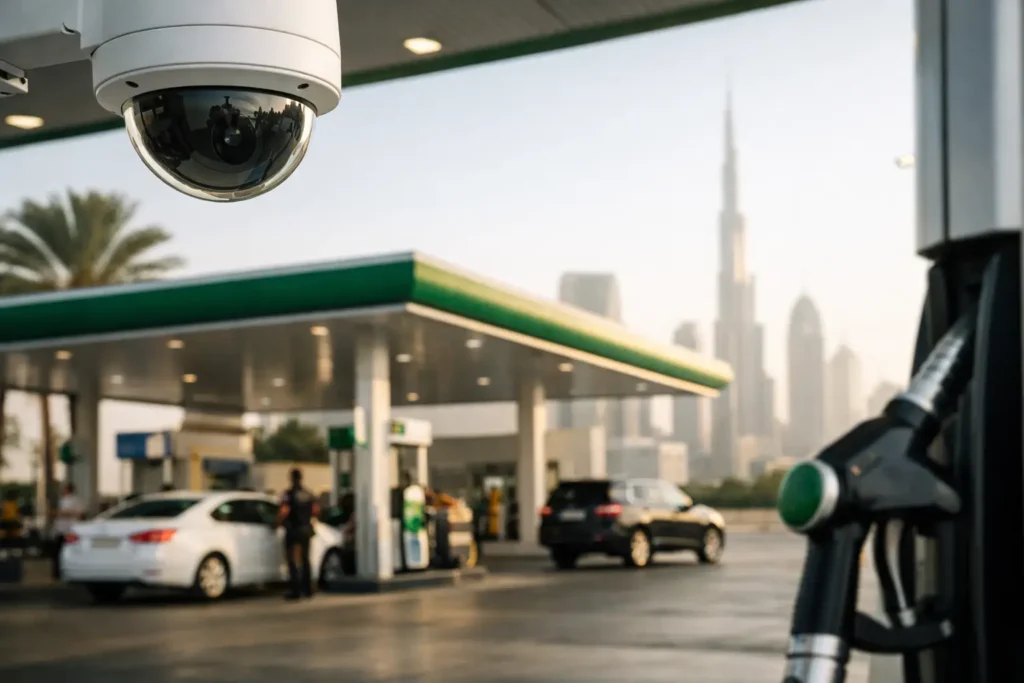
A petrol station has no room for blind spots. Vehicles move continuously through forecourts, fuel dispensing areas handle high-risk transactions, and staff must manage cash, customer safety, and vehicle access at the same time. Meeting SIRA CCTV requirements for petrol stations in Dubai is therefore not simply an equipment purchase. It is a compliance project that must be designed around the site, installed correctly, documented properly, and ready for inspection.
For station owners, operators, developers, and facility managers, the goal is clear: achieve approval without delaying opening, upgrades, tenancy works, or daily operations. A camera system that looks complete but misses a required area, records poor evidence at night, or lacks the right documentation can create expensive rework.
Why Petrol Stations Need a Different CCTV Design
Petrol stations are open, fast-moving environments. A standard retail camera layout is rarely enough because the site includes wide external areas, vehicle entry and exit points, fuel pumps, cashier zones, storage rooms, and perimeter boundaries. Each area presents different security and operational risks.
The system must support effective monitoring of people, vehicles, transactions, and incidents. Footage should allow operators and authorities to understand what happened, where it occurred, and who or what was involved. This depends on camera positioning, image quality, lighting conditions, recording settings, and storage capacity working together.
Petrol stations also operate outdoors in heat, dust, humidity, glare, and low-light conditions. Selecting cameras solely on price can lead to unclear night footage, failed equipment, or coverage gaps caused by poor placement. Compliance begins with a site-specific design, not a box of cameras.
Core SIRA CCTV Requirements for Petrol Stations in Dubai
SIRA requirements can vary based on the site category, risk profile, layout, and current authority standards. The approved design should always be confirmed against the latest requirements before procurement or installation. However, compliant petrol station projects generally focus on complete coverage, identifiable footage, secure recording, and a system that can be inspected and maintained.
Coverage of Critical Areas
Cameras should be planned to cover the station’s operational and security-sensitive zones without creating avoidable blind spots. This commonly includes:
- Vehicle entrances and exits, including lanes where vehicle movement can be observed
- Fuel dispensing islands and the surrounding forecourt
- Cashier counters, payment points, and convenience-store entrances
- Shop floor areas, stock rooms, offices, and cash-handling locations where applicable
- Perimeter boundaries, service yards, delivery areas, and access doors
Coverage is not just about seeing an area from a distance. A camera facing a pump island may show that an event occurred, but not provide a usable view of faces, vehicle plates, or activity at the payment point. The required field of view and image detail depend on the purpose of each camera.
A proper survey also accounts for canopies, columns, signboards, parked vehicles, landscaping, and reflections from headlights. These are common reasons why a design that appears adequate on a drawing performs poorly after installation.
Camera Quality and Low-Light Performance
Petrol stations commonly trade late into the evening or operate around the clock. Cameras must provide usable evidence during daylight, under canopy lighting, and in low-light conditions. Wide dynamic range is often valuable where a camera faces bright forecourt lighting, vehicle headlights, or the contrast between shaded areas and direct sunlight.
Camera placement should prevent backlight from turning faces into silhouettes. In some locations, dedicated lighting or a different camera angle is more effective than simply choosing a higher-resolution model. The right solution depends on the actual lighting and traffic pattern at the station.
External cameras should also be selected and installed for the UAE environment. Weather-resistant housings, protected cable routes, stable mounting points, and appropriate surge protection all affect long-term performance.
Recording, Storage, and Evidence Retrieval
A compliant CCTV system needs more than live images on a monitor. It must record continuously or according to the approved design, retain footage for the required period, and allow authorized users to retrieve an incident quickly.
Storage calculations should be completed before the recorder is selected. Retention is affected by the number of cameras, resolution, frame rate, compression settings, recording mode, and the amount of activity on site. A system with insufficient hard-drive capacity may appear to work during handover but fail to retain footage for the required duration.
The recording unit should be installed in a protected location with controlled access. Network equipment, power supply, backup arrangements, and recorder health should be considered as part of the same system. If a camera is offline, recording has stopped, or the time is incorrect, footage may have limited value during an investigation.
Monitoring and System Access
The monitoring arrangement must suit the station’s operation and approved security plan. Depending on the site, this may involve local viewing at a management point, controlled access to footage, or integration with an approved monitoring setup.
Only authorized personnel should be able to view, export, change, or delete recordings. User accounts, passwords, access levels, and audit practices matter because CCTV footage can contain personal information and may be needed as evidence. Remote viewing, where permitted and required, should be configured securely rather than left exposed through default settings.
Approval Starts Before Installation
One of the most costly mistakes is installing a system first and checking compliance later. If the camera layout, equipment selection, drawings, or documentation does not meet the required standard, the station may need additional cameras, revised containment, new storage capacity, or repeated inspections.
A controlled approval process typically begins with a detailed site survey. The contractor reviews the forecourt layout, building areas, existing infrastructure, lighting, cable routes, network requirements, equipment room, and operational constraints. From there, the project team develops drawings and technical documentation for authority review as required.
Once the design is approved, installation should follow the approved plan. Any field change, such as moving a camera because of a canopy beam or adding a new payment lane, should be assessed before it creates a coverage gap. After installation, testing and commissioning confirm that every camera is online, views are correct, recording is active, storage is available, and exported footage is usable.
Final inspection readiness depends on documentation as much as hardware. Camera schedules, layouts, equipment details, test results, user access information, and handover records should be organized before the inspection stage.
Common Compliance Failures at Fuel Stations
The most frequent issues are preventable. Cameras may be installed too high for facial identification, angled too wide to capture useful detail, or blocked by signs and canopy structures. In other cases, vehicle entry points are visible but license plates are unreadable because the lighting and viewing angle were not considered.
Another recurring issue is storage. Stations may add cameras during fit-out but retain the original recorder capacity, reducing the footage retention period without realizing it. Poor cable protection, unsecured network cabinets, incorrect camera timestamps, and neglected maintenance can also lead to failure at the moment footage is needed.
It is equally important to separate CCTV compliance from other safety obligations. CCTV supports security, incident review, and operational control, but it does not replace fire detection, emergency systems, hazardous-area requirements, or staff safety procedures.
Maintenance Protects Approval and Operations
Approval is not the end of the responsibility. Petrol station environments can affect lenses, housings, connectors, power supplies, and network equipment over time. Dust buildup, vibration, weather exposure, and accidental damage can reduce image quality or take cameras offline.
A planned maintenance program should include camera cleaning, image checks, recorder health checks, storage verification, timestamp checks, network testing, and review of backup power where installed. Staff should also know how to identify a fault, preserve footage after an incident, and contact the service provider without delay.
For multi-site operators, a standardized camera schedule and maintenance record make it easier to track performance across locations. This is particularly useful when stations are renovated, rebranded, expanded, or brought under new operational management.
Choose a Contractor That Controls the Full Process
A petrol station CCTV project requires coordination between the operator, contractor, civil team, electrical team, network provider, and approving authority. Fragmenting this work across multiple vendors often creates delays and unclear responsibility when a system needs correction.
ALNAJAH ALAWAL SECURITY SYSTEMS & EQUIPMENT TRADING L.L.C. manages site surveys, compliant system design, equipment supply, installation, testing, commissioning, approval support, and ongoing maintenance for SIRA-regulated CCTV projects. This approach gives station operators one accountable team from the first survey through handover.
Before committing to a new installation or upgrade, assess the actual station layout, current camera performance, recording capacity, and approval status. A focused survey now can prevent a failed inspection, avoid unnecessary equipment changes, and keep the station protected while business continues.