

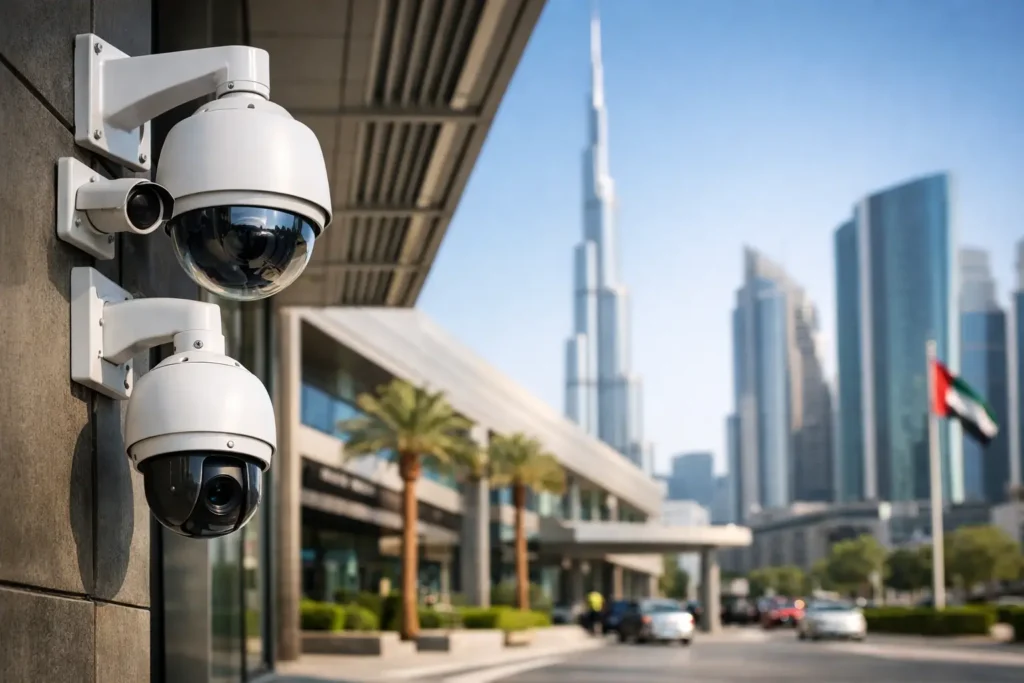
A camera installed in the wrong location can be more expensive than no camera at all. It may leave a loading bay unprotected, fail to identify faces at an entrance, create an unusable image at night, or delay an authority inspection. This commercial CCTV system guide is built for businesses that need surveillance to protect operations and meet site-specific compliance requirements from the start.
For warehouses, retail outlets, commercial buildings, industrial facilities, hotels, clinics, and labor accommodations, CCTV is not simply an equipment purchase. It is a planned security system involving risk assessment, camera coverage, recording capacity, network performance, authority requirements, installation quality, and ongoing maintenance. Get each stage right and the system supports daily operations. Miss one stage and the project can face rework, approval delays, or blind spots that only become visible after an incident.
Start With the Site, Not the Camera Catalog
The right commercial CCTV system begins with a site survey. Before selecting camera models, a security specialist should understand how the site operates: where people enter, where vehicles move, when high-risk activity occurs, which assets require protection, and how incidents are likely to develop.
A warehouse may need clear coverage of gates, truck movements, racking aisles, loading docks, and perimeter access. A retail business may prioritize entrances, point-of-sale areas, stock rooms, and customer circulation. A manufacturing site may require coverage around production areas, restricted rooms, material storage, and vehicle yards. Each environment has different lighting, distance, privacy, and operational constraints.
The survey should also identify practical installation conditions. Ceiling height, poles, wall structure, cable routes, network cabinets, power availability, lighting glare, and outdoor weather exposure all affect the final design. A camera that looks suitable on a floor plan may be difficult to service or poorly positioned once installed.
For regulated projects in Dubai, Abu Dhabi, or Sharjah, compliance planning must begin at this point. Camera locations, recording arrangements, equipment specifications, and documentation may need to meet the requirements of the relevant authority. Designing first and asking about approvals later is a common cause of unnecessary delay.
Define What Each Camera Must Prove
Coverage is not the same as identification. A wide-angle camera can show that someone entered an area, but it may not capture a face clearly enough to identify that person. A vehicle camera may record activity at a gate but fail to read a license plate if the angle, speed, lighting, or lens selection is wrong.
Every camera should have a defined purpose. Is it intended to detect movement, monitor general activity, recognize a person, identify a face, read a plate, supervise a transaction, or document access to a restricted area? That purpose determines the lens, resolution, mounting height, field of view, and lighting requirement.
This is where low-cost, generic designs often fail. Adding more cameras does not automatically improve security. A properly designed system uses the right camera at the right point, with an image quality standard appropriate to the risk. It also avoids excessive overlap that consumes storage and creates unnecessary complexity without improving evidence quality.
Key Areas That Need Deliberate Coverage
Entrances and exits require face-level identification and a clear view of the direction of travel. Vehicle gates need coverage that records both the vehicle and the driver or occupants where practical. Cash handling areas, reception desks, loading bays, stock rooms, server rooms, fuel storage, and perimeter lines often require more detailed planning because loss, disputes, or unauthorized access are more likely there.
Do not overlook transitional spaces. Corridors, stairwells, side doors, fire exits, and routes between a loading area and a stock room can explain how an incident occurred. Cameras should support a logical sequence of events rather than creating isolated views with no connection between them.
Select Equipment for Operating Conditions
Commercial CCTV equipment must suit the environment, not just the budget. Indoor office cameras and outdoor perimeter cameras face different conditions. Heat, dust, humidity, vibration, low light, glare, salt exposure, and continuous vehicle movement can all affect performance and equipment life.
For outdoor areas, weather-rated housings and secure mounting are essential. Infrared capability can support night monitoring, but infrared alone does not solve every low-light challenge. Reflective surfaces, vehicle headlights, and poorly placed external lighting can wash out images. In some locations, additional lighting or cameras with stronger low-light performance are the better answer.
Network cameras offer flexibility, high-resolution recording, remote monitoring, and integration with access control or video management platforms. However, they require correct network design. Bandwidth, Power over Ethernet capacity, switch selection, cybersecurity controls, and dedicated recording infrastructure must be calculated before installation. A high-resolution camera system placed on an undersized network will create dropped frames, delayed viewing, and unreliable recordings.
Analog HD systems can remain a practical option where existing cabling is in good condition and the project scope is straightforward. The correct choice depends on the site, existing infrastructure, required image detail, expansion plans, and compliance criteria. A site survey should lead the decision.
Plan Recording Storage Before Installation
A recorder is only useful if it retains footage for the required period and captures it at usable quality. Storage planning should account for the number of cameras, resolution, frame rate, compression settings, recording schedule, motion activity, and required retention period.
Continuous recording provides a complete timeline but requires more storage. Motion-based recording can reduce storage use, yet it may miss relevant activity if motion settings are poorly configured. For high-risk areas such as entrances, cash points, loading bays, or restricted access points, continuous recording is often the safer operational choice.
Retention requirements can vary by sector, site type, and approving authority. Businesses should confirm the applicable requirement before finalizing recorder capacity. Increasing storage after handover can be possible, but it is more efficient to size the system correctly from the beginning.
Recording equipment should be installed in a protected, ventilated, access-controlled location. If the recorder is left in an unsecured office or exposed cabinet, an intruder may be able to damage or remove the evidence the cameras captured. For critical sites, consider redundancy, health monitoring, and controlled remote access.
Build Compliance Into the Commercial CCTV System Guide
For UAE commercial projects, authority approval is not an administrative detail. It is part of the technical scope. SIRA-approved CCTV installations in Dubai, Abu Dhabi monitoring and control requirements, and Sharjah Police approval processes may involve specific standards for camera coverage, equipment, drawings, storage, installation practices, and inspection readiness.
The practical approach is to work with an approved contractor that manages the process from survey through commissioning. This includes preparing the design, supplying compliant equipment, coordinating installation, arranging required documentation, supporting inspection, and resolving issues before they become approval failures.
A compliant system should also respect privacy and operational controls. Camera views should be purposeful and limited to legitimate security needs. Access to live and recorded footage should be restricted to authorized personnel, with clear procedures for exporting footage after an incident. Strong passwords, user permissions, firmware management, and network segmentation are equally important. CCTV systems are connected security assets and must be protected accordingly.
Installation Quality Determines System Reliability
A technically correct design can still fail through poor installation. Loose camera mounts, exposed cable joints, unlabelled connections, overloaded power supplies, badly routed conduits, and unprotected outdoor terminations all create future faults.
Professional installation includes proper cable containment, durable labeling, secure mounting, tested power distribution, clean rack organization, and documented device configuration. Camera angles should be adjusted on site using live views, not assumed from drawings. The installer should confirm that faces are visible at entry points, plates are readable where required, and critical areas remain covered after shelves, signage, or operational equipment are in place.
Testing and commissioning should verify more than whether an image appears on a monitor. The team should test recording playback, time synchronization, remote access permissions, camera health alerts, storage status, night performance, and power recovery after an outage. Site staff should receive practical training on live viewing, playback, exporting footage, and reporting faults.
Keep the System Ready After Handover
CCTV maintenance protects the value of the original investment. Lenses collect dust, camera angles shift, hard drives degrade, vegetation blocks perimeter views, and site layouts change. A camera that worked at installation may no longer protect the area it was designed to cover.
Routine maintenance should include camera cleaning, image-quality checks, recorder health review, storage verification, firmware assessment, cable and mount inspection, and a review of changes to the site. After a warehouse expansion, a store refit, or a new access route, coverage should be reassessed rather than assumed.
ALNAJAH ALAWAL SECURITY SYSTEMS & EQUIPMENT TRADING L.L.C. supports commercial CCTV projects through survey, compliant design, installation, authority approval support, commissioning, and long-term maintenance. The goal is direct: approved right the first time, installed correctly, and ready when your business needs evidence.
Before approving a CCTV proposal, ask the contractor to explain what every camera is intended to capture, how long footage will be retained, how authority requirements will be managed, and who will support the system after handover. Clear answers at this stage prevent expensive uncertainty later. Stay compliant. Stay protected.