

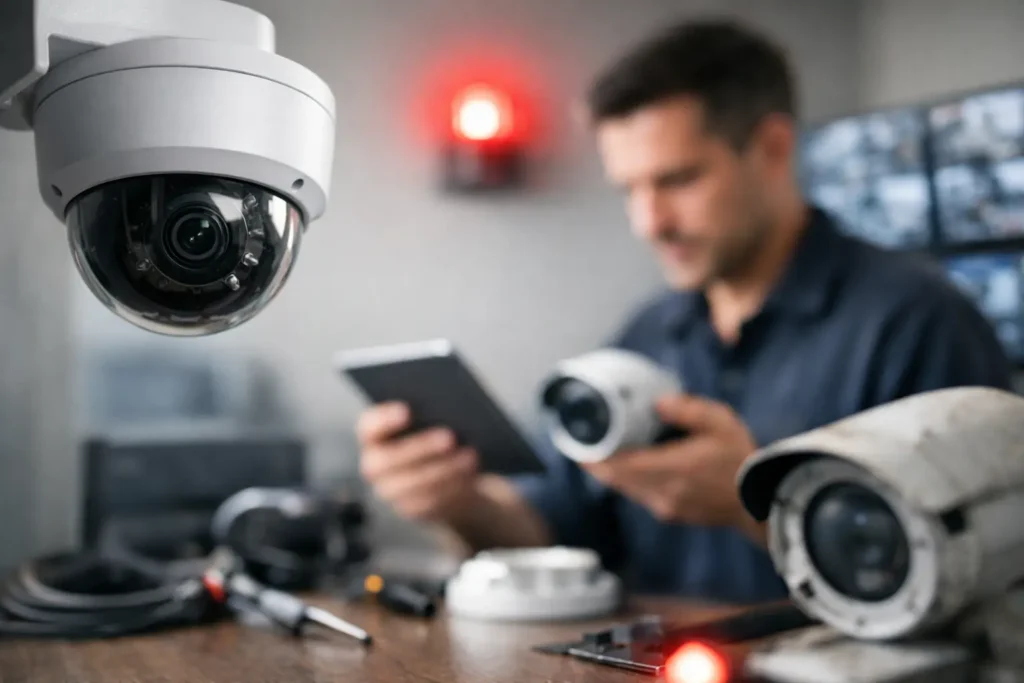
A camera that records a recognizable person in daylight but produces a blurred image at night is not providing dependable security evidence. The same applies to systems with recurring offline cameras, full storage, unsupported recorders, or layouts that no longer cover critical access points. Knowing when CCTV systems should be upgraded helps facility managers act before a security incident, failed inspection, or operational disruption exposes a serious gap.
For businesses in Dubai, Abu Dhabi, Sharjah, and across the UAE, a CCTV upgrade is not simply an equipment replacement decision. It can affect regulatory approval, insurance requirements, investigation capability, site operations, and the ability to protect people, stock, vehicles, and high-value assets. The right decision starts with a practical assessment of what the existing system can still do – and what it can no longer do reliably.
When Should CCTV Systems Be Upgraded?
There is no fixed replacement date that applies to every site. A well-designed system in a low-risk office may remain suitable longer than one operating around the clock in a warehouse, retail store, fuel facility, or logistics yard. However, nine warning signs usually indicate that an upgrade should be planned rather than postponed.
- Recorded footage cannot identify people, vehicles, or incidents clearly. Low resolution, poor low-light performance, glare from headlights, and excessive pixelation can make recordings of limited value when evidence is needed.
- Cameras repeatedly go offline or require frequent repairs. Regular failures often point to aging equipment, degraded cabling, unstable network connections, inadequate power, or a recorder reaching its operational limit.
- The recorder, software, or cameras are no longer supported. Unsupported systems may not receive security updates, replacement parts, firmware fixes, or compatible expansion options. This creates both cybersecurity and maintenance risk.
- Storage does not meet operational or authority requirements. If footage is overwritten too quickly, recording stops when storage is full, or the system cannot reliably retain the required recording period, the installation may not be fit for purpose.
- Your site has changed since the original installation. New loading bays, expanded warehouses, altered retail layouts, additional entrances, parking areas, or restricted zones create blind spots that older camera plans were never designed to cover.
- The system cannot support remote monitoring or efficient incident review. If managers must scroll through hours of footage, visit the site to check a camera, or rely on one person with recorder access, response time is slower than it should be.
- Image quality falls short in difficult conditions. Poor night images, bright backlighting, dust, heat, weather exposure, or fast-moving vehicles can reveal that cameras selected years ago no longer suit the environment.
- The installation may no longer meet current compliance expectations. Regulatory requirements, approved equipment lists, camera coverage standards, signage, storage periods, and monitoring arrangements can change. A system that was accepted previously should not be assumed compliant indefinitely.
- The cost of keeping the old system running is rising. Replacing individual cameras and recorders can appear economical, but repeated callouts, lost recordings, unavailable parts, and downtime can cost more than a phased modernization.
One warning sign may justify a targeted repair. Several signs at the same time usually justify a full site survey and upgrade plan.
Evidence Quality Is the First Test
CCTV is often judged only after something has happened: a theft, access dispute, vehicle damage claim, health and safety event, or unauthorized entry. At that point, the question is simple: can the footage establish what happened, who was involved, and when it occurred?
Older analog cameras and early-generation IP cameras may still display a live image, but that does not mean they produce useful evidence. A wide-angle camera placed too far from an entrance may show activity without capturing a face clearly. A camera overlooking a vehicle gate may record movement but fail to read a plate. Nighttime noise or motion blur can reduce an otherwise acceptable image to a vague outline.
An upgrade should be based on the required outcome at each location. Identification at a reception desk requires a different camera position and image standard than monitoring a warehouse aisle. License plate capture at a gate requires a different design than general perimeter observation. Selecting cameras by resolution alone is not enough. Lens choice, mounting height, lighting, scene width, frame rate, storage settings, and camera placement all affect the final result.
Compliance Changes Can Trigger a CCTV Upgrade
For compliance-driven sites, waiting until an inspection or project handover creates avoidable pressure. CCTV requirements may involve approved equipment, coverage of designated areas, retention capacity, recorder specifications, monitoring arrangements, signage, and documented installation details. Requirements differ by location and site type, so a design suitable for one facility may not be acceptable for another.
Businesses operating under SIRA requirements in Dubai, relevant Abu Dhabi monitoring and control requirements, or Sharjah Police requirements should review their systems when they renew a license, expand a property, change use of a premises, or receive an authority observation. New construction, fit-outs, tenant changes, and security incidents are also sensible points to reassess coverage.
Compliance is not achieved by adding cameras wherever there is an empty wall. Poor positioning, incorrect mounting, insufficient retention, unapproved components, or incomplete documentation can still delay approval. A proper review considers the full system, including cameras, network infrastructure, recording equipment, power backup, viewing access, labeling, drawings, testing, and handover records.
Do Not Ignore the Recorder and Network
Many CCTV upgrades fail because all attention goes to the cameras. The recorder, storage drives, PoE switches, network bandwidth, cable condition, and power supply determine whether those cameras can record consistently.
For example, replacing a few cameras with higher-resolution models increases data demand. If the network is undersized or the recorder lacks processing capacity, footage may drop frames, display slowly, or record at a lower setting than intended. Adding more cameras without calculating storage can also shorten retention periods without anyone noticing.
Cybersecurity deserves equal attention. Default passwords, old firmware, exposed remote access, and poorly segmented networks can turn surveillance equipment into an entry point for unauthorized access. A modern upgrade should include controlled user permissions, secure remote access, firmware management, protected network design, and clear responsibility for ongoing maintenance.
Upgrade the Design, Not Just the Devices
A like-for-like replacement is sometimes appropriate, particularly when the existing layout is proven and compliance requirements are unchanged. In many cases, however, the site has evolved enough that replacing devices without redesigning coverage preserves old blind spots.
Start with the areas that carry the highest risk: entrances and exits, cash handling points, loading docks, vehicle gates, stock rooms, server rooms, restricted zones, perimeter lines, and public-facing areas. Then assess how people, vehicles, and goods actually move through the property. This reveals gaps that floor plans alone may miss.
A phased upgrade can be the right commercial decision for larger properties. High-risk areas can be upgraded first, followed by secondary zones, provided the final design maintains operational continuity and meets any applicable approval requirements. The trade-off is that mixed old and new systems can be more difficult to manage, and compatibility must be confirmed before work begins.
What a Professional CCTV Assessment Should Cover
A useful assessment does more than count cameras. It should confirm the condition of existing devices and cabling, test recorder health and storage retention, review live and recorded image quality, identify coverage gaps, and assess power and network capacity. It should also compare the installation against current site needs and relevant authority requirements.
The assessment should produce a clear recommendation: retain, repair, expand, or replace. It should explain why each proposed camera is needed, what it is expected to capture, how long footage will be retained, and whether existing infrastructure can support the design. This prevents scope changes late in the project and gives decision-makers a reliable basis for budgeting.
ALNAJAH ALAWAL SECURITY SYSTEMS & EQUIPMENT TRADING L.L.C. manages this process from site survey and compliant system design through installation, testing, commissioning, approval support, training, and maintenance. For clients, that means accountability stays with one contractor rather than being divided between equipment suppliers, installers, and approval consultants.
Plan Before the System Fails
The best time to upgrade is before a failed camera, missing recording, or compliance issue becomes an urgent problem. Review your system after a site expansion, a change in operational risk, recurring maintenance problems, or any incident that reveals weak evidence. Ask for a site-specific assessment that measures performance against the conditions your business actually faces.
A CCTV system should give managers confidence when questions arise, not create more questions. Stay compliant. Stay protected. Plan the upgrade while you still have time to make the right technical and operational decision.