

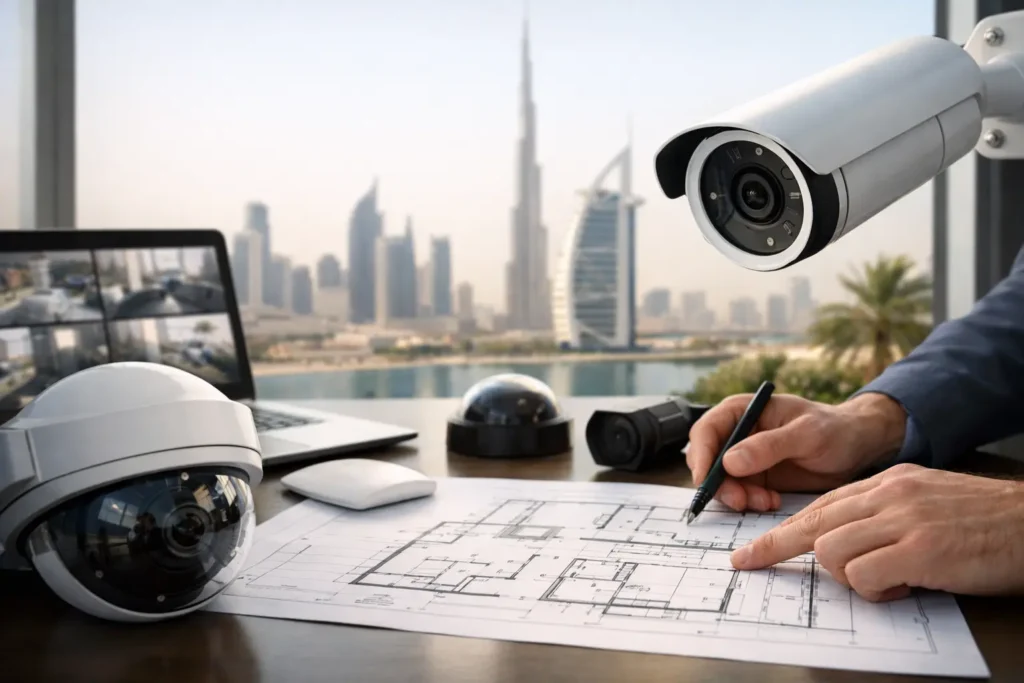
A camera mounted in the wrong location can create a false sense of security, fail to capture usable evidence, and delay project approval. Knowing how to plan CCTV coverage means designing around real risks, operational activity, and local authority requirements – not simply installing cameras wherever there is an empty wall.
For warehouses, retail sites, commercial buildings, industrial facilities, and residential developments, an effective CCTV plan must provide clear coverage where it matters most while remaining practical to install, operate, and maintain. In Dubai, Abu Dhabi, and Sharjah, the plan must also support the applicable approval process from the first site survey.
Start CCTV Coverage Planning With Risk and Operations
Every security design should begin with the question: what needs to be protected, and from what? A warehouse with high-value stock has different surveillance priorities from a hotel, clinic, construction site, or fuel storage facility. The goal is not maximum camera quantity. The goal is reliable visibility of incidents, people, vehicles, and critical activities.
Walk the facility with operations, security, and facility management teams. Identify entry and exit points, perimeter boundaries, delivery areas, parking, cash-handling zones, loading docks, server rooms, storage areas, and restricted-access locations. Review where previous incidents occurred, where visitors enter, and where employees or contractors move through the site.
This assessment should also consider normal operating conditions. A loading bay may be quiet during the day but active through the night. A retail entrance may require clear face capture in changing sunlight. A manufacturing floor may contain dust, heat, vibration, or machinery that affects camera placement and equipment selection. Good planning accounts for these conditions before installation begins.
Define What Each Camera Must Prove
A useful coverage plan gives each camera a specific purpose. “Cover the lobby” is not enough. The design should state whether the camera needs to detect movement, observe activity, recognize a person, identify a face, read a license plate, or monitor a transaction.
These requirements directly affect camera type, mounting height, lens selection, image resolution, lighting, and field of view. A wide-angle camera can provide an overview of a reception area, but it may not capture enough detail to identify a person at the far end of the room. A dedicated entrance camera, positioned at the correct height and angle, is usually needed for reliable facial identification.
For vehicle gates, a general overview camera should be paired with a dedicated license plate capture camera where required. The overview records the vehicle’s approach and surrounding activity. The plate camera is configured for the specific lane, vehicle speed, lighting, and direction of travel. Trying to make one camera perform both tasks often produces compromised evidence.
Avoid Blind Spots and False Coverage
A camera view on a drawing does not always reflect what happens on site. Doors can block sightlines. Shelving can be moved. Trucks can obstruct loading areas. Trees, signage, and future fit-out work can create new blind spots. During the survey, consider viewing angles at actual operating height, including the effect of parked vehicles and stored materials.
Overlapping coverage is valuable at high-risk points such as main entrances, cash areas, loading bays, and perimeter gates. It provides an alternative view if one camera is blocked, damaged, or unable to capture a key detail. However, overlap should be purposeful. Excessive duplication increases cost, storage demand, and maintenance without improving security outcomes.
Select Cameras for the Environment, Not the Catalog
Camera selection should follow the coverage objective and site conditions. Fixed cameras are effective where activity occurs in a defined area, such as corridors, entrances, access-control doors, and cashier counters. Varifocal cameras provide flexibility where the final field of view needs adjustment during commissioning. Pan-tilt-zoom cameras can monitor large open areas, but they should not replace fixed cameras at critical locations because they can only view one direction at a time.
Outdoor cameras require suitable protection against heat, dust, rain, and corrosion. In industrial environments, housing ratings, vibration resistance, and hazardous-area requirements may be relevant. Low-light performance and infrared illumination also need careful review. Infrared can support nighttime monitoring, but reflective surfaces, gates, vehicle headlights, and poor aiming can reduce image quality.
Mounting height is equally important. Cameras installed too high may provide a broad overview but poor facial detail. Cameras installed too low may be easy to tamper with or blocked by passing traffic. The correct position depends on the required evidence, the available structure, lighting conditions, and the risk of obstruction.
Plan CCTV Coverage With Lighting, Network, and Power
CCTV cameras do not operate independently. Their performance depends on the supporting infrastructure. A camera that performs well in daylight may be ineffective at night if the area has uneven or insufficient lighting. Review natural light, glare from windows, reflections from polished floors, headlights at vehicle entrances, and shadowed corners around the perimeter.
Network capacity must be calculated for the number of cameras, resolution, frame rate, compression method, and viewing requirements. Underestimating bandwidth can create delayed video, dropped streams, or unstable remote access. The same applies to storage. Retention periods, recording quality, motion settings, and camera activity all affect the required storage capacity.
Use managed network equipment, appropriate cabling, secure equipment cabinets, and backup power where the operational risk justifies it. Critical cameras at entrances, cash areas, data rooms, and high-value storage may need stronger resilience than cameras covering low-risk general areas. The design should make these decisions clear rather than treating every camera identically.
Build Compliance Into the Design Early
For regulated projects, compliance is not a final checklist item. It shapes the CCTV layout, equipment specification, recording configuration, monitoring arrangements, and documentation from the outset. Businesses operating in Dubai may need to meet SIRA requirements, while sites in Abu Dhabi and Sharjah may fall under separate authority requirements. Requirements can differ by facility type, risk category, and jurisdiction.
Approval-ready planning typically involves more than a camera layout. It may require floor plans, site details, equipment schedules, network diagrams, storage calculations, camera coverage details, and other supporting documents. A design that is technically sound but missing required documentation can still cause avoidable delays.
This is why a site survey should be completed by a contractor that understands both installation and local approval processes. ALNAJAH ALAWAL SECURITY SYSTEMS & EQUIPMENT TRADING L.L.C. manages compliant CCTV design, installation, testing, commissioning, and approval support for projects across the UAE. The objective is straightforward: get the system approved right the first time and keep the site protected after handover.
Test Coverage Before Final Handover
The final test should confirm more than whether cameras are online. Review live and recorded footage during daytime and nighttime conditions. Test entrances with people walking at normal speed, vehicles entering gates, deliveries arriving at loading areas, and activity occurring under realistic lighting conditions.
Check whether each camera meets its intended purpose. Can operators identify a person at the entrance? Can they see activity around a loading dock when trucks are present? Is the license plate image readable at the expected vehicle speed? Are recording dates, times, and camera names accurate? Can authorized personnel retrieve footage quickly when an incident occurs?
Commissioning should include proper camera aiming, focus adjustment, image-quality checks, recording verification, user access setup, and staff training. Document the completed installation, camera locations, network equipment, retention settings, and maintenance requirements. This creates accountability and makes future expansion or troubleshooting much easier.
Plan for Change and Ongoing Maintenance
Facilities change. Warehouses add racking, retailers revise store layouts, developers hand over new spaces, and businesses expand their parking or delivery operations. A CCTV design should allow for sensible future growth through spare network capacity, reserved recorder capacity where practical, and cable pathways that can support additions without major disruption.
Maintenance is also part of coverage planning. Dirty lenses, damaged cables, blocked camera views, incorrect time settings, and failed storage drives can quietly reduce system effectiveness. Schedule regular inspections, health checks, firmware review where appropriate, cleaning, and recording tests. For compliance-driven sites, ongoing maintenance helps ensure the system continues to meet operational and regulatory expectations.
The strongest CCTV coverage plan is one that gives your team usable evidence when it is needed, supports approval requirements, and remains dependable as the site evolves. Start with a professional survey, define the evidence each area requires, and make every camera placement answer a clear security question.