

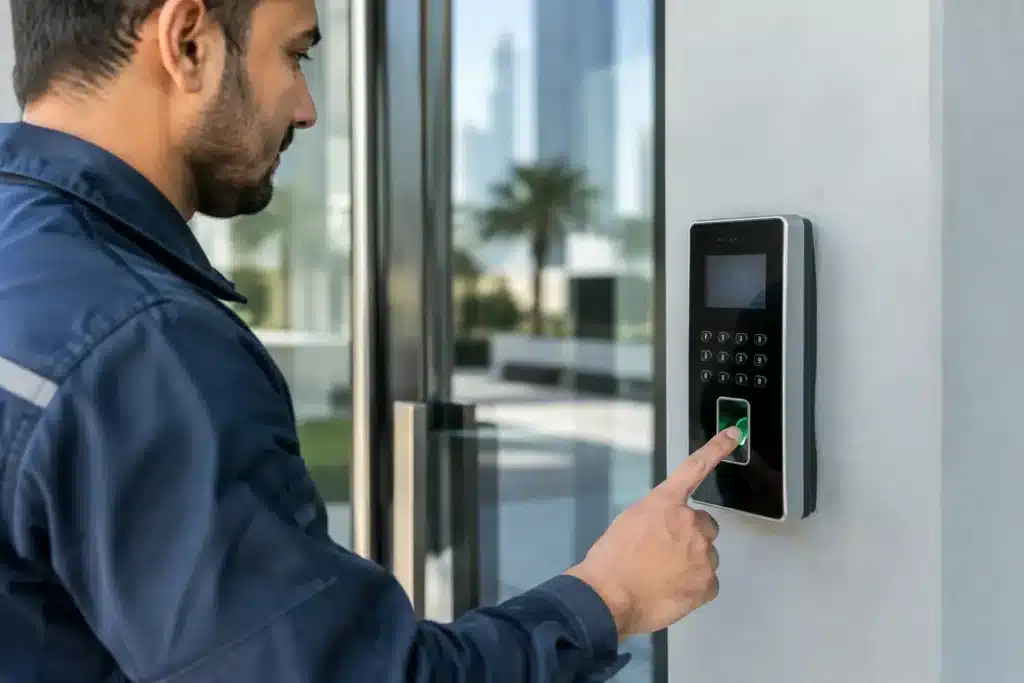
A door that opens for the wrong person, fails to release during an emergency, or cannot produce an audit trail creates a direct operational risk. Access control installation Dubai projects must do more than place a card reader beside a door. They must match how the site operates, protect critical areas, support safe egress, and meet the requirements that apply to the building and its security scope.
For warehouses, offices, retail sites, labor accommodations, healthcare facilities, and industrial properties, access control is a working part of daily operations. The right system manages who enters, where they can go, and when their access should end. The wrong system creates delays at busy entry points, leaves doors unsecured, and becomes expensive to correct after handover.
Start With the Site, Not the Device
Every access control project should begin with a site survey and a clear operational brief. A reader, controller, lock, and software platform are only useful when they are selected for the door, user group, traffic level, and security requirement in front of them.
A main staff entrance may need fast card or mobile credential access during peak arrival times. A server room may require restricted access, time schedules, and detailed event reporting. A loading bay may need access linked to delivery windows, while a cash office, jewelry stockroom, or pharmaceutical store may require dual authorization or tighter visitor controls.
The survey should assess door construction, existing locks, emergency exits, power availability, network routes, door usage, and the condition of any existing cabling. It should also identify interfaces with CCTV, intrusion alarms, elevators, barriers, intercoms, and fire alarm systems. These details determine whether a project can be installed cleanly or whether hidden limitations will cause change orders and delays.
A competent contractor does not recommend the same reader and lock for every opening. Glass doors, wooden doors, aluminum frames, fire-rated doors, gates, and turnstiles each require a different approach. The locking method must also fit the life-safety design. Fail-safe and fail-secure hardware have different behaviors during power loss, and the correct choice depends on the door’s purpose and emergency egress requirements.
What a Proper Access Control Installation Includes
A complete installation is a controlled process, not an equipment delivery. The work should cover design, equipment selection, installation, testing, user setup, documentation, and support after handover.
The design stage establishes the door schedule, controller capacity, cable routes, network architecture, power requirements, backup power, and credential strategy. It also defines permissions. This prevents a common problem: issuing access to a broad group because the system was not structured around actual job roles.
During installation, technicians fit readers, locks, door contacts, request-to-exit devices, break-glass units where required, controllers, enclosures, and power supplies. Cable containment and labeling matter. Poor cable management makes future fault finding slower, creates a weak appearance, and can affect reliability in demanding sites.
Testing should verify much more than whether the door opens. Each opening needs functional testing for valid and invalid credentials, door-held-open alerts, forced-door alerts, request-to-exit operation, lock release behavior, alarm events, time schedules, and reporting. Where access control is integrated with fire and life-safety systems, the required release sequence must be tested with the responsible parties.
Finally, the site team needs training. Reception, security, facilities, and authorized administrators should know how to issue cards, remove departing employees, change access schedules, review events, respond to door alarms, and escalate faults. A system that only the installer can operate is not fully handed over.
Compliance Is Part of the Project Scope
Dubai projects often involve compliance requirements that affect security infrastructure, especially when access control is connected with CCTV, visitor management, alarms, or authority-regulated security systems. The exact obligations depend on the property type, project scope, landlord rules, consultant specifications, and relevant authority requirements.
This is why compliance should be considered before installation begins, not after equipment has been fitted. Drawings, equipment specifications, device locations, containment routes, and integration methods may all require coordination. If a building requires security approvals or specific documentation, late changes can hold up occupancy, tenant opening, or project closeout.
For multi-site operators, consistency is equally valuable. A retail chain or logistics operator should not have unrelated access platforms, card formats, and reporting methods at every location unless there is a clear reason. Standardized design makes onboarding, maintenance, and auditing more manageable.
ALNAJAH ALAWAL SECURITY SYSTEMS & EQUIPMENT TRADING L.L.C. manages the survey, design, supply, installation, testing, commissioning, and support process so clients have one accountable contractor from planning through handover. For compliance-driven projects, that accountability reduces the risk of gaps between installers, IT teams, consultants, and authority requirements.
Choosing Credentials and Authentication Methods
Cards and key fobs remain practical for many workplaces because they are fast, familiar, and cost-effective at scale. They are suitable for standard staff doors, common areas, and sites with frequent employee movement. Their limitation is administrative: lost cards must be deactivated quickly, and shared credentials should never be allowed.
Mobile credentials can reduce physical card handling and work well for organizations with distributed teams or frequent visitors. They depend on the selected platform, phone compatibility, and reliable credential administration. They are not automatically the best option for every workforce, particularly where users share devices or operate in environments where phones are restricted.
PIN codes can support temporary access but should not be the only protection for sensitive rooms. Codes are easily shared, observed, or retained by former staff. Biometric access can add stronger identity verification, but it requires careful consideration of privacy, user acceptance, enrollment procedures, and local data handling obligations.
For high-risk areas, multi-factor access may be appropriate. This can combine a card with a PIN, biometric verification, or a second authorized person. The goal is proportional security. Adding friction to every staff door can slow operations without meaningfully reducing risk.
Access Control Installation Dubai: Design for Daily Operations
The best access control installation Dubai solution reflects the movement of people through the building. It should support shifts, contractors, deliveries, visitors, cleaning teams, and emergency procedures without creating avoidable bottlenecks.
For example, a warehouse may separate office personnel, drivers, pickers, maintenance teams, and external delivery staff. Each group can receive access only to the zones needed for its role. When a contractor’s job ends, their credentials can expire automatically instead of relying on someone to collect a physical key.
In commercial towers and hospitality properties, access control can manage back-of-house rooms, staff entrances, elevators, parking areas, and tenant spaces. In healthcare and education, the priority may be protecting records, medication areas, laboratories, staff-only zones, and student safety while retaining quick emergency access.
The system should also be sized for growth. A small office with four doors may later add a warehouse, second floor, gate barrier, or visitor registration point. Selecting scalable controllers and software from the start can avoid replacing the entire platform later.
Integration Creates Better Visibility
Access control becomes more useful when it works alongside other security systems. A forced-door event can prompt a nearby CCTV camera to record and help the security team verify what happened. A visitor management process can issue temporary credentials with defined expiration times. Elevator control can restrict access to selected floors without placing a reader at every tenant door.
Integration needs to be planned carefully. A connection between systems should provide a clear operational benefit, not extra complexity. The project team should define which events need monitoring, who receives alerts, how incidents are investigated, and which records need to be retained.
Network security also deserves attention. Controllers, workstations, and remote management tools should be configured with appropriate user permissions, protected credentials, and documented network settings. Physical security and cybersecurity meet at the controller panel. Ignoring either side leaves a gap.
Maintenance Protects the Investment
Access control hardware is used every day. Doors are slammed, cards are lost, batteries age, locks wear, and building alterations change how spaces are used. Preventive maintenance helps identify worn hardware, loose connections, failing backup batteries, and configuration issues before they interrupt operations.
Support should include a clear fault-reporting process, response expectations, software administration assistance, and the ability to add users, doors, or integrations as the facility changes. Keep access records current by removing inactive users, reviewing administrator permissions, and checking that emergency release functions are tested on schedule.
A well-planned system gives facility managers control without turning security into a daily burden. Start with a professional site survey, define the operational and compliance requirements early, and insist on testing that proves every door performs as intended. Stay compliant. Stay protected.