

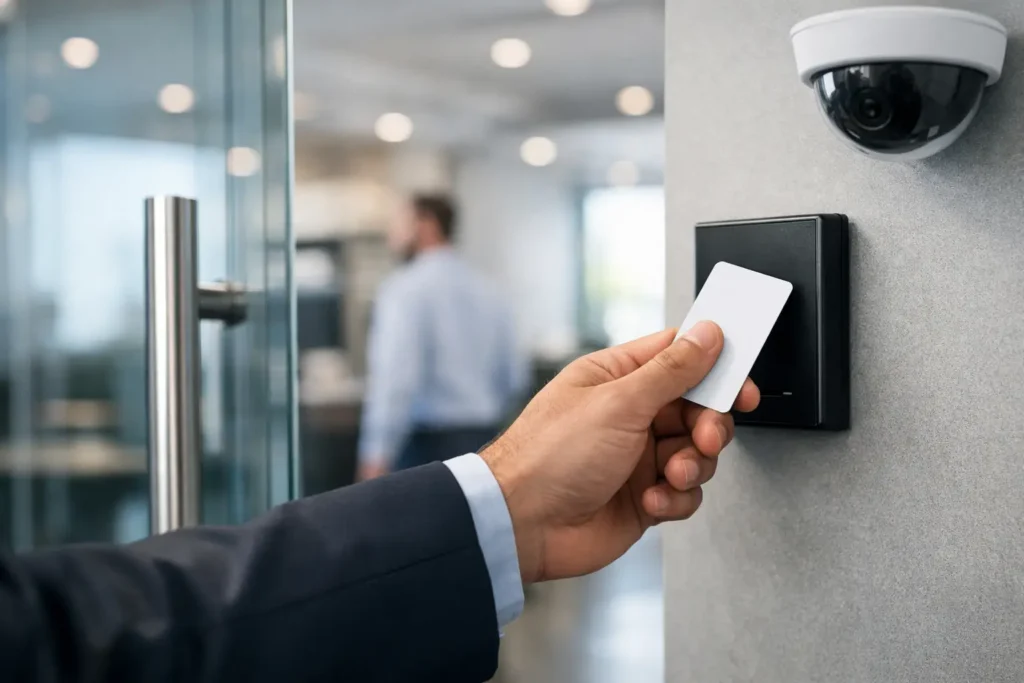
A door that opens for everyone is not access control. It is a security gap waiting to become an incident, a disputed attendance record, a stolen asset, or an unauthorized after-hours entry. Commercial access control systems give businesses a clear answer to a basic operational question: who entered, where, and when?
For warehouses, offices, retail sites, hotels, clinics, industrial facilities, and multi-tenant buildings, the right system does more than replace physical keys. It assigns permission by person, role, time, and location. That control protects restricted areas while allowing staff, contractors, visitors, and delivery teams to move through the site without disrupting operations.
What Commercial Access Control Systems Should Deliver
A commercial system must be designed around the way a facility actually operates. A small office may need controlled entry at the main door and server room. A logistics facility may need separate permissions for loading bays, stores, control rooms, staff accommodation, and vehicle gates. A property developer may need a scalable system that can support multiple tenants and common areas over time.
The objective is not to place a reader on every door. It is to create reliable, auditable control at the points that matter most. This starts with a site survey, a review of daily movement, identification of restricted areas, and a clear access policy.
A properly specified system should provide controlled entry, live event monitoring, access history, user management, and a practical process for revoking lost cards or former employee credentials. It should also continue to support safe egress during an emergency. Access control must never compromise life-safety requirements.
Credentials and entry methods
The best credential depends on the risk level and operating environment. Cards and key fobs remain cost-effective for many commercial sites, especially where users need fast entry at multiple points. Mobile credentials can reduce the administrative burden of issuing and recovering cards, but they require reliable device management and user adoption.
PIN codes are useful as a second verification step, although shared codes weaken accountability. Biometric readers can provide stronger identity verification in high-security areas, but they require careful consideration of privacy, environmental conditions, user consent, and local policy. For many facilities, a card or mobile credential combined with a PIN at sensitive doors is the practical balance.
Doors, gates, and barriers are different applications
A pedestrian office door, a fire-rated stairwell door, a warehouse roller shutter, and a vehicle barrier cannot be treated as identical access points. Each requires the correct locking hardware, controller configuration, emergency release method, cabling, and integration approach.
For example, a warehouse gate may need access control linked to intercom verification, CCTV coverage, and vehicle or visitor procedures. A data room may require door-held-open alerts and tighter access schedules. Installing the same reader and lock configuration everywhere can create failures, maintenance issues, or unsafe door behavior.
Design Around Operations Before Equipment
Access control projects often fail before installation begins because the system is selected first and the operational rules are considered later. The result is familiar: too many users have unrestricted access, managers cannot retrieve useful reports, and staff find workarounds when doors or credentials slow them down.
A stronger design begins with the site’s access groups. Consider employees, supervisors, cleaning teams, security personnel, contractors, visitors, delivery drivers, and temporary workers. Then define which doors each group can use, during which hours, and under what approval process.
For a retail chain, store managers may need full access only to their assigned location, while regional teams require scheduled access across several branches. In a factory, maintenance teams may require controlled entry to plant rooms, but only when a work order is active. A clinic may separate public reception areas from records rooms, medicine storage, and treatment areas.
This approach reduces unnecessary access without creating bottlenecks. It also makes onboarding and offboarding faster because administrators apply a role-based profile instead of manually programming every door for every individual.
Integration Creates Better Control, Not More Complexity
Access control becomes more valuable when it works with the systems already protecting the premises. The goal is a coordinated response, not a crowded control room with disconnected screens.
Integration with CCTV can associate a door event with video footage, helping security teams verify tailgating, forced-door alarms, or disputed entries. When a credential is denied repeatedly, operators can review the relevant camera rather than relying only on an event log. This is particularly useful at loading bays, high-value storage areas, and staff entrances.
Fire alarm integration is equally critical. Door locking behavior must be coordinated with fire and life-safety requirements so occupants can exit safely during an emergency. This requires correct planning, approved hardware, testing, and commissioning. It is not a feature to be added casually after the main installation is complete.
For larger sites, access control may also connect with intercoms, visitor management, elevator control, turnstiles, parking barriers, and time-attendance platforms. Integration should be justified by a real operational need. A simple, well-managed system is better than an over-engineered platform that staff cannot administer confidently.
Compliance and Life Safety Must Be Built Into the Plan
In the UAE, security and building compliance can affect system design, project timing, and handover requirements. Commercial premises may need to meet authority, landlord, municipality, fire and life-safety, or sector-specific requirements. Where CCTV and access control are part of the same security scope, coordination is essential to avoid rework and approval delays.
A compliant installation is not only about selecting recognized equipment. It includes correct drawings, cable routing, labeling, power backup considerations, emergency door release, testing, documentation, and commissioning records. The system must perform as intended under normal conditions and during fault or emergency scenarios.
Businesses should also consider how access data is handled. Access logs can support investigations, attendance reviews, and incident reporting, but they should be retained and accessed according to company policy and applicable privacy obligations. Restrict administrator privileges, use strong passwords, review inactive users, and keep a clear record of who can make changes to permissions.
ALNAJAH ALAWAL SECURITY SYSTEMS & EQUIPMENT TRADING L.L.C. manages access control projects from survey and design through installation, testing, commissioning, and ongoing support, helping clients coordinate security requirements without losing control of the operational details.
Common Gaps That Put Facilities at Risk
The most expensive problems are often small omissions that remain unnoticed until an incident or inspection. A door may be fitted with a reader but have no reliable door-status monitoring. A former employee’s card may remain active. A controller cabinet may be accessible to unauthorized staff. A server room may be protected, while the key cabinet containing its spare keys is not.
Another common issue is treating access control as a one-time installation. Organizations change. Teams expand, tenants move, contractors rotate, and restricted areas are repurposed. If access rights are never reviewed, the system gradually stops reflecting real business risk.
A practical maintenance plan should include credential audits, testing of locks and exit devices, battery and power checks, review of offline controllers, software updates where appropriate, and verification of event reporting. Facility managers should know who owns system administration and what happens when that person is unavailable.
Selecting the Right Access Control Partner
The lowest equipment quote rarely captures the full cost of an access control project. A system may appear affordable until door hardware, civil works, power supplies, network requirements, fire alarm coordination, software licensing, user enrollment, testing, and maintenance are added later.
Choose a contractor that can assess the entire opening, not just install a reader. They should understand door hardware, cabling, network infrastructure, emergency release requirements, security integration, authority coordination where required, and handover documentation. They should also explain what the system can and cannot do before the work starts.
Ask direct questions. How will the site handle emergency egress? What happens if network connectivity fails? Who can create and delete users? Can the system expand to new doors or sites? What maintenance is included? Which drawings, test records, and training will be handed over?
Clear answers protect the project schedule and reduce operational surprises after handover.
A Controlled Door Supports a Controlled Operation
The value of access control is measured after installation, during a busy shift, a staff change, a delivery dispute, an investigation, or an emergency test. When permissions are accurate, doors operate correctly, events are visible, and records are available, security becomes part of a disciplined operation rather than a daily obstacle.
Start with the real movement of people, vehicles, and assets through your facility. Then build the controls that protect those movements, meet applicable requirements, and remain manageable as the business grows. Stay compliant. Stay protected.