

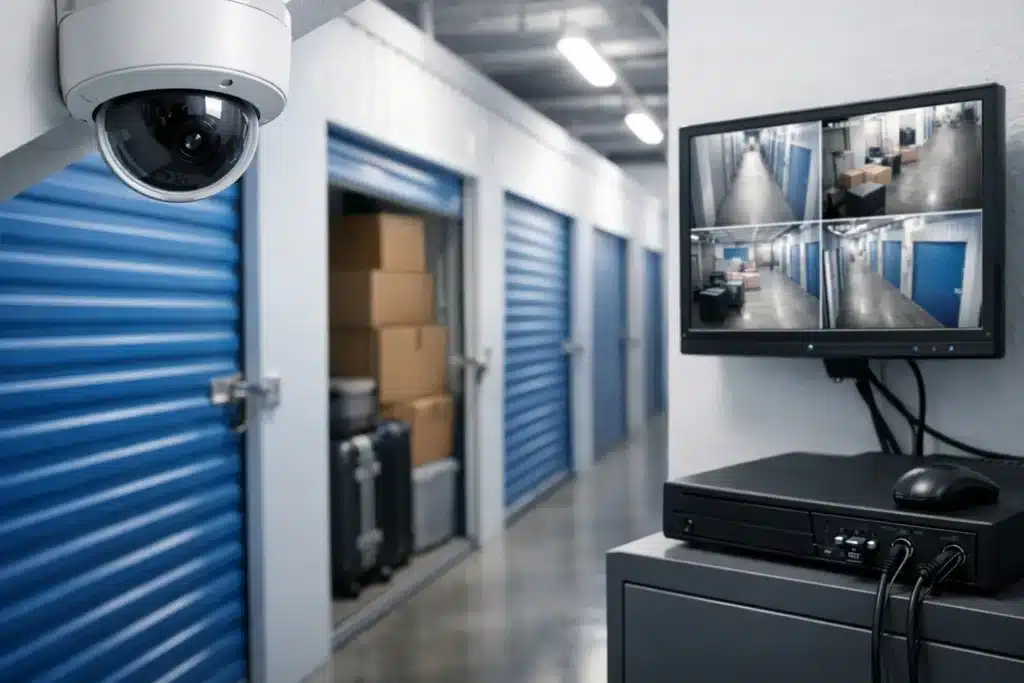
A personal storage facility can have hundreds of customers, frequent vehicle movements, after-hours access, and high-value belongings behind one controlled entrance. That makes CCTV a core operational system, not a box-ticking exercise. Understanding SIRA CCTV requirements for personal storage facilities before construction, fit-out, or system replacement helps prevent approval delays, coverage gaps, and expensive rework.
For self-storage operators in Dubai, the right approach is to design surveillance around real site activity: who enters, where they go, what they access, and how an incident can be investigated afterward. SIRA compliance must be built into that plan from the beginning.
Why storage facilities need a different CCTV design
Personal storage sites are not standard retail spaces. A customer may enter through a gate, park at a loading bay, pass through a lobby, use an elevator or corridor, and access a unit with limited staff supervision. Contractors, moving companies, and delivery drivers can add another layer of activity.
A single wide-angle camera at the entrance will not provide usable evidence if a dispute occurs inside the facility. The system must create a clear, traceable visual record across critical routes while protecting customer privacy. Camera placement, image quality, lighting, recording retention, cybersecurity, and monitoring access all affect whether the installation will satisfy both operations and compliance expectations.
The exact scope depends on the facility’s layout, risk profile, operating hours, and approved drawings. A multi-story storage building with electronic access control requires a different design from a ground-level facility with exterior container units. This is why an early site survey is more reliable than applying a generic camera count.
SIRA CCTV requirements for personal storage facilities
SIRA requirements are assessed against the proposed site and security design. The authority’s conditions, the approved equipment list, and the final installation must align. Facility operators should avoid treating a quotation with cameras and a recorder as a compliance plan.
A compliant project normally starts with a detailed survey and CCTV layout. The design identifies each camera, its field of view, mounting height, lens selection, cable route, recording equipment, storage capacity, and power or network requirements. It should also show how the system covers the facility’s security-critical areas without creating unnecessary blind spots.
Coverage of access and movement points
Cameras should provide usable identification and activity coverage at primary entry and exit points. This commonly includes pedestrian entrances, vehicle gates, reception areas, loading and unloading zones, parking areas, and perimeter access points.
Inside the facility, coverage should follow the customer journey. Corridors, elevators, stairwells, access-controlled doors, and main circulation routes are often priority areas. Where units open directly onto drive aisles or external corridors, the camera design must account for vehicle headlights, changing daylight, narrow passageways, and possible obstruction by moving trolleys or trucks.
Every camera must have a purpose. Excessively wide views may cover a large area but fail to capture recognizable detail at the point where it matters. Conversely, too many tightly focused cameras can increase cost, bandwidth, and maintenance without improving security. Proper lens selection and test images are essential.
Protecting privacy without losing evidence
Storage customers expect secure access to their belongings, but they also expect privacy. Cameras are generally designed to monitor common areas and access routes rather than the interior of private rented units. Any exception should be justified by the facility model, legal obligations, and the approved security design.
Camera views must also avoid inappropriate coverage of restrooms, changing areas, or neighboring private spaces. Privacy masking may be required where a camera’s necessary field of view includes restricted areas. Clear signage and controlled access to recorded footage support transparency and reduce avoidable complaints.
Approved equipment and recording performance
SIRA compliance is not only about where cameras are installed. The cameras, network video recorder or server, storage devices, monitors, cabinets, transmission equipment, and related components must be suitable for the approved system design and applicable authority requirements.
Image quality must remain usable in actual operating conditions. A loading area that is clear at noon may be unusable at night without correct low-light performance, supplemental lighting, or appropriate camera settings. Exterior cameras also require weather-resistant housings and mounting methods that withstand heat, dust, vibration, and tampering.
Recording capacity must be calculated rather than assumed. It depends on camera quantity, resolution, frame rate, compression settings, continuous or motion-based recording, and the retention period required for the approved project. Under-sized storage is a common failure point because footage may overwrite before the required retention period ends.
Secure control room and system access
Recording equipment should be installed in a secure location with restricted access, appropriate ventilation, stable power, and protection against interference. If a facility relies on remote viewing, user permissions must be controlled. Not every employee needs the ability to export footage, delete recordings, or change camera settings.
A practical access policy separates daily monitoring from administrator functions. It also records who has access to the platform and establishes a process for footage requests, incident exports, and evidence handover. These controls are as important as the camera hardware when an incident leads to an investigation.
Approval depends on documentation and execution
A well-designed system can still face delays if the approval process is handled late or the site installation differs from the submitted drawings. Changes such as relocated doors, added partitions, altered loading bays, or revised access routes can affect the approved camera layout.
The project process should include the site survey, system design, authority submission, equipment supply, installation, testing, commissioning, and final inspection coordination. Documentation must match what is installed on site. During commissioning, each camera should be checked for field of view, clarity, night performance, recording status, date and time accuracy, and playback availability.
Facility managers should keep handover records organized. These typically include approved layouts, equipment details, user access information, test results, warranty documentation, and maintenance records. They provide a reliable reference when staff change, an authority inspection occurs, or the facility expands.
Common mistakes that cause compliance and security problems
The most expensive mistakes usually begin with a low initial price. A contractor may quote a basic camera package without accounting for civil works, containment, network switching, storage calculations, lighting limitations, or approval documentation. The client then pays more later to correct the installation.
Other recurring issues include cameras blocked by signage or new shelving, poor facial detail at doors, unprotected external cable runs, recorder cabinets left accessible, and missing coverage at side gates or loading areas. A system can appear operational on a monitor while still failing to produce useful evidence.
Another risk is installing before the final layout is stable. Storage facilities often change unit partitions, reception counters, access gates, and racking arrangements during fit-out. Review the CCTV design after these changes, before final commissioning, so the completed system reflects real site conditions.
Build compliance into daily operations
Approval is the starting point, not the finish line. Cameras can lose focus, storage drives can fail, time settings can drift, and vegetation or signage can block views. Routine preventative maintenance keeps the system ready when footage is needed.
A scheduled maintenance plan should verify camera operation, image quality, recording health, storage status, network connectivity, backup power, and remote access permissions. It should also review whether new operational risks require additional coverage, such as an expanded loading area or extended access hours.
ALNAJAH ALAWAL supports storage operators with site surveys, SIRA-compliant system design, installation, approval coordination, testing, and ongoing maintenance. Using one accountable contractor reduces gaps between the approved design, installed equipment, and final handover.
The strongest storage security system is the one that gives managers a clear answer when something happens: who entered, where they went, what occurred, and whether the footage is available. Plan for that standard from the first drawing. Stay compliant. Stay protected.