

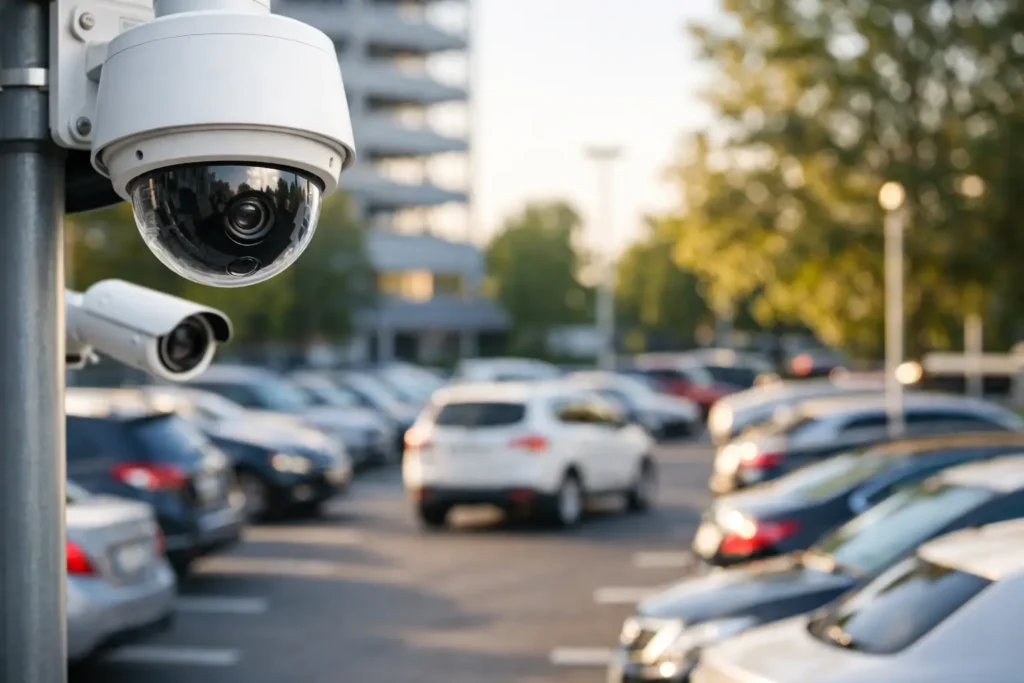
A parking area is one of the first places where security gaps show up. Poor lighting, wide open spaces, vehicle movement, blind spots, and after-hours access all make it harder to monitor than a lobby, office, or retail floor. That is why choosing the best CCTV cameras for parking is less about buying a popular model and more about matching the camera type to the operational risk, site layout, and compliance requirement.
For commercial buildings, warehouses, retail sites, labor accommodations, hotels, and fleet yards, parking surveillance has to do more than record footage. It needs to identify incidents clearly, support investigations, deter theft and vandalism, and in many cases meet authority standards for approval. If the image quality fails at night or the camera placement leaves gaps between parked vehicles, the system may still be installed but it will not perform when needed.
What makes a parking camera effective
Parking areas create a difficult surveillance environment because they combine distance, motion, headlights, shadows, and weather exposure. A camera that works well indoors may struggle badly outside in an open lot. The best CCTV cameras for parking areas are designed to handle these conditions without losing usable detail.
Resolution matters, but it is only one part of the decision. A higher megapixel camera can cover a larger zone, yet if the lens is wrong or the lighting is poor, the extra pixels will not give you better evidence. In practice, image clarity depends on the full setup – sensor quality, lens angle, low-light performance, infrared range, mounting height, and recording settings.
A reliable parking surveillance system also needs stable storage, proper cabling or network design, and recording retention based on site policy or regulatory expectations. Many failures come from weak system design rather than the camera itself.
Best CCTV cameras for parking: the right types for each job
There is no single best camera for every parking area. Most effective systems use a combination of camera types to cover entrances, circulation lanes, parked vehicles, pedestrian movement, and payment or barrier points.
Bullet cameras for long-range coverage
Bullet cameras are often the strongest choice for perimeter lines, entry roads, ramps, and open parking rows. Their shape allows for more directional coverage, which makes them suitable when you need to watch a defined path or a longer distance.
For fleet yards, warehouse parking, and loading-adjacent vehicle zones, bullet cameras help security teams monitor vehicle movement from one end of the area to the other. They also act as a visible deterrent, which can reduce opportunistic theft, unauthorized parking, and vandalism.
The trade-off is exposure. Because they are more visible and protrude outward, bullet cameras can be more vulnerable to tampering if installed too low or in accessible locations.
Dome cameras for closer zones and vandal resistance
Dome cameras work well in covered parking, basement parking, lift lobby exits, cashier points, payment machines, and building-side parking zones. Their housing is generally more discreet and harder to reposition by hand.
They are a practical option where aesthetics matter or where the camera may be within reach of the public. In mixed-use or residential-commercial properties, this can be a better fit than a large bullet camera mounted at eye level near entrances.
Their limitation is range. A dome camera can be excellent for capturing activity in a specific zone, but it is not always the best choice for long perimeter views unless selected and positioned very carefully.
PTZ cameras for active monitoring
Pan-tilt-zoom cameras are useful in larger parking facilities where security personnel actively monitor live views. A PTZ can track movement across a wide area and zoom in on suspicious behavior, vehicle congestion, or after-hours activity.
This makes sense in malls, industrial compounds, transport depots, and high-traffic commercial sites. A PTZ is not a replacement for fixed cameras, though. It can only focus on one direction at a time, so relying on it alone creates coverage gaps. The better approach is to use PTZ cameras as part of a layered system.
ANPR cameras for vehicle identification
If the site needs to capture plate numbers at entry and exit points, an automatic number plate recognition camera is often the better investment than a standard CCTV camera. This is especially relevant for fleet operators, logistics sites, gated communities, commercial towers, and facilities with vehicle access control.
ANPR cameras are designed for vehicle speed, headlight glare, and plate capture angles. A standard camera may record the vehicle but fail to capture a readable plate at night or during peak movement. When incident tracing or access logging matters, that difference is significant.
Features that matter more than brand names
Buyers often start by asking which brand is best. The better question is which features are necessary for the parking environment you are securing.
Low-light performance is essential. Many incidents happen early morning, after sunset, or in partially lit corners. Cameras with strong night imaging, smart infrared, or full-color low-light capability produce more useful evidence than cameras chosen only for daytime sharpness.
Wide dynamic range is also critical in parking areas. Headlights, reflective surfaces, shaded ramps, and bright sunlight can wash out important details. A camera with proper dynamic range handles contrast better and keeps faces, vehicles, and movement visible.
Weather resistance should not be treated as optional for outdoor sites. Heat, dust, and humidity affect camera life and image consistency. In exposed environments, housing quality and temperature tolerance have a direct effect on maintenance frequency and downtime.
Finally, coverage design matters as much as the spec sheet. One high-resolution camera mounted too high is usually less effective than several properly placed cameras with clear task-based coverage.
How to choose the best CCTV cameras for parking by site type
A retail parking lot usually needs strong entrance and exit coverage, payment area visibility, and broad recording of vehicle rows. The priority is incident review, customer safety, and liability protection.
A warehouse or logistics site needs more attention on truck lanes, loading-adjacent parking, perimeter fencing, and after-hours vehicle activity. In these settings, combining fixed long-range cameras with selective PTZ coverage often works well.
For residential towers and mixed-use properties, camera choice tends to balance security, privacy, and appearance. Basement parking may need vandal-resistant domes, while ramps and gate lanes may require dedicated vehicle-focused cameras.
For fleet yards, the system should be built around operational control as much as security. Vehicle entry logs, parked asset visibility, fuel area coverage, and integration with tracking or gate control may all matter. This is where a contractor with both CCTV and fleet technology experience can add practical value.
Installation decisions that affect results
Even the best camera will underperform if it is mounted in the wrong location. Parking cameras should be placed based on real movement patterns, not just available poles or walls. Entrance lanes, turning points, hidden corners, stair exits, payment equipment, and pedestrian crossing areas all need separate consideration.
Mounting height is a common mistake. Cameras placed too high give a wide view but poor identification. Cameras placed too low may be blocked by larger vehicles or become easy targets for tampering. The right height depends on whether the goal is overview, identification, or plate capture.
Recording configuration matters too. If the frame rate is too low, vehicle movement may blur. If compression is too aggressive, important details can be lost. These are technical settings, but they directly affect whether footage is useful during an incident.
Compliance is part of the decision
For many sites, parking surveillance is not just an operational improvement. It is part of a compliance process. Commercial and regulated projects may need camera layouts, equipment specifications, recording standards, and installation methods that align with authority requirements.
In the UAE, that means the system design should be reviewed in the context of applicable approval standards before installation starts. This reduces the risk of redesign, delayed approvals, or failed inspections. For businesses managing new developments, facility upgrades, or handover timelines, that is a major practical advantage.
A compliance-led contractor will look beyond the camera catalog. They will assess the site, identify coverage obligations, confirm the correct equipment category, and plan the system so the project can move from design to approval to commissioning without unnecessary rework. That execution discipline is often what separates a functioning security project from an expensive correction job.
What a smart buyer should ask before choosing
Before selecting a parking camera system, ask what the footage needs to achieve. Do you need general monitoring, face identification, number plate capture, incident reconstruction, or all of the above? Each objective changes the camera type, lens, and placement.
You should also ask how the system will be maintained. Outdoor cameras require periodic cleaning, health checks, storage monitoring, and firmware review. A system that performs well in month one but degrades by month six creates risk that is easy to miss until an incident occurs.
For businesses that need reliable execution, this is where working with an approved contractor such as ALNAJAH ALAWAL SECURITY SYSTEMS & EQUIPMENT TRADING L.L.C. can make the decision easier. The value is not just equipment supply. It is getting the site survey, camera selection, compliance path, installation, testing, and long-term support aligned from the start.
The right parking surveillance system should leave you with fewer blind spots, clearer evidence, and fewer approval problems – not more equipment to worry about later.