

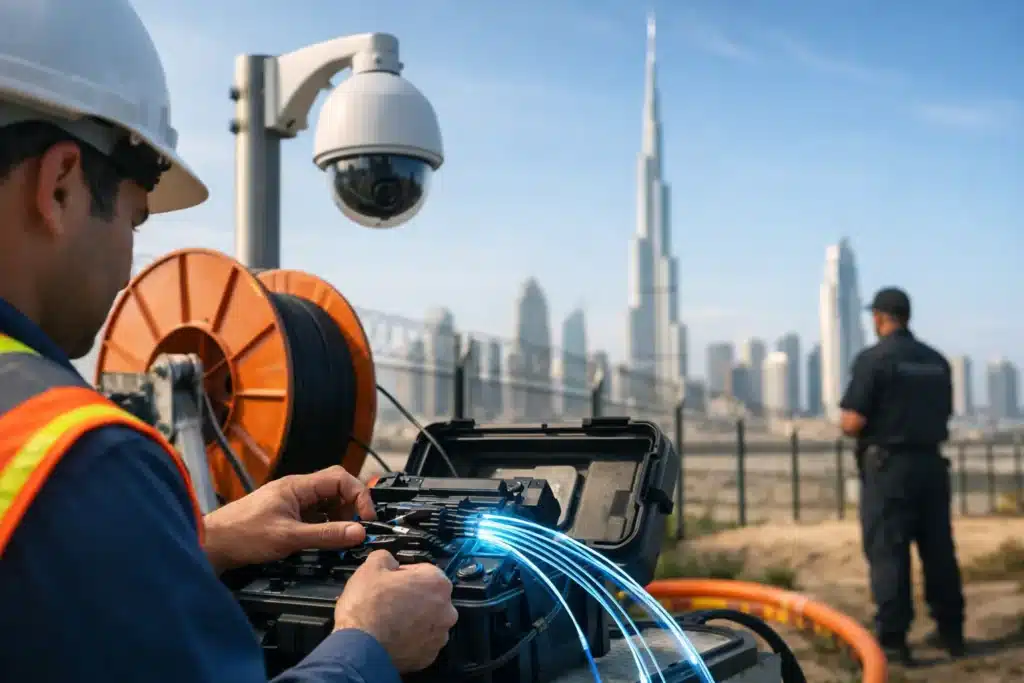
A camera that drops offline during an incident, an access control door that responds slowly, or a warehouse network that fails at peak activity usually points to one issue: the underlying cabling was not designed for the operational load. Fiber optic installation Dubai projects require more than pulling cable through a conduit. They require a clear understanding of site conditions, system priorities, authority requirements, and the consequences of downtime.
For commercial, industrial, retail, hospitality, and logistics facilities, fiber provides the high-capacity backbone that connects security, communications, automation, and management systems across buildings and large sites. When it is planned and installed correctly, it supports dependable performance today and gives the facility room to expand without repeated disruption.
Why Fiber Matters for Security and ELV Infrastructure
Copper cabling remains suitable for many local connections, particularly within offices and at endpoint devices. Fiber becomes the stronger option where distances are longer, bandwidth demand is high, electrical interference is present, or critical systems must connect between buildings.
This matters in practical terms. A large CCTV deployment can generate substantial video traffic, especially when it includes high-resolution cameras, recording servers, remote monitoring, and analytics. A fiber backbone helps carry that traffic between network racks without creating the bottlenecks that cause delayed video, packet loss, or unstable camera connections.
Fiber is also immune to electromagnetic interference. In factories, parking structures, plant rooms, fuel facilities, and sites with heavy electrical equipment, this can be a decisive advantage over copper runs. It does not mean fiber is automatically the right answer everywhere. Short, low-demand connections may be more economical on copper. The design should match the actual distance, device count, future load, and risk profile of the facility.
For sites that need systems to operate across separate buildings, fiber can provide reliable connectivity without the limitations associated with long copper runs. It is often the foundation for connecting guard rooms, server rooms, gates, warehouses, administration offices, and perimeter security points into one managed network.
Fiber Optic Installation Dubai Starts With Site Design
The most expensive fiber problems are often created before installation begins. An undersized cable, poorly located cabinet, inaccessible route, or missing spare capacity may not be visible on handover day. It becomes visible later, when a new tenant, camera expansion, or access control upgrade requires costly rework.
A professional site survey should identify the route from source to destination, available containment, building transitions, riser pathways, environmental exposure, power and rack locations, and the systems that will use the network. The contractor should also identify whether the route crosses areas that require special protection, fire stopping, trenching, or coordination with other trades.
The design then establishes the correct fiber type and core count. Single-mode fiber is commonly selected for longer distances and future scalability. Multimode fiber may suit shorter internal building links where the active equipment and distance support it. The choice is not simply a technical preference. It affects transceiver compatibility, budget, expansion options, and replacement risk.
Core count deserves the same attention. Installing only the exact number of cores needed for the current project may reduce initial cost, but it can create a major limitation later. Spare fibers provide capacity for additional cameras, separate networks, redundancy, or fault recovery. For high-priority operations, planning for spare capacity is a sensible control, not unnecessary excess.
Four questions that should be answered before cable pulling
- What systems will use the fiber now, including CCTV, access control, Wi-Fi, intercom, building management, and data services?
- What expansion is expected over the next three to five years?
- Which routes need physical protection, fire-rated treatment, or outdoor-rated cable?
- What level of redundancy is required if a primary link is damaged or a network switch fails?
Clear answers prevent a design from being driven only by the shortest available cable path.
Installation Quality Is More Than Cable Placement
Fiber cable is durable when it is handled correctly, but it is not forgiving of poor installation practice. Excessive pulling tension, tight bends, damaged sheathing, poor route segregation, and exposed joints can compromise performance or shorten service life.
The installation team should use suitable containment and support methods for the environment. Indoor routes may require trays, trunking, risers, and properly protected wall penetrations. Outdoor and inter-building routes may require armored cable, ducts, chambers, warning tape, or other physical safeguards based on the route and civil conditions. In high-traffic or industrial areas, cable protection must account for impact, vibration, moisture, heat, and maintenance access.
Terminations are equally critical. Fibers must be properly spliced or terminated, labeled at both ends, and organized within suitable patch panels or enclosures. Untidy fiber management creates unnecessary risk during maintenance. A technician should be able to identify a cable, trace its route, and isolate a fault without disturbing live services.
For security infrastructure, labeling should align with the system documentation. If a core supports a camera network, gate controller, or remote cabinet, the records should make that relationship clear. This is particularly valuable during inspections, system expansions, tenant fit-outs, and emergency troubleshooting.
Testing Proves the Link Will Perform
A fiber connection is not complete because a device appears online. Basic connectivity can hide weak splices, marginal loss levels, damaged connectors, or installation defects that may cause future intermittent failures.
Proper commissioning includes optical testing appropriate to the project scope. Power meter and light source testing can verify insertion loss across a link. Optical time-domain reflectometer testing can help identify the location of events such as splices, connectors, bends, and breaks on longer or more complex runs. Test results should be recorded and supplied as part of the project handover.
The acceptable loss level depends on the fiber type, length, connector count, splice quality, and the optical budget of the active equipment. A good contractor does not rely on generic pass-or-fail assumptions. The results should be reviewed against the designed link budget and the requirements of the connected devices.
Documentation is not an administrative extra. It gives facility managers a usable record of cable routes, core allocations, rack locations, test readings, and installed equipment. When a fault occurs six months or three years later, complete documentation reduces investigation time and prevents avoidable disruption.
Supporting Compliance and Operational Continuity
Fiber itself is not a security approval, but it directly supports the performance of regulated and operationally critical systems. CCTV, access control, intercom, and control room infrastructure depend on stable connectivity. If the network design is weak, the wider system may fail to deliver the coverage, recording availability, or response capability expected by the client and relevant authorities.
For Dubai projects involving regulated surveillance systems, fiber planning should be coordinated with the CCTV design, camera locations, storage requirements, monitoring architecture, and approval process. This avoids a common problem: installing cameras and network equipment first, then discovering that the backbone cannot reliably support the required video load or site layout.
ALNAJAH ALAWAL SECURITY SYSTEMS & EQUIPMENT TRADING L.L.C. approaches fiber as part of the wider ELV and security environment. The objective is not simply to install cable. It is to deliver a documented infrastructure that supports the approved system design, works under real operating conditions, and remains maintainable after handover.
This integrated approach is especially useful for warehouses, retail portfolios, labor accommodations, hotels, industrial facilities, and multi-building developments where several systems share the same routes and network cabinets. Coordinating containment, device locations, electrical works, and testing early can protect the project schedule and reduce conflicts between trades.
When to Upgrade an Existing Fiber Network
Existing fiber does not always need replacement. Sometimes the issue is active equipment, poor patching, inadequate switch capacity, contaminated connectors, or missing documentation. A survey and test report can distinguish between a cable fault and a network design problem.
An upgrade should be considered when video traffic is increasing, new buildings are being connected, links frequently fail, spare cores are unavailable, or the installed cable type no longer supports the required distance and speed. It may also be necessary where cable routes lack protection or records are too incomplete for safe maintenance.
The right solution may be targeted remediation rather than a full replacement. Re-terminating damaged ends, installing additional fiber on a new route, adding protected cabinets, or separating security traffic from general business traffic can resolve the specific risk without unnecessary scope.
A fiber backbone should make security systems easier to operate, not harder to maintain. Before approving any installation, ask for the route plan, fiber specification, spare-core strategy, test method, and handover documents. Those details are what turn a cable installation into infrastructure your facility can rely on when it matters.