

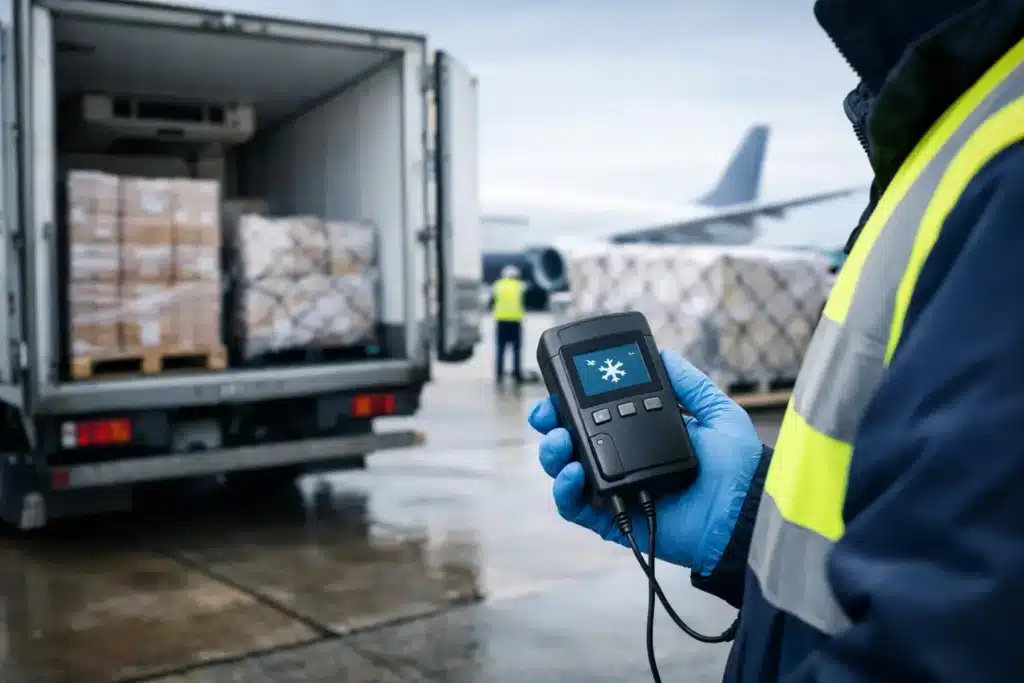
A refrigerated vehicle can look fully operational while its cargo compartment is already moving outside the approved temperature range. A door left open during delivery, a failing reefer unit, poor airflow around pallets, or an unplanned stop can put food, pharmaceuticals, and other sensitive goods at risk before anyone notices. Cold chain temperature monitoring gives operators the evidence and early warning needed to act before a temperature excursion becomes a rejected shipment, customer claim, or compliance issue.
For logistics companies, warehouses, healthcare suppliers, food distributors, and fleet operators, temperature data is not a nice-to-have report. It is operational control. The right system shows what happened, where it happened, how long it lasted, and whether the issue was corrected in time.
What Cold Chain Temperature Monitoring Must Deliver
Cold chain temperature monitoring is the continuous measurement, recording, and reporting of temperature conditions throughout storage and transport. It can apply to refrigerated trucks, freezer vans, cold rooms, distribution centers, medicine storage areas, insulated containers, and last-mile delivery operations.
A basic logger may provide a record after a journey. That can help with investigation, but it does not prevent product loss. A connected monitoring solution provides live temperature visibility and exception alerts, allowing managers to intervene while the cargo is still recoverable.
For commercial operations, an effective setup should answer four questions clearly: What is the current temperature? Has it moved outside the permitted range? Where is the vehicle or asset? Who was notified, and what action was taken?
That level of visibility matters when customers, auditors, insurers, or internal quality teams ask for proof that temperature-sensitive cargo was handled correctly.
Monitoring Is Not the Same as Refrigeration Control
This distinction is often missed during procurement. A refrigeration unit cools the cargo area. A temperature monitoring system verifies the actual conditions and records performance over time. One does not replace the other.
A reefer controller may report its setpoint or equipment status, but the air temperature near the evaporator is not always the same as the temperature around the product. Warm spots can develop because of loading patterns, blocked vents, frequent door openings, damaged seals, or inadequate pre-cooling.
Independent sensors placed in appropriate locations provide a more reliable picture of cargo conditions. The required sensor layout depends on the vehicle body, cargo type, trip duration, operating range, and customer requirements. A single probe may be adequate for a small, controlled application. Multi-zone vehicles, freezer compartments, or high-value pharmaceutical loads usually require more detailed coverage.
Where Temperature Failures Usually Start
Most cold chain failures are not caused by one dramatic equipment breakdown. They often develop through routine operating gaps that are not detected quickly enough.
Pre-cooling is a common example. If a vehicle is loaded before the compartment reaches the required temperature, the refrigeration unit may spend the first part of the trip trying to recover from a preventable heat load. The cargo can remain outside its target range even when the reefer unit appears to be running normally.
Door activity creates another risk. Every stop introduces warm air, especially during frequent urban deliveries. A monitoring system paired with door status data can show whether a temperature rise matches a normal delivery event or indicates that a door was left open longer than permitted.
Route delays, unauthorized stops, and reefer unit faults also require attention. This is where integrated GPS fleet tracking becomes valuable. Rather than reviewing separate systems after an incident, fleet managers can see temperature history alongside vehicle location, trip route, speed, ignition status, and stop duration. The result is faster investigation and clearer accountability.
Build Alerts Around Action, Not Noise
An alert that arrives too late has limited value. An alert that triggers every few minutes creates alarm fatigue and eventually gets ignored. Alert rules must reflect the cargo, operating process, and realistic response time.
For example, a short temperature change during a scheduled delivery may not require the same escalation as a prolonged excursion while a vehicle is parked with the engine off. Alert logic can account for upper and lower thresholds, duration outside range, sensor failure, low device battery, loss of power, prolonged door opening, and communication loss.
The escalation path also matters. Drivers may need an immediate notification for a door-open event. Supervisors may need a call or dashboard alert when a critical threshold is exceeded for a defined period. Quality personnel may require a complete incident report after the shipment is completed.
Before deployment, define who owns each response. If the driver receives an alert, can they safely check the refrigeration unit? If the fleet controller receives it, can they redirect the vehicle to a nearby cold facility? If no action is possible, is the product quarantine process clear? Technology supports control, but people and procedures determine whether it produces the right result.
Select Sensors and Connectivity for the Actual Operation
There is no single cold chain temperature monitoring configuration that fits every fleet or facility. The system should be designed around the operating environment rather than selected only on the basis of device price.
For refrigerated transport, consider the temperature range, sensor accuracy, calibration requirements, battery life, enclosure protection, data transmission frequency, and connectivity across planned routes. For frozen cargo, sensors must remain accurate at low temperatures. For long-haul or cross-border routes, temporary network loss should not create gaps in the temperature record. Devices should store readings locally and transmit them once the connection returns.
Cold rooms and warehouses have different requirements. Fixed sensors may be combined with gateway devices, power-failure alerts, door contacts, and multiple measurement points to identify hot and cold zones. Large facilities may also need separate monitoring for loading docks, staging areas, freezer rooms, and temperature-controlled storage sections.
Calibration is not an administrative detail. If measurement accuracy cannot be demonstrated, the data may be challenged when it matters most. Establish a documented calibration schedule, retain certificates where required, and replace damaged or drifting sensors promptly.
Use Reports as Evidence, Not Just Administration
Temperature history should be easy to retrieve by vehicle, trip, customer, route, compartment, or date. A useful report shows the required range, actual readings, time outside threshold, alert events, corrective actions, and any data gaps.
For food distribution, this evidence can support customer handover and quality assurance. For pharmaceutical and healthcare logistics, it can support product handling records and internal audit requirements. For fleet managers, it reveals recurring operational issues, such as a specific vehicle with poor temperature recovery or a route that produces repeated door-open excursions.
The strongest reports do not hide exceptions. They make them clear, explain what occurred, and show whether the issue was addressed. This protects the operator when a customer dispute arises and helps management correct the root cause instead of repeatedly dealing with symptoms.
Installation Quality Affects Data Quality
A capable device can still produce unreliable results if installation is poorly planned. Sensor location, cable routing, power connection, antenna placement, enclosure protection, and commissioning all affect system performance.
In a refrigerated vehicle, sensors should not be placed only where cold air is strongest. They should be located to reflect the conditions that matter for the cargo, while avoiding positions that create misleading readings from direct airflow, sunlight, or repeated contact with doors and walls. Wiring must be protected against moisture, vibration, washdown activity, and accidental damage during loading.
Commissioning should include a functional test of each sensor, live data confirmation, alert verification, GPS position validation where applicable, and staff training. Drivers and dispatch teams need to know what each alert means and what action they are expected to take. A system is only fully operational when the team can use it confidently under pressure.
A Practical Standard for UAE Operations
Businesses operating refrigerated fleets or controlled storage facilities in Dubai, Abu Dhabi, Sharjah, and across the UAE need more than periodic temperature checks. High ambient temperatures, demanding delivery schedules, and customer quality requirements leave little room for undetected deviations.
ALNAJAH ALAWAL SECURITY SYSTEMS & EQUIPMENT TRADING L.L.C. can integrate temperature monitoring with GPS vehicle tracking to give fleet operators a single operational view of cargo conditions, vehicle movement, and delivery activity. The approach should begin with a site or fleet assessment, followed by system design, professional installation, testing, training, and support.
Start with your highest-risk routes, vehicles, or storage areas. Measure the current gaps, set practical alert rules, and test the response process before expanding across the operation. When temperatures change, the goal is not simply to collect data later. The goal is to know early, respond correctly, and keep the cargo protected.