

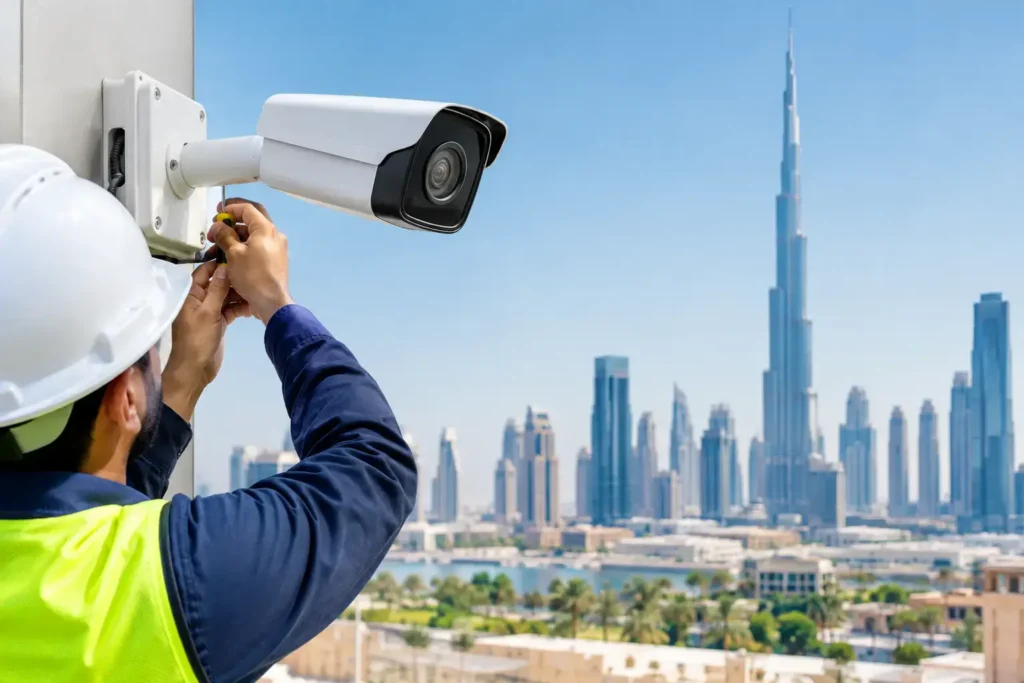
A camera mounted in the wrong place can create more risk than no camera at all. CCTV installation is not simply an equipment purchase: it is a compliance, coverage, recording, and operational continuity project. For businesses in the UAE, a system must protect the site while meeting the requirements of the relevant authority, whether that involves SIRA in Dubai, Abu Dhabi monitoring requirements, or Sharjah Police standards.
The difference shows up at inspection time. A system with poor camera angles, inadequate retention, missing identification labels, or undocumented testing can delay approvals and disrupt an opening, handover, or operating license. The right approach begins before the first camera is installed.
Start CCTV Installation With a Site Survey
A proper site survey identifies what must be protected, how people and vehicles move through the facility, and where evidence is most likely to be needed. This is particularly important for warehouses, retail stores, labor accommodations, construction sites, hotels, clinics, and industrial facilities, where risk is rarely limited to a front entrance.
The survey should assess access points, perimeter boundaries, loading bays, parking areas, cash handling locations, server rooms, storage zones, elevators, corridors, and emergency exits. It should also consider lighting conditions. A camera that produces a clear image at noon may provide unusable footage at night if infrared range, external lighting, glare, or reflective surfaces have not been considered.
Site conditions influence the installation method as well. Ceiling height, cable routes, wall construction, outdoor exposure, power availability, network capacity, and access for future maintenance all affect the final design. A practical survey prevents costly changes after work has started.
Design for Evidence, Not Just Visibility
A camera view can look impressive on a monitor while still failing to identify a person, read a vehicle plate, or verify an incident. The purpose of the design is to produce usable evidence in the locations that matter.
For example, a wide-angle camera may be appropriate for general activity in a warehouse floor, but an entrance usually needs a dedicated view capable of capturing faces clearly. Vehicle gates may require a specific camera position and lighting arrangement for plate recognition. A cash counter, jewelry display, or fuel dispensing area may need closer coverage and higher detail than a general retail aisle.
Camera selection should follow the scene, not a generic package. Dome cameras may suit indoor public areas, bullet cameras may work well for exterior coverage, and PTZ cameras can support active monitoring of larger compounds. PTZ units are not a replacement for fixed cameras, however. If no operator is actively controlling the camera, a critical event can occur outside its field of view.
The recording system must be designed with the same care. Storage capacity depends on camera count, resolution, frame rate, recording mode, image complexity, and required retention period. Increasing resolution without reviewing storage can shorten retention unexpectedly. Recording continuously may be necessary for key areas, while motion or event-based recording can be appropriate in lower-risk spaces if it meets the project requirement.
Compliance Must Shape the System From Day One
Authority approval is not a final administrative step. It affects camera locations, equipment specifications, storage duration, monitoring arrangements, signage, network design, drawings, and documentation. Treating compliance as an afterthought is one of the most common causes of rework.
Requirements vary by emirate, business activity, building type, and risk profile. A retail shop, warehouse, high-value goods facility, and residential development may not be subject to the same scope. The correct design therefore begins by confirming the applicable authority standards and project-specific conditions.
For regulated projects, work should be supported by clear technical drawings, camera schedules, cable routing plans, equipment details, and records that match what is physically installed. During inspection, inconsistency between documentation and the completed system can create unnecessary delays.
ALNAJAH ALAWAL SECURITY SYSTEMS & EQUIPMENT TRADING L.L.C. manages approved CCTV projects from survey and design through installation, testing, authority processing, and handover. This single-point responsibility helps clients avoid the gaps that arise when design, installation, and approvals are handled by separate parties.
Installation Quality Determines Long-Term Reliability
Even high-quality cameras cannot compensate for poor workmanship. Cable terminations, conduit protection, mounting stability, weatherproofing, grounding, labeling, and rack organization all influence whether a system remains dependable after handover.
Outdoor cameras need appropriate protection from dust, heat, moisture, vibration, and direct sunlight. Network and power connections should be secured and protected against unauthorized interference. In large facilities, properly planned cabinets and cable pathways make it easier to trace faults, add cameras, and perform maintenance without interrupting operations.
Network planning deserves close attention. IP cameras consume bandwidth, and larger systems can place meaningful demand on switches, uplinks, and storage infrastructure. A shared business network may need segmentation to protect CCTV performance and reduce cybersecurity exposure. Remote viewing should use controlled access, strong credentials, and defined user permissions rather than open, unmanaged connections.
Power resilience is another operational decision. A short outage can leave cameras and recorders offline at the moment they are needed. Depending on the site and risk level, uninterruptible power supply backup and correctly sized power distribution may be necessary to maintain recording through brief interruptions.
Test the System as It Will Be Used
Commissioning should confirm more than whether each camera displays an image. Every camera must be checked for its actual purpose: face identification at the entrance, clear vehicle movement at the loading bay, full coverage of the emergency exit, or readable activity in a restricted area.
Testing should include daytime and nighttime image quality, recording playback, timestamps, storage retention, remote access permissions, motion detection where used, and power recovery. The installer should also verify that the recorder is capturing every assigned channel at the expected resolution and that no blind spots were created by shelves, signage, parked vehicles, or later construction changes.
Before handover, the site team should receive practical training. Security staff and facility managers need to know how to retrieve footage, check system health, report faults, manage authorized users, and preserve relevant recordings after an incident. A system becomes less effective when only the installer knows how to operate it.
Plan for Maintenance Before a Fault Occurs
CCTV systems need periodic attention. Camera lenses collect dust, outdoor housings can shift, storage drives age, network equipment may lose configuration, and site layouts change. A camera aimed at an open loading area can become blocked when racking or a new partition is installed.
A maintenance plan should include image checks, camera cleaning, recording verification, storage health review, firmware management where appropriate, cable and enclosure inspections, and confirmation that timestamps remain accurate. For compliance-driven premises, ongoing maintenance also supports readiness for audits, renewals, and future inspections.
The most effective approach is to keep a simple operational record: system drawings, equipment details, service reports, user access responsibilities, and a log of changes to camera locations or facility layout. This creates accountability and makes future expansion faster and more controlled.
Common Decisions That Require Careful Judgment
There is no single camera count that fits every site. Adding cameras without a coverage plan can increase cost and storage needs without improving evidence quality. Conversely, reducing camera count to meet a short-term budget can leave high-risk zones uncovered and create much larger losses later.
Cloud recording may be useful for some smaller sites or as an additional backup layer, but bandwidth, retention, data control, and recurring costs must be evaluated. On-premises recording can provide greater local control and predictable performance, though it requires suitable hardware space and maintenance. Hybrid designs can be appropriate when continuity and remote access are both priorities.
The best CCTV installation is one that matches the site’s real risks, meets the relevant approval requirements, and remains easy to operate after handover. Start with a detailed survey, confirm compliance early, and insist on testing that proves the footage will be useful when it matters. Stay compliant. Stay protected.