

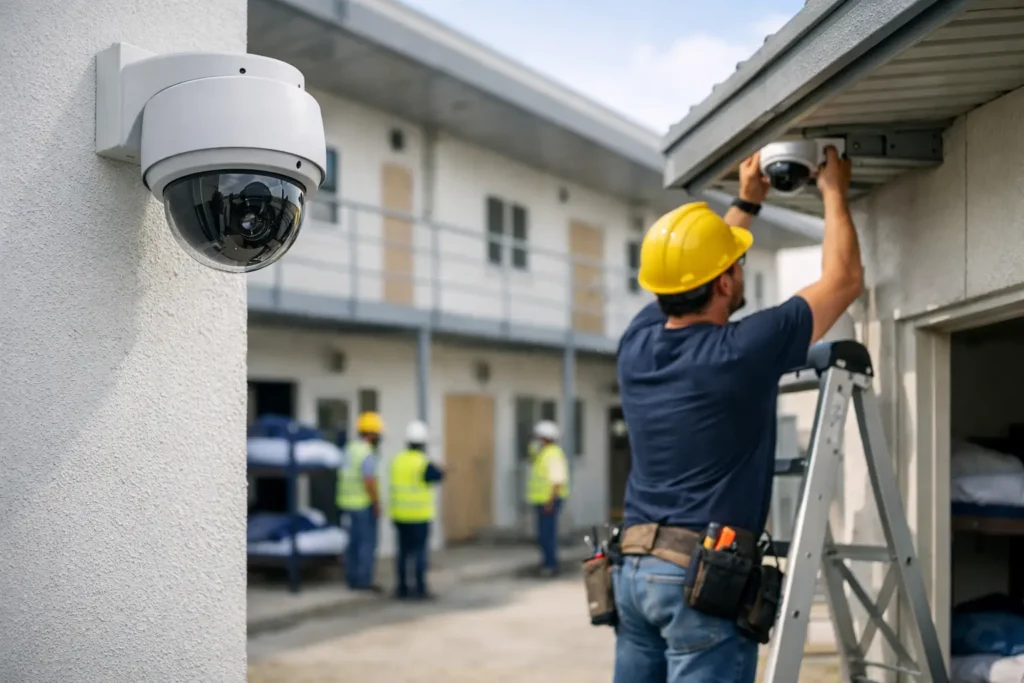
A camera placed only at the main gate will not resolve the real security risks in a labor accommodation. Incidents often occur in circulation areas, parking zones, entrances to shared facilities, and perimeter blind spots. CCTV installation for labor accommodation must therefore be designed around how residents, visitors, service teams, and vehicles actually move through the property – while protecting privacy and meeting the applicable authority requirements.
For operators, developers, and facility managers, the objective is clear: maintain a safer, orderly site, investigate incidents with reliable footage, and avoid installation decisions that create approval or operational problems later.
Why Labor Accommodation CCTV Needs a Site-Specific Design
Labor accommodation is not a standard commercial office. It has high occupancy, frequent movement at shift-change times, shared amenities, contractor access, delivery activity, and often a large external perimeter. A generic package with a fixed number of cameras can leave critical areas uncovered or create unnecessary coverage in sensitive locations.
A proper survey starts with the site layout, resident capacity, entry and exit points, existing guards, lighting conditions, building blocks, parking arrangements, and the location of management offices. The design should then identify where video evidence will have the most operational value.
Priority coverage typically includes main gates, reception areas, visitor entry points, building entrances and exits, corridors where appropriate, stairwell access points, parking areas, perimeter gates, waste collection zones, and common external spaces. CCTV can also support oversight around recreation areas, laundry facilities, dining access, stores, and maintenance yards when the risk assessment justifies it.
The goal is not to record every square foot. It is to cover meaningful access routes, deter misconduct, provide visibility during incidents, and give management a dependable record when questions arise.
CCTV Installation for Labor Accommodation: Privacy Comes First
Security coverage must never disregard resident dignity. Cameras should not be installed inside bedrooms, bathrooms, shower areas, changing rooms, or other private spaces. This is both an ethical and operational requirement. A system that creates privacy concerns can damage resident trust and expose the operator to serious complaints.
Shared living environments require a clear balance. Cameras may be appropriate at entrances to residential blocks and in public circulation areas, but their position, angle, and field of view must be carefully controlled. A camera facing a doorway should secure access without recording into a private room. Signage should also make surveillance visible and establish that the site is professionally managed.
Access to live views and recorded footage should be restricted to authorized personnel. Facility managers should know who can review footage, under what circumstances, and how each review is documented. Password sharing, unmanaged mobile access, and an unlocked recorder in a general office are avoidable weaknesses.
Design the System Around Real Risks
Camera selection should follow the risk, not a product catalog. A wide-angle camera may be effective for an open courtyard but inadequate for identifying a person at a distant vehicle gate. A low-light camera may be necessary in poorly lit perimeter sections. At vehicle entrances, number plate capture may be required where traffic control and incident investigation are priorities.
The following areas commonly need separate design consideration:
- Main and secondary pedestrian entrances, including visitor approach routes
- Vehicle gates, parking access, loading areas, and delivery points
- Perimeter walls, remote corners, utility areas, and exterior gathering spaces
- Shared facilities and public circulation routes with recurring incident history
Image quality matters as much as coverage. A camera that shows activity but cannot provide a usable identification image may offer little value after an incident. During design, consider viewing distance, camera height, lighting direction, facial detail requirements, obstructions, and expected traffic flow.
Night performance deserves special attention. External lighting can create glare, deep shadows, or overexposed faces if cameras are positioned without testing. Proper installation includes checking the actual night image, not assuming that a camera specification alone will solve difficult lighting conditions.
Compliance Is Part of the Installation, Not an Afterthought
In the UAE, CCTV requirements can vary by emirate, property type, and authority jurisdiction. For projects in Dubai, SIRA requirements may apply. Projects in Abu Dhabi may be subject to applicable monitoring and control authority requirements, while Sharjah installations may require compliance with Sharjah Police procedures. The exact scope, camera locations, recording retention, equipment specifications, and documentation should be confirmed before procurement begins.
This is why a compliance-led site survey is more effective than installing equipment first and trying to correct the design during inspection. Late changes can mean additional cabling, replacement cameras, revised drawings, delayed handover, and unnecessary cost.
A capable contractor manages the technical and administrative work together. That includes site assessment, system layout, camera schedule, equipment selection, cable routing, recorder sizing, storage calculations, testing, commissioning, and required approval submissions. The result is a system designed to be approved right the first time, subject to the authority’s review and current project requirements.
ALNAJAH ALAWAL SECURITY SYSTEMS & EQUIPMENT TRADING L.L.C. supports labor accommodation projects with this end-to-end approach, combining compliant CCTV design, installation, testing, authority coordination, and ongoing support.
Storage, Monitoring, and Evidence Management
Recording storage is a frequent planning failure. High-resolution cameras, continuous recording, multiple blocks, and longer retention requirements can quickly increase storage demand. Underestimating capacity can cause footage to overwrite before it is needed. Oversizing without a clear retention plan increases cost without necessarily improving security.
Storage should be calculated based on the approved camera count, resolution, frame rate, compression settings, recording schedule, and required retention period. Critical entrances may need continuous recording, while lower-risk areas may be configured differently if permitted by the project requirements. The recorder, network switches, and power backup should be sized as one system, not selected independently.
Monitoring also requires a practical policy. A live viewing screen is useful only when someone has a defined responsibility to respond. For many accommodations, the best arrangement is controlled monitoring at the security desk, with incident-based footage retrieval by authorized management. Larger or higher-risk sites may need centralized monitoring procedures, escalation contacts, and clear handover records between shifts.
Footage is most useful when it can be found quickly. Camera names should match the site plan, dates and times must be accurate, and staff should be trained to export clips without compromising the original recording. A monthly check of recording health, camera views, storage status, and time synchronization can prevent a failure from becoming visible only after an incident.
Installation Quality Affects Long-Term Reliability
Even a well-designed camera system will underperform if installation quality is poor. Exposed or loosely routed cables, inadequate weather protection, unstable camera brackets, overloaded network equipment, and poorly labeled connections make maintenance harder and can create repeated outages.
For accommodation sites, installation work should be planned to minimize disruption to residents and operations. Work schedules, access permissions, safety controls, drilling locations, and cable routes should be agreed with site management before teams mobilize. In occupied buildings, clean work practices and careful coordination matter as much as installation speed.
Commissioning should include more than switching cameras on. Each camera should be tested for field of view, image clarity, day and night performance, recording confirmation, playback, network stability, and correct naming. The client should receive clear handover information, including the camera layout, equipment details, user access process, basic operating guidance, and maintenance contacts.
Keep the System Effective After Handover
Labor accommodation conditions change. A new block may open, a parking pattern may shift, lighting may be altered, or an informal entry route may become heavily used. CCTV should be reviewed when the site layout or risk profile changes, not only after a major incident.
Preventive maintenance protects the original investment. Camera lenses need cleaning, external housings need inspection, storage health should be checked, and failed devices must be replaced promptly. Management should also review whether cameras still provide the intended view after construction work, landscaping, signage, or parked vehicles introduce new obstructions.
The strongest CCTV program combines correctly positioned cameras, controlled access to footage, disciplined maintenance, and a management team that knows how to respond when an event occurs. Start with a professional survey, confirm the applicable compliance pathway, and build the system around the way the accommodation truly operates. That is how a surveillance installation becomes a dependable part of safer daily living and site control.