

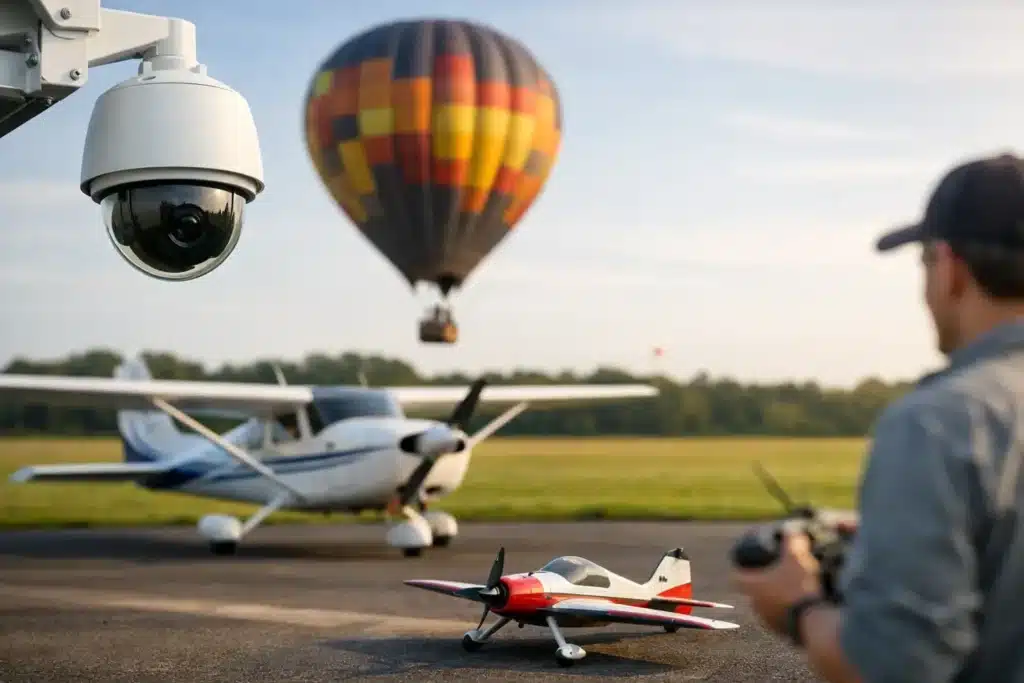
A camera overlooking a runway gate, balloon launch field, or RC flight line can answer critical questions after an incident. It can also create privacy, safety, and liability issues if it is pointed, operated, or retained without a clear policy. CCTV compliance for flying clubs, hot-air balloons and RC plane facilities is not simply about installing cameras. It is about building a documented surveillance program that supports safe operations without creating unnecessary exposure for members, guests, pilots, and neighboring properties.
For most aviation recreation facilities, there is no single federal rule that dictates every camera location or retention period. Compliance depends on the facility’s ownership, local and state privacy laws, lease conditions, insurance obligations, airport or landowner requirements, and the rules of any governing authority. A practical system begins with those requirements, not with a camera catalog.
Start With the Operational Risk, Not the Equipment
Flying clubs and model aircraft sites have a different risk profile from a conventional commercial property. Activity may be concentrated around a gate, fuel storage area, hangar, parking apron, launch field, flight line, or equipment shed. Operations can start before sunrise and continue after dark, while weather, prop wash, moving vehicles, and wide open terrain complicate camera performance.
The best surveillance design identifies what must be verified if something goes wrong. This may include unauthorized vehicle access, theft of aircraft parts or radios, damage to hangars, fuel handling concerns, restricted-area entry, vehicle movement near the launch area, or a dispute involving a member or visitor. Cameras should provide useful evidence for those events, rather than broad footage of people who have no connection to the incident.
A site survey should map entry and exit routes, boundaries, blind spots, power availability, network paths, lighting conditions, and the direction of nearby homes, public roads, or businesses. This is particularly important at balloon facilities, where the launch site may change with wind conditions, and at RC facilities, where the flight line and spectator area may sit close together.
Privacy Rules Shape CCTV Compliance for Flying Clubs
The central compliance question is simple: are you recording only what is reasonably necessary for a legitimate security or safety purpose? A camera aimed at a gate or hangar entrance is easier to justify than one continuously recording a neighboring backyard, public trail, changing area, or private meeting space.
Clubs should use visible notice at entrances and any other appropriate points where visitors may enter a monitored area. The notice should state that CCTV is in use and identify the organization responsible for the system. Depending on applicable local requirements, it may also need to explain how individuals can request information about the processing of their images.
Audio recording requires additional caution. In many jurisdictions, recording conversations is subject to stricter rules than recording video. Unless audio is essential, legally reviewed, and clearly disclosed, disabling it is usually the lower-risk decision. A security camera should not become an accidental conversation-recording system around a clubhouse patio, briefing area, or launch crew gathering.
Facilities should also establish rules for remote viewing. Board members, instructors, managers, and security personnel should not all receive unrestricted app access merely because it is convenient. Access should be assigned by role, protected with strong passwords and multi-factor authentication, and reviewed when staff, volunteers, or officers leave their position.
Keep Cameras Away From High-Expectation Privacy Areas
Never place CCTV cameras in restrooms, locker rooms, changing areas, or any location where a person reasonably expects privacy. Care is also needed around medical response areas and private administrative offices. If a camera is required near a sensitive area for access control, frame the entrance rather than the interior, and document why that coverage is needed.
Capture Evidence That Is Actually Usable
A wide view of an airfield may look impressive on a monitor but may not identify a vehicle, person, or event when footage is needed. Camera selection should follow the required outcome. An overview camera can monitor activity across a launch field, while a dedicated camera at a gate may be needed to identify a vehicle entering after hours.
For flight club locations, key coverage commonly includes the main gate, hangar doors, fuel storage, aircraft parking or tie-down areas, equipment storage, clubhouse entry, and parking areas. Balloon operators may prioritize trailer parking, propane storage where permitted, vehicle staging, launch preparation zones, and secure equipment areas. RC facilities often benefit from coverage of gates, parking, pilot stations, club storage, charging areas, and restricted maintenance zones.
Do not aim cameras directly into the flight path or place poles, cabinets, or wiring where they could create an operational hazard. Camera mounts must withstand wind, vibration, temperature changes, and outdoor exposure. Any work near an airport environment or controlled airspace should be coordinated with the landowner, airport management, and relevant authorities before installation. A camera system must support aviation operations, never interfere with them.
Night performance also deserves careful testing. Glare from vehicle headlights, low-angle sun, reflective aircraft surfaces, and floodlights can reduce image quality. The system should be tested during the actual conditions it is expected to record, not only during a daytime installation visit.
Retention, Access, and Evidence Handling
Keeping footage indefinitely is rarely a sensible compliance position. Long retention increases storage costs, expands the impact of a breach, and makes it harder to manage data requests. On the other hand, a very short retention period may erase footage before an incident is reported.
Set a retention period that reflects the site’s incident reporting timeline, insurer requirements, and applicable law. Many facilities choose a defined operational window and preserve relevant clips immediately when an accident, theft, complaint, or claim is reported. The right period depends on the facility and jurisdiction, so it should be approved by management and reviewed periodically rather than copied from another site.
A written procedure should identify who can export video, where exported clips are stored, and how releases are approved. When footage may be used for an insurance claim, law enforcement inquiry, disciplinary process, or legal matter, preserve the original recording and record who accessed or copied it. This basic chain of custody helps protect the credibility of the evidence.
Cybersecurity is part of CCTV compliance. Internet-connected recorders and cameras should be placed on a managed network, updated with current firmware, and protected from default credentials. Remote access should be limited to authorized users. If the facility uses a third-party monitoring provider or cloud storage platform, management should understand where footage is stored, who can access it, and how long it remains available.
Build a Policy Members Can Follow
A short, clear surveillance policy is more useful than a long document nobody reads. It should explain the purpose of CCTV, monitored areas, expected retention period, who controls access, how footage requests are handled, and the situations in which clips may be shared. Members should know that footage is not for casual review, social media posts, or settling personal disputes.
The policy should also cover contractors and event organizers. A weekend fly-in, balloon festival, open house, or training event can significantly increase visitor numbers and vehicle traffic. Temporary camera coverage may be appropriate, but notices, access controls, and footage handling rules still apply.
If the facility is located on public land, at a municipal airport, or within a shared industrial or recreational property, the operator should check its lease and site rules before making changes. Landowners may impose their own approval process, technical standards, insurance conditions, or restrictions on recording common areas.
Treat Compliance as an Ongoing Operating Control
A compliant installation can become noncompliant when a camera is moved, a new board member receives unrestricted access, passwords are shared, or retention settings are changed without review. Schedule routine checks of camera views, recording health, storage capacity, firmware, signage, and user permissions. Test footage retrieval before an incident occurs.
For facilities in Dubai, Abu Dhabi, or Sharjah, surveillance requirements may also involve local security authority standards and approval processes. ALNAJAH ALAWAL can assess site risks, design compliant CCTV coverage, manage approved installation requirements, and support long-term maintenance for facilities that need accountability from survey through commissioning.
The most effective system is rarely the one with the most cameras. It is the one that captures the right areas, respects the people using the site, and gives management dependable evidence when decisions need to be made.