

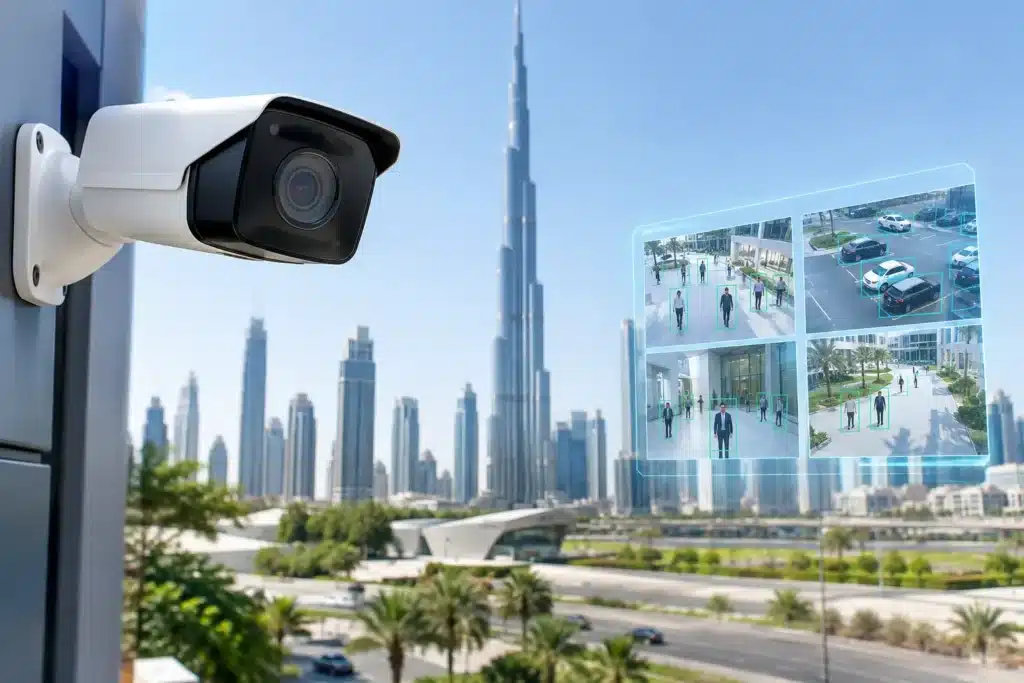
A warehouse gate left open after hours, a queue forming at a retail entrance, or a vehicle moving outside an approved yard boundary can create risk long before a security operator notices it on a monitor. AI video surveillance trends are changing that response model. Instead of relying only on people to watch recorded footage, businesses can use properly designed systems to identify events, prioritize alerts, and support faster operational decisions.
For UAE facilities, the opportunity is significant, but so is the responsibility. AI analytics must be selected around the site’s risk profile, camera placement, retention requirements, network capacity, and applicable authority approvals. Technology alone does not create a compliant security system. Correct design, installation, testing, and ongoing maintenance do.
AI Video Surveillance Trends Shaping Facility Security
The most meaningful change is the shift from passive recording to event-based monitoring. Traditional CCTV provides evidence after an incident. AI-enabled video can help teams identify a potential incident while there is still time to respond. This does not mean every camera needs advanced analytics. It means the highest-risk areas should be equipped to detect the events that matter most.
Event detection is replacing constant screen watching
Security teams cannot realistically observe every camera feed around the clock, particularly across warehouses, compounds, retail branches, labor accommodations, and multi-building developments. AI analytics can filter routine activity and flag defined exceptions, such as intrusion into a restricted area, loitering near a perimeter, object removal, crowding, or a vehicle traveling in the wrong direction.
The practical benefit is not simply more alerts. It is fewer irrelevant alerts when the system is properly configured. A camera overlooking a busy loading bay, for example, needs different rules during operating hours than it does overnight. Poor configuration can produce repeated notifications from authorized staff, forklifts, shadows, rain, or moving signage. Site-specific rules and testing are what turn analytics into an operational tool rather than another source of noise.
AI is becoming more useful at the perimeter
Perimeter protection remains a high-value use case for industrial sites, construction projects, storage yards, fuel facilities, and logistics operations. Modern analytics can distinguish people and vehicles from many non-critical movements, helping operators focus on potential intrusion rather than every motion event.
Detection performance still depends on physical conditions. Camera height, viewing angle, illumination, fence lines, weather exposure, and distance to the target all affect results. A system that works well on a clear daytime demonstration may perform differently at night or during dust, humidity, and heavy rain. Facilities should validate analytics on the actual site before depending on them for critical response procedures.
Search is becoming faster and more targeted
Investigating footage has traditionally required staff to scroll through hours of recordings. AI-assisted search can reduce that workload by allowing authorized users to look for attributes or event types, such as a person entering a defined zone, a truck passing a gate, or an object left in an area.
This is especially valuable for facility managers handling incident reviews, delivery disputes, access violations, and safety investigations. However, search results must be treated as an investigation aid, not as unquestionable evidence. Operators should verify the original video, confirm time synchronization, and maintain correct retention and export procedures.
Compliance Must Lead AI Video Surveillance Decisions
For regulated premises, the first question should not be, “Which AI feature is most advanced?” It should be, “Will this system meet the applicable security design and approval requirements?” In Dubai, Abu Dhabi, and Sharjah, CCTV projects may be subject to different authority requirements based on facility type, location, risk level, and project scope.
AI functions do not remove the need for compliant camera coverage, recording capacity, approved equipment where required, secure control room arrangements, or documented testing. A camera with advanced analytics is still ineffective if it does not capture the required entrance, cash handling area, perimeter, corridor, or vehicle access point at the required level of detail.
Privacy and data handling also require attention. Video systems collect information about employees, visitors, contractors, and customers. Organizations should define who can access live feeds and recordings, how long footage is retained, how footage is exported, and how user activity is logged. Role-based access is particularly important when multiple departments, security providers, or site managers use the same platform.
Facial recognition deserves additional caution. Its use may be appropriate only in tightly defined circumstances and subject to legal, policy, and authority considerations. It should not be added because it is available. A clear operational purpose, governance controls, accuracy testing, and lawful data handling must come first.
Video Analytics Is Moving Beyond Security
The strongest AI video surveillance trends are not limited to intrusion detection. Businesses are also using video data to improve safety, service, and asset protection. The value increases when analytics are connected to a defined workflow rather than left as a feature on a specification sheet.
In a logistics yard, cameras can support gate activity monitoring, vehicle movement review, loading-zone oversight, and unauthorized access detection. In retail, analytics can help identify queue buildup, occupancy concerns, after-hours movement, and suspicious activity around high-value displays. In industrial environments, designated zones can be monitored for unsafe entry or unusual movement near critical equipment.
These applications require a disciplined approach. Video analytics can indicate that an event needs attention, but they do not replace trained supervisors, site safety procedures, or access control. If an alert shows a person entering a restricted maintenance area, the response process must already define who verifies the event, who contacts the person, and how the incident is documented.
Edge AI Is Reducing Network and Storage Pressure
Another important trend is the use of edge analytics, where selected processing occurs inside the camera rather than sending every video stream to a central server for analysis. This can reduce bandwidth demands and allow faster event notifications, particularly across larger sites with many cameras.
It is not automatically the right choice for every project. Edge-based systems can simplify deployment, but camera processing capacity, firmware management, cybersecurity, and future scalability need to be considered. Centralized analytics may suit organizations that need consistent rules across many locations or want to upgrade analytics without replacing cameras.
The right architecture depends on the number of cameras, site connectivity, control room requirements, retention targets, and integration plans. A single warehouse may have very different needs from a retail chain, residential development, or government facility.
Cybersecurity Is Now Part of Physical Security
As CCTV systems become more connected, they must be protected like any other business network asset. Default passwords, outdated firmware, exposed remote access, and unmanaged user accounts can create serious weaknesses. AI cameras often have greater processing power and more network functionality, making correct configuration even more important.
A professional project should include secure password policies, segmented network design where appropriate, controlled remote access, user permission management, firmware planning, and documented handover. The organization should also know who is responsible for future updates and what happens if a recorder, switch, camera, or storage drive fails.
Cybersecurity is not a separate IT issue that can be addressed after installation. It affects system availability, evidence integrity, and the ability of security teams to respond when needed.
How to Choose the Right AI Capabilities
Start with risks and outcomes, not product names. A facility with repeated perimeter incidents may need person and vehicle classification at key fence lines. A distribution center may prioritize truck movement, loading bay visibility, and access event verification. A retail operator may place more value on entrance coverage, queue observation, and loss-prevention investigation.
Before approving a design, establish the answers to several practical questions: What event should trigger an alert? Who receives it? What happens next? What level of false alerts is acceptable? Is lighting sufficient for night detection? How will the system be tested after installation? And does the design meet the applicable approval requirements?
A site survey is essential because analytics are only as reliable as the video scene they receive. Camera selection, lens choice, mounting position, lighting, and coverage overlap should be determined before installation, not corrected after a failed test. For compliance-driven projects, this planning also helps avoid redesigns, delayed approvals, and unnecessary equipment replacement.
ALNAJAH ALAWAL approaches CCTV projects as an end-to-end security and compliance requirement, from site survey and system design through installation, testing, approval support, and maintenance. That approach matters when AI analytics must work reliably within a larger, authority-compliant surveillance system.
Before investing in AI features, walk the site with the people who manage security, operations, IT, and compliance. The most effective system is not the one with the longest feature list. It is the one that detects the right events, supports a clear response, protects recorded evidence, and stays approved right the first time.