

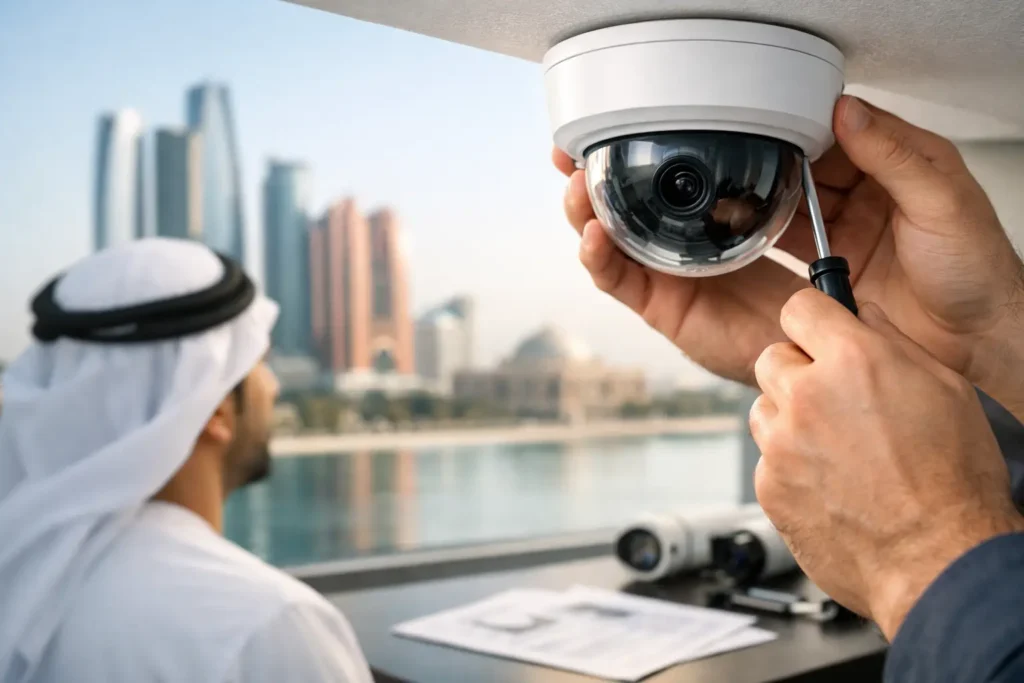
A CCTV system can be technically functional and still fail Abu Dhabi MCC approval. The difference is usually not the camera itself. It is the gap between a standard installation and a system designed, documented, installed, and presented for inspection in line with the project’s applicable authority requirements.
For warehouse operators, developers, retail businesses, industrial facilities, and property managers, that gap can delay handover, opening dates, tenancy, or site operations. Approval needs to be treated as part of the project scope from the first site survey, not as paperwork to chase after installation.
What Abu Dhabi MCC Approval Means for CCTV Projects
Abu Dhabi MCC approval is commonly associated with security surveillance compliance requirements for premises in Abu Dhabi. The approval process is intended to confirm that the installed CCTV system provides the required coverage, recording capability, image quality, equipment configuration, and supporting documentation for the specific site.
The exact scope depends on the facility. A retail shop, labor accommodation, logistics yard, villa community, fuel storage area, clinic, and commercial tower do not carry the same risk profile or surveillance needs. Camera quantities, locations, recording retention, monitoring arrangements, and access-control expectations may therefore differ.
This is why copying a previous project’s camera layout is risky. A layout that worked for one building may leave blind spots at another site, especially around entrances, loading bays, cash areas, corridors, perimeter gates, parking zones, and critical plant rooms. The approval path begins with a site-specific design.
Why CCTV Projects Fail at the Approval Stage
Most approval delays are preventable. They happen when compliance is separated from technical delivery, or when equipment is supplied before the contractor has confirmed what the authority and project consultant expect.
A common issue is inadequate camera coverage. Cameras may be installed in the right general area but positioned too high, pointed at the wrong angle, affected by glare, or unable to capture usable identification footage at critical points. Wide-angle coverage is valuable for situational awareness, but it does not always provide the level of detail needed at an entrance, cashier, gate, or vehicle access point.
Recording capacity is another frequent concern. A system must be sized around the required retention period, camera resolution, frame rate, compression settings, and continuous or motion-based recording mode. Installing a recorder with insufficient storage can create a compliance failure even when every camera is operational.
Documentation also matters. Incomplete drawings, incorrect camera schedules, missing serial numbers, inconsistent labeling, and unclear network diagrams can slow the inspection process. The authority must be able to verify what has been installed and how the system operates. If the documentation does not match the site, the project team may be asked to correct and resubmit it.
Finally, installation quality affects approval. Unprotected cabling, poorly mounted cameras, inaccessible racks, unlabeled equipment, weak power backup planning, and untidy containment all signal that the system may not be dependable over time. CCTV is not a decoration on the ceiling. It is an operational security system that must remain available when an incident occurs.
The Right Process for Abu Dhabi MCC Approval
The most reliable approach is to manage the approval process as a controlled sequence. Early coordination prevents expensive changes after ceilings are closed, finishes are completed, or operations have started.
Start With a Proper Site Survey
A meaningful survey looks beyond room dimensions. It reviews entry and exit routes, public-facing areas, asset locations, perimeter conditions, lighting levels, vehicle movement, existing infrastructure, network availability, and the location of the security control room or communications rack.
At this stage, the contractor should identify physical constraints. For example, a camera facing a glass entrance may need a different positioning strategy because of sunlight and nighttime reflections. An outdoor loading yard may require weather-rated equipment, suitable illumination, and coverage that accounts for truck heights and turning movements.
Build the Design Around the Site Risk
The CCTV design should show exactly what each camera is intended to achieve. Some cameras are selected for overview coverage, while others are assigned to identification points or operational monitoring. Camera type, lens selection, mounting height, field of view, and lighting conditions all affect performance.
The design should also account for the supporting system: network switches, structured cabling, recorder or server capacity, hard drives, display monitors, user access, UPS backup, and secure equipment housing. A camera system is only as reliable as the infrastructure behind it.
Where a project includes access control, intrusion detection, intercoms, gate barriers, ANPR, or other ELV systems, coordination is essential. Integrating systems can improve operational control, but it also introduces dependencies that must be designed and tested carefully.
Submit Accurate Drawings and Documents
The submission package must reflect the proposed system clearly. Depending on the project requirements, this can include camera layout drawings, equipment schedules, technical data sheets, storage calculations, network architecture, method statements, and site details.
Accuracy is more valuable than volume. A large document package with mismatched information creates questions and delays. Drawings should identify cameras consistently, and the final installation should follow those identifiers so inspectors, facility teams, and maintenance technicians can trace each device quickly.
Install to the Approved Design
Once the design is accepted, field execution must stay aligned with it. Last-minute camera changes should not be made casually because a small position adjustment can alter coverage, privacy considerations, cable routes, and documentation.
During installation, equipment should be securely mounted, cabling should be protected and labeled, and rack equipment should be organized for maintenance. Camera views should be verified on live monitors rather than assumed from a drawing. The installer should check daytime and nighttime performance where relevant, including image clarity at doors, gates, and other high-priority locations.
Test Before the Inspection
Pre-inspection testing is where a professional contractor protects the client’s schedule. Every camera should be checked for live view, recording, playback, date and time accuracy, image quality, storage health, and correct labeling. Remote viewing, user permissions, alarm integration, and backup power functions should also be tested when included in the scope.
The project team should then compare the installed system against the approved layout and documentation. This catches common issues such as blocked camera views, reversed labels, missing cameras, weak night images, recorder capacity errors, or unrecorded channels before they become inspection observations.
What Clients Should Expect From Their CCTV Contractor
Approval-driven projects need more than an equipment supplier. They need a contractor that can take responsibility for the process from survey through commissioning and handover.
Before appointing a contractor, ask whether they will conduct the survey, prepare compliance-oriented drawings, supply suitable equipment, manage installation, coordinate documentation, support inspection, and provide maintenance after handover. If these responsibilities are split across multiple parties, accountability can become unclear when an approval issue appears.
ALNAJAH ALAWAL SECURITY SYSTEMS & EQUIPMENT TRADING L.L.C. manages CCTV compliance projects as an end-to-end scope, from system design and installation through testing, commissioning, approval support, and ongoing maintenance. This reduces handover risk and gives clients one accountable point of contact.
Price should be assessed in the same way. The lowest quotation may omit storage sizing, UPS backup, testing, documentation, authority coordination, or post-installation support. Those exclusions often become costly variations later. A clear proposal should define the equipment, coverage intent, approval scope, assumptions, timeline, and maintenance obligations.
Abu Dhabi MCC Approval Questions
How long does approval take?
Timing depends on the project type, readiness of drawings and documents, authority review cycles, site access, and whether the installation passes inspection without observations. A well-prepared project moves faster because there is less rework and fewer document corrections.
Can an existing CCTV system be approved?
It depends on its condition and configuration. Existing systems can sometimes be upgraded with additional cameras, improved recording capacity, new cabling, corrected coverage, or updated documentation. A site survey is the practical first step because it identifies whether targeted modifications are enough or whether a larger replacement is more economical.
Does approval guarantee the system will remain compliant forever?
No. Changes to the premises can affect compliance. Renovations, added partitions, altered entrances, changes in business activity, damaged cameras, failed hard drives, and expired maintenance can all reduce system performance. Routine preventive maintenance keeps the installed system operational and helps protect the investment made in approval.
A compliant CCTV project should leave your team with more than an approval record. It should provide dependable coverage, clear incident evidence, organized handover documents, and a system that facility staff can operate confidently. Start with the right survey, build the system around the site, and get it approved right the first time.