

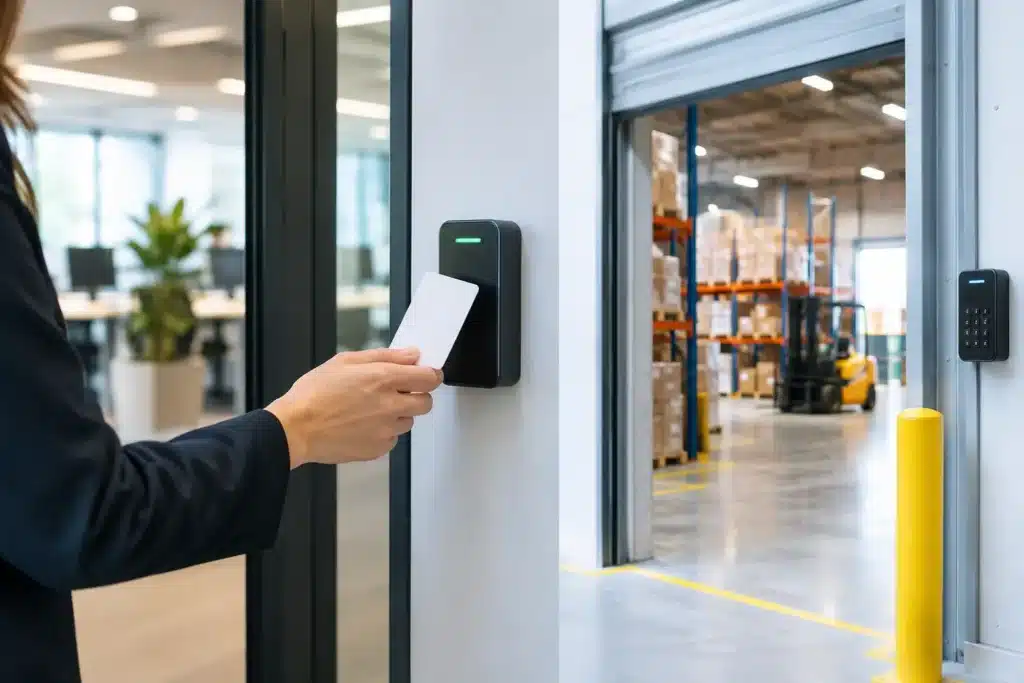
A lost key to an executive office is inconvenient. A lost key to a warehouse, loading bay, server room, or controlled inventory area can create a serious operational and security gap. Door access control for offices & warehouses gives facility managers a clear answer to three essential questions: who entered, where did they go, and when did it happen?
For commercial and industrial sites, access control is not simply a replacement for mechanical locks. It is an operational control that protects employees, visitors, stock, records, equipment, and restricted processes. When designed correctly, it also supports faster investigations, cleaner handovers between shifts, and stronger accountability across the facility.
Why Offices and Warehouses Need Different Access Strategies
Offices and warehouses may operate under one company, but their risks are rarely the same. An office environment often needs controlled access to main entrances, executive areas, HR files, finance departments, IT rooms, and meeting spaces. The priority is protecting people, confidential information, and business continuity without making daily access difficult for employees and approved visitors.
Warehouses have a broader physical risk profile. There may be high-value stock, dispatch zones, loading docks, hazardous materials, cold storage, maintenance rooms, fuel areas, and third-party drivers moving through the property. Shift changes can involve dozens of employees entering within minutes. A system that works well for a small office reception may fail at a busy logistics gate.
The right design reflects how the site actually operates. It should account for entry volumes, door type, staff roles, shift patterns, emergency routes, delivery schedules, and the areas that require restricted or escorted access. One credential policy for every door is easy to administer, but it can leave sensitive areas unnecessarily exposed.
Door Access Control for Offices & Warehouses: What It Should Deliver
A properly planned access control system should make authorized movement simple and unauthorized movement difficult. At the minimum, it should provide controlled entry, activity records, permission-based access, and the ability to remove access immediately when an employee, contractor, or tenant leaves.
Credentials can include proximity cards, key fobs, mobile credentials, PIN codes, or biometric readers. Each option has a place. Cards and fobs are familiar, affordable, and fast at high-traffic entrances. Mobile credentials reduce the need to issue physical cards, although they depend on staff device policies and reliable enrollment procedures. PINs work well as a secondary verification method but should not be used alone for high-risk doors because codes can be shared. Biometric systems may provide stronger identity assurance, yet they require careful privacy, consent, hygiene, and operational planning.
The controller and software matter as much as the reader on the wall. They determine whether the organization can assign door schedules, set role-based permissions, review events, issue temporary visitor access, and respond quickly to incidents. A door that opens electronically without reliable reporting and administration is only part of an access control solution.
Role-Based Access Reduces Everyday Risk
Access should follow job function, not personal convenience. Warehouse pickers may need access to staff entrances, lockers, and assigned storage zones during their shifts. Supervisors may need broader access, while finance staff may only need office areas. Contractors should receive time-limited credentials that expire automatically after their approved work period.
This approach limits the impact of a lost credential and reduces the chance that former employees or temporary workers retain access. It also makes audits more manageable because permissions are based on defined roles rather than a long list of individual exceptions.
Access Events Need Context
A record showing that a door opened at 2:14 a.m. is useful. It becomes far more useful when it can be reviewed alongside CCTV footage, alarm events, intercom calls, or visitor records. Integration helps security teams verify whether a door was forced, held open, accessed by an approved employee, or used outside normal working hours.
For warehouses, door-held-open alerts are particularly valuable. Loading and dispatch activity can require doors to remain open for legitimate reasons, but the system should distinguish approved operational periods from unattended security exposures. The correct setup uses schedules, alarms, and escalation procedures that match real workflows rather than generating alerts staff will ignore.
Start With a Door-by-Door Risk Review
The best installations begin before equipment is selected. A site survey should identify every access point, the users who need it, the risk level behind it, and what happens during a power failure or emergency evacuation.
Main entrances, office suites, server rooms, stock cages, warehouses, maintenance rooms, loading bays, roof access doors, and parking barriers may all need different hardware and rules. A glass office door may need an electromagnetic lock or electric strike. A heavy industrial gate may need a purpose-built controller, weather-rated readers, and safety devices. Fire-rated doors require special care so that access hardware does not compromise life-safety performance.
The survey should also check cable routes, network availability, power capacity, emergency release points, door condition, and the existing fire alarm arrangement. Retrofitting a reader onto a poorly aligned door or unsuitable lock creates repeat maintenance issues and weakens user confidence in the system.
Plan for Safety, Compliance, and Continuity
Access control must never prevent safe exit. Exit routes, emergency break-glass units, fire alarm interfaces, and fail-safe or fail-secure lock behavior must be selected according to the door’s purpose and applicable authority requirements. This is where a generic installation can create costly problems.
In the UAE, requirements can vary by emirate, building type, and the wider scope of the security project. Where access control is connected with CCTV, intrusion alarms, visitor management, or regulated premises, design coordination and approval planning should happen early. A compliant security design is easier to install, test, document, and hand over than a system modified after an inspection concern.
Business continuity also deserves attention. Ask what happens if network communication is interrupted, a controller loses power, or the management software is temporarily unavailable. Depending on the system architecture, doors can continue operating from local controller permissions while events are stored for later synchronization. Battery backup and appropriate lock selection help maintain security without trapping authorized occupants.
Avoid the Most Common Implementation Mistakes
The first mistake is treating every door as identical. A public lobby entrance, a controlled stock room, and an emergency exit have different security and life-safety requirements. The second is issuing broad access rights to avoid administration. That may save time initially, but it increases exposure and makes investigations harder.
Another common failure is neglecting the credential lifecycle. Access must be removed promptly when employees resign, change departments, or complete temporary assignments. Visitor and contractor credentials should expire automatically. A regular review of active users, door groups, and exception permissions keeps the system aligned with current operations.
Finally, do not overlook training. Reception staff, security guards, warehouse supervisors, and system administrators need clear procedures for lost cards, rejected access, forced-door alarms, visitor enrollment, and emergency events. Technology supports accountability only when people know how to use it consistently.
Choose a System That Can Grow With the Site
A small office may begin with two controlled doors and later add meeting rooms, parking access, or a second location. A warehouse may add new storage zones, tenant areas, temperature-controlled rooms, or additional loading gates. Selecting a scalable platform avoids replacing the core system when operations expand.
Scalability does not mean buying more capacity than the business will ever use. It means choosing compatible controllers, software, and licensing that can support a realistic growth plan. The right balance depends on the number of doors, the need for multi-site management, integration requirements, and how much control the organization needs at a central level.
ALNAJAH ALAWAL SECURITY SYSTEMS & EQUIPMENT TRADING L.L.C. approaches access control as part of the site’s full security and ELV environment. From survey and design through installation, testing, commissioning, authority coordination where required, and maintenance, the objective is simple: install a system that works correctly on day one and remains manageable after handover.
A well-designed access control system should not slow down legitimate work. It should give the right people the right access at the right time, while giving management a dependable record when questions arise. Start with the doors that carry the greatest operational risk, define clear access roles, and build from there with safety and compliance already built into the plan.