

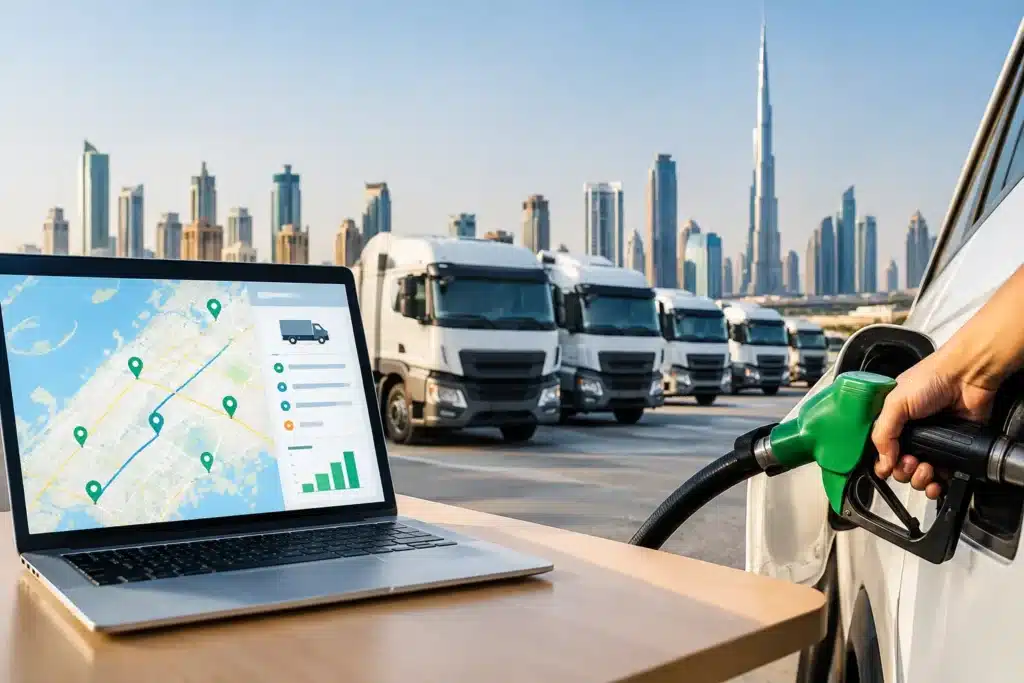
Fuel is one of the largest controllable expenses in transport, logistics, construction, and service fleets. Understanding how GPS tracking reduces fuel costs for Dubai fleets: real savings examples starts with a simple fact: most fuel waste is not caused by one major failure. It is lost through unnecessary idling, unplanned detours, harsh driving, unauthorized trips, and fuel transactions that cannot be verified.
For fleet managers, the objective is not simply to see vehicles on a map. It is to turn vehicle movement, driver behavior, and fuel data into accountable operating decisions. A correctly installed GPS tracking system provides the evidence required to identify waste, enforce policy, and measure whether corrective action is working.
How GPS Tracking Reduces Fuel Costs for Dubai Fleets
GPS tracking reduces fuel costs by connecting each vehicle’s location, route, speed, engine status, and operating time to a clear reporting process. Instead of relying on driver estimates or fuel receipts alone, fleet managers can compare fuel consumption with distance traveled, route conditions, delivery schedules, and engine hours.
This matters in Dubai, where traffic congestion, high ambient temperatures, long engine-on periods, and frequent delivery schedules can push fuel consumption higher than expected. A vehicle may appear productive because it is active all day, while its reports show that a significant portion of that time is spent stationary with the engine running.
The system does not reduce fuel use by itself. Savings come from the management actions taken after reliable data identifies the cause. That is why installation quality, device configuration, driver identification, reporting rules, and ongoing support all affect the result.
Idle-Time Control Produces Immediate Savings
Excessive idling is one of the fastest sources of avoidable fuel spend. Drivers may leave engines running while waiting at customer sites, during loading, while taking breaks, or while parked between jobs. Air conditioning requirements can make this issue more complex in the UAE, but it should still be measured rather than accepted without review.
GPS tracking can create engine-on, vehicle-stationary alerts after a defined period, such as 10 or 15 minutes. Managers can then distinguish legitimate idling, such as waiting for site access or maintaining temperature-sensitive cargo conditions, from avoidable behavior.
Consider a 25-vehicle delivery fleet where each vehicle idles an unnecessary 20 minutes per day. If each vehicle consumes approximately 2 liters of fuel per hour at idle, the fleet wastes around 16.7 liters daily. Across 26 working days, that is roughly 434 liters per month before considering the added engine wear. Reducing that idle time by half creates a measurable monthly fuel saving without reducing delivery capacity.
Route Compliance Limits Detours and Unauthorized Use
A planned route is not always the shortest route, but it should be the route that supports the job. GPS route history shows whether vehicles follow approved delivery zones, visit unauthorized locations, make repeated diversions, or take longer paths without an operational reason.
Geofences are especially useful for warehouses, customer premises, labor accommodations, construction sites, fuel stations, and restricted areas. Managers can receive records of arrival time, departure time, route deviation, and unplanned stops. This reduces the need for manual follow-up and creates a factual basis for driver discussions.
For example, a field service fleet may travel an extra 12 kilometers per vehicle each day because technicians return to the office between nearby jobs or choose inconsistent routes. For 15 vans averaging 10 kilometers per liter, that adds 18 liters of fuel per day. Better dispatch planning and route adherence can remove a large portion of this waste while also increasing the number of completed calls.
Driver Behavior Has a Direct Fuel Impact
Hard acceleration, high-speed driving, harsh braking, and prolonged high RPM operation consume more fuel than controlled driving. They also increase the likelihood of collisions, tire wear, brake replacement, and unplanned maintenance. Fuel savings and road safety are therefore closely connected.
GPS tracking platforms can report speeding events, rapid acceleration, harsh braking, and excessive engine speed. The most effective approach is not to use this data only for penalties. Fleet managers should establish clear thresholds, review trends by driver and vehicle type, and provide practical coaching.
A courier van that frequently exceeds speed limits may save a few minutes on an individual trip but consume more fuel and create greater operational risk. When drivers understand that performance is measured by safe, efficient completion of assigned work, not simply by speed, behavior becomes easier to manage.
Real Fuel Savings Examples in Fleet Operations
The savings available depend on vehicle type, operating hours, traffic exposure, load weight, route design, and existing controls. The following examples are practical operating scenarios, not guaranteed savings figures. They show where GPS data commonly exposes preventable fuel loss.
Example: A Logistics Fleet Reduces Unplanned Stops
A 40-truck logistics operation notices higher fuel consumption on several urban routes despite similar delivery volumes. GPS reports reveal repeated 15- to 25-minute stops outside approved customer locations. Some are legitimate delays, but others are personal stops that are not recorded on delivery schedules.
The fleet manager sets approved stop locations, introduces route exception reports, and reviews patterns with dispatch supervisors. If the changes eliminate only 10 minutes of unnecessary engine-on time per truck per day, the annual reduction can be significant across 40 vehicles. The bigger benefit is operational control: dispatch can identify real delays early and update customers with accurate arrival information.
Example: A Construction Fleet Identifies Fuel Use Outside Working Hours
Construction vehicles and generators often work across changing sites, making manual monitoring difficult. A GPS and fuel-monitoring setup can show when equipment enters or exits a site, how long engines operate, and whether fuel levels fall outside approved working periods.
Imagine a contractor operating 12 pickups and support vehicles. Reports show several vehicles moving during evenings and weekends without assigned work orders. By applying geofence schedules and requiring authorization for out-of-hours movement, the contractor can reduce unauthorized mileage and investigate exceptions immediately. This protects fuel budgets and strengthens asset accountability.
Example: A Service Fleet Improves Dispatch Efficiency
A maintenance company with 20 technicians receives urgent calls across multiple zones. Without live vehicle visibility, dispatchers often assign jobs based on assumption rather than the nearest available technician. The result is unnecessary travel, late arrivals, and inconsistent workloads.
With real-time GPS visibility, dispatch can assign the closest qualified technician and avoid sending two vehicles into the same area unnecessarily. Even a modest reduction of 8 kilometers per vehicle per working day can reduce monthly mileage by more than 4,000 kilometers across the fleet. The actual fuel saving depends on vehicle efficiency, but the reduction in travel time and vehicle wear is immediate.
GPS Tracking Works Best With Fuel Monitoring
GPS data explains where and how a vehicle operated. Fuel monitoring adds another layer by showing fuel level changes, consumption patterns, refueling events, and potential fuel loss. For fleets with high fuel spend, combining both systems produces stronger control than either system alone.
A sudden fuel-level drop may indicate theft, but it can also result from sensor calibration issues, a vehicle parked on an incline, or normal operating conditions. Alerts should trigger verification, not assumptions. Proper sensor installation, calibration, and reporting thresholds are essential to avoid false alarms.
Fuel transaction records can also be matched against vehicle location and time. If a fuel card receipt shows a purchase while the assigned vehicle was elsewhere, the discrepancy can be investigated quickly. This reduces the opportunity for misuse and improves confidence in fuel reconciliation.
Turning Tracking Data Into Savings
Many fleets install tracking devices but fail to establish a management routine. The result is a map view with limited financial value. To control fuel costs, reports should be reviewed consistently and linked to operational responsibility.
Start with a baseline. Measure fuel use, kilometers traveled, idle time, average trip duration, speeding events, and after-hours movement for at least several weeks. Then set realistic targets by vehicle class. A refrigerated truck, heavy-duty vehicle, and small delivery van should not be judged by the same consumption standard.
Assign responsibility for reviewing exceptions. Dispatch should address route deviations, supervisors should validate job-related idle time, and fleet management should review recurring driver behavior or vehicle-specific consumption issues. When rules are clear and exceptions are verified fairly, drivers are more likely to accept the system as an operational control rather than surveillance for its own sake.
ALNAJAH ALAWAL supports fleet operators with GPS vehicle tracking and fuel management solutions designed around practical reporting, installation quality, and long-term operational accountability. The right configuration should reflect the fleet’s vehicle types, operating zones, work schedules, and reporting requirements.
Fuel savings become sustainable when every kilometer, engine hour, and refueling event has a clear business purpose. Start by measuring the waste that is currently invisible, then apply controls that your drivers, dispatchers, and managers can follow every day.