

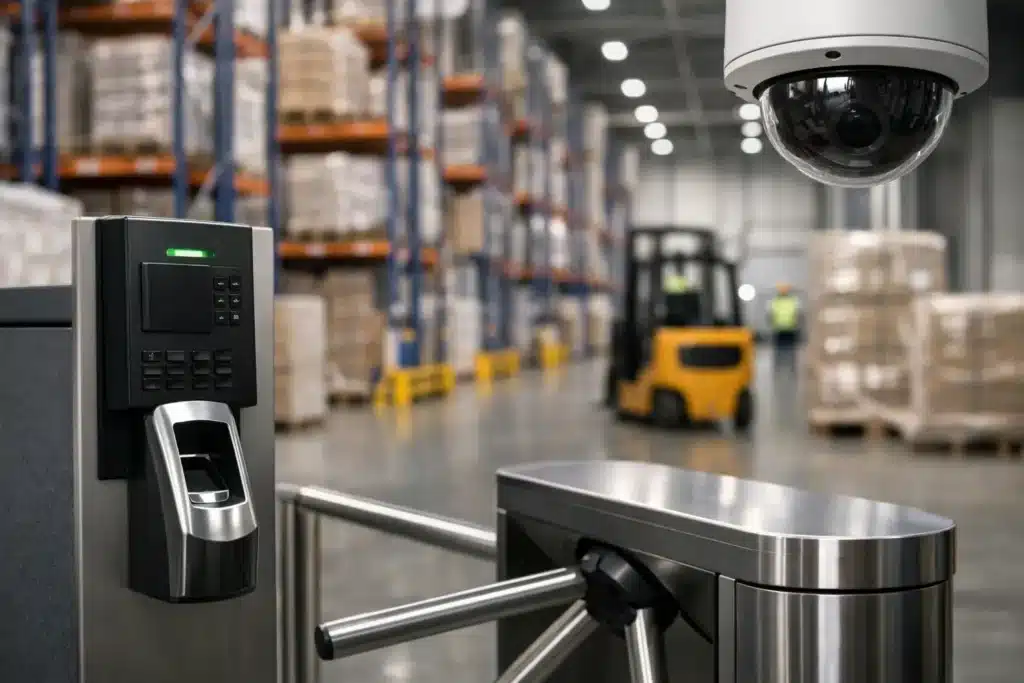
A warehouse security failure rarely starts with a broken door. It starts when a former employee’s card still works, a delivery driver walks past the reception desk, or a contractor reaches a restricted storage zone without an audit trail. The best warehouse access control systems prevent these gaps while keeping goods, people, and vehicle movements moving on schedule.
For warehouse operators, the right system is not simply an electronic lock at the main entrance. It is a controlled access plan for staff doors, loading bays, inventory cages, server rooms, fuel areas, offices, and high-value storage. It must also fit the site’s operating hours, workforce size, visitor traffic, safety procedures, and compliance obligations.
What Makes an Access Control System Right for a Warehouse?
Warehouses are demanding environments. Dust, heat, shift changes, forklifts, temporary labor, frequent deliveries, and multiple points of entry can expose weaknesses in basic door security. A suitable access control system must be reliable in industrial conditions and simple for supervisors to manage during busy operations.
The strongest systems allow management to decide exactly who can enter each area, at what time, and for how long. A picker may need access to general inventory during an assigned shift but not to the IT room or controlled goods cage. A maintenance contractor may require temporary access to a plant room, while a driver should be limited to a designated entry point and loading area.
Every access event should be recorded. When an incident, stock discrepancy, or safety question arises, managers need clear evidence of who entered a door, when it happened, and whether access was granted or denied. This accountability is one of the main reasons warehouses replace mechanical keys with managed electronic access.
The Best Warehouse Access Control Systems by Use Case
There is no single system that suits every warehouse. The right choice depends on the risk level of each door, the number of users, and whether the facility needs integration with cameras, alarms, attendance, visitor management, or vehicle barriers.
Card and Fob Access for Daily Staff Entry
Proximity cards and key fobs remain a practical choice for staff entrances, office doors, break rooms, and standard internal access points. They are quick to issue, easy to deactivate, and familiar to most employees. A lost card can be canceled immediately without changing locks or collecting keys from every user.
For a warehouse with a stable workforce and many doors, card access provides a cost-effective foundation. The trade-off is that cards can be shared, lost, or used by someone other than the assigned employee. This risk can be reduced through anti-passback settings, camera coverage at key doors, and regular credential reviews.
Mobile Access for Supervisors and Flexible Teams
Mobile credentials allow authorized users to open doors using a managed smartphone application. This can work well for warehouse managers, facilities teams, and approved contractors who move between multiple locations. Credentials can be issued remotely and withdrawn without a physical handover.
Mobile access is useful when an operator manages several facilities or needs rapid access changes outside normal office hours. However, it should not be selected solely for convenience. The system needs a clear policy for lost phones, device replacement, user verification, and emergency access if a phone battery fails.
Biometric Access for High-Value or Restricted Areas
Biometric readers use a fingerprint, facial template, or another personal identifier to verify the user. They are best suited to high-risk zones such as pharmaceutical stores, bonded goods areas, cash offices, data rooms, sensitive inventory cages, and restricted production sections.
Biometrics provide stronger confirmation that the credential holder is physically present. They can reduce card sharing and improve accountability. The trade-off is that biometric deployment requires careful attention to privacy, staff communication, enrollment quality, reader placement, and contingency procedures. In dusty, wet, or high-glove-use work areas, facial recognition or a combined card-and-biometric method may perform better than fingerprint-only access.
PIN and Keypad Access for Low-Traffic Controlled Doors
PIN pads can be effective for small storage rooms, electrical rooms, or shared staff areas. They are often installed alongside a card reader, giving the site two-factor access for more sensitive spaces.
A keypad alone is rarely the best answer for a busy warehouse entrance. Codes can be shared and are difficult to trace to a specific individual unless each user has a unique PIN. If PINs are used, they should be unique, changed when staff leave, and never displayed near the door.
Integrated Access Control and CCTV
For most logistics and industrial sites, the most effective approach is access control integrated with CCTV. When a door event occurs, the security team can review the related camera footage rather than relying only on a text log. This helps verify tailgating, forced-door events, propped doors, delivery activity, and credential misuse.
Integration also improves incident response. If a restricted door is opened outside approved hours, the system can notify designated personnel, record the event, and present visual evidence for investigation. For regulated projects in Dubai, Abu Dhabi, or Sharjah, coordination between access control, CCTV design, network infrastructure, and authority requirements helps avoid rework during the approval process.
Design the System Around Warehouse Movement
A warehouse access control project should begin with a site survey, not a product catalog. The goal is to understand how people and goods actually move through the property.
Start by mapping every entry and exit: pedestrian gates, main staff doors, emergency exits, loading dock personnel doors, mezzanine access, roof access, administrative offices, inventory cages, and technical rooms. Then classify each point by risk. A public-facing reception entrance needs a different level of control from a high-value storage cage or a door leading to a loading bay.
Emergency exits require particular care. They must support life safety and local fire requirements while preventing misuse. Access control should monitor these doors and report when they are opened or held open, but egress must remain safe during an emergency. An experienced installer coordinates door hardware, fire alarm interfaces, door schedules, and testing so security does not compromise evacuation.
Vehicle access also needs a separate plan. Barrier gates, license plate recognition, intercoms, visitor credentials, and delivery scheduling can control who enters the yard. For fleet-intensive operations, access events can be aligned with GPS vehicle tracking and dispatch records to create a clearer operational picture.
Questions to Ask Before Selecting a System
Before approving a warehouse access control system, decision-makers should establish the operational requirements behind the specification. Four questions usually clarify the scope:
- How many users, doors, shifts, and sites must the system support now and over the next three to five years?
- Which zones require standard access, restricted access, or two-factor verification?
- What evidence is needed after an incident, and which cameras or alarms should be linked to door events?
- Who will add users, remove credentials, review reports, and respond to alerts after installation?
These questions prevent a common mistake: purchasing capable hardware without assigning responsibility for daily administration. Security is weakened when terminated employees remain active, temporary cards are not recovered, or door alarms are ignored because nobody owns the response process.
Installation Details That Determine Performance
Even high-quality equipment will underperform if doors, cabling, network connections, and power backup are poorly designed. Warehouse doors may be exposed to vibration, heavy traffic, weather, or misuse. Reader locations need protection from forklifts and loading activity. Cable routes need to be secure and maintainable. Controllers should be housed in protected locations with appropriate backup power and network resilience.
Door hardware selection matters as much as the reader. Magnetic locks, electric strikes, electric locks, turnstiles, and barrier gates each suit different applications. The hardware must match the door type, fire rating, access direction, and emergency release requirements. A site survey identifies these constraints before installation begins.
The system should also be commissioned properly. This includes testing every credential type, access schedule, forced-door alarm, door-held-open event, emergency release, CCTV association, report function, and administrator account. Staff training should cover more than opening a door. Supervisors need to know how to issue temporary access, deactivate departing employees, investigate exceptions, and escalate faults.
Compliance and Long-Term Support Matter
A warehouse security project can be delayed when security designs, equipment specifications, or installation methods do not align with applicable authority requirements. Compliance planning is especially relevant where CCTV coverage, monitoring, or site approvals are part of the project scope. Treat access control as part of the wider security and ELV design, not as an isolated device installation.
ALNAJAH ALAWAL SECURITY SYSTEMS & EQUIPMENT TRADING L.L.C. manages warehouse security projects from survey and design through installation, testing, commissioning, training, and ongoing maintenance. This approach gives operators a clear point of accountability when access control must work alongside CCTV, intercoms, gate barriers, structured cabling, and fleet-related security technology.
The best result is a system that is easy for authorized staff to use and difficult for unauthorized people to bypass. Start with the doors and zones that create the greatest operational risk, define who owns daily access administration, and build outward as the warehouse grows. Stay compliant. Stay protected.