

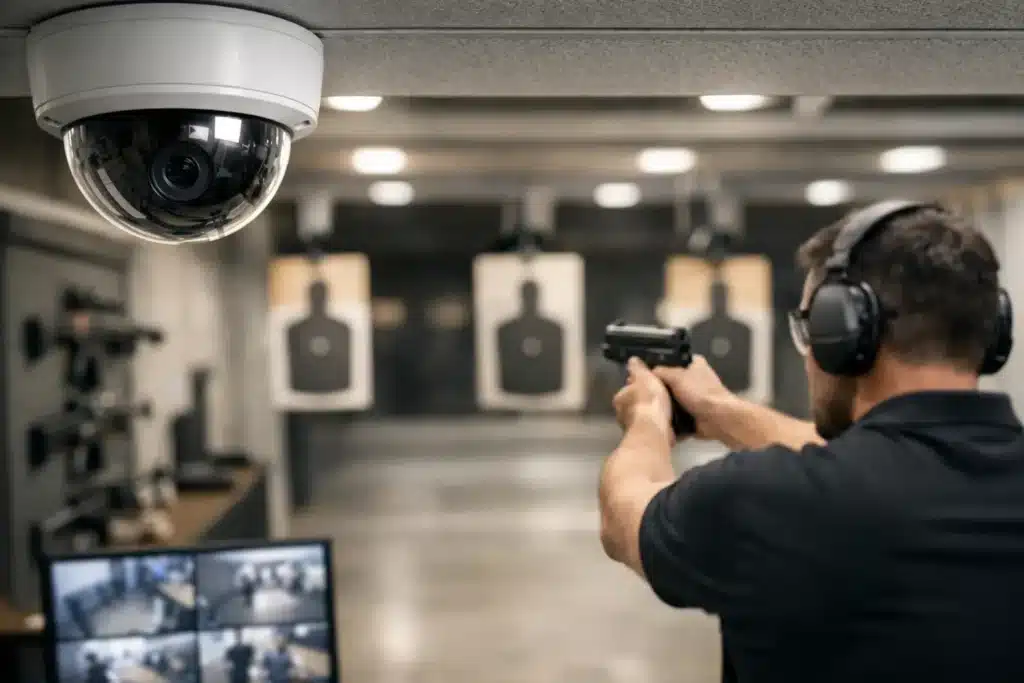
A shooting club cannot treat CCTV as a standard building-security item. The SIRA CCTV requirements for shooting clubs in Dubai must support a controlled environment where visitor identity, staff access, weapon handling areas, entry and exit activity, and incident investigation all require clear, reliable records. A system that is installed without the right design, documentation, or authority coordination can delay opening, fail inspection, or create serious operational exposure after an incident.
For operators, developers, and facility managers, the right approach is to design surveillance around the club’s actual movement, risk profile, and operating procedures before equipment is ordered. Stay compliant. Stay protected.
Why shooting clubs need a higher CCTV standard
Shooting clubs contain areas with very different security needs. A reception desk, retail counter, firearms storage area, training room, firing range, parking area, and staff-only corridor should not be treated as one open space. Each area has a different purpose, traffic pattern, and evidentiary requirement.
SIRA compliance is not simply about placing cameras on walls. Inspectors and approving authorities need to see that the system provides usable coverage, protected recording, appropriate storage, and controlled access to footage. In a shooting-club setting, image quality matters as much as camera quantity. A camera may be present, but if it cannot clearly identify a person at a critical access point or capture activity in the intended field of view, it may not meet the operational objective.
The final scope can depend on the club’s size, layout, services, and current authority directives. A facility with firearm retail activity, storage rooms, multiple ranges, VIP areas, or high daily visitor numbers will require a more detailed design than a small members-only training facility. This is why a site survey and compliant camera layout should come before procurement.
SIRA CCTV requirements for shooting clubs in Dubai
A compliant project begins with a risk-based surveillance design. The design should identify every critical area, show camera positions and viewing direction, and confirm how footage will be recorded and retained. It should also account for lighting, indoor and outdoor conditions, ceiling heights, cable routes, network infrastructure, and access-control integration where applicable.
Coverage of critical zones
CCTV coverage is generally expected at points where people, valuables, controlled items, and vehicles enter, leave, or change custody. For a shooting club, the design commonly considers the following zones:
- Main entrances, exits, reception counters, and visitor processing points
- Parking access, external perimeter areas, and delivery or service entrances
- Firearms storage, issue and return counters, retail displays, and staff-controlled rooms
- Range entrances, firing lanes or observation areas, corridors, and emergency exits
- Server rooms, recording equipment locations, and other restricted operational spaces
The goal is not to create unnecessary surveillance in every corner. The goal is to document critical activity with clear images and without gaps that affect accountability. Camera placement must also respect the facility’s safety plan. For example, equipment should not obstruct emergency signage, interfere with range operations, or be placed where vibration, impact, smoke, dust, or muzzle blast could compromise performance.
Camera quality, lighting, and usable identification
Camera specifications should be selected for the required outcome, not just a catalog description. Wide-angle cameras are useful for general situational awareness, but they may not deliver facial detail at a reception point or weapon issue counter. Conversely, a narrow field of view can capture detail but leave too much of the surrounding area uncovered.
A proper design balances overview coverage with identification coverage. It also considers difficult lighting conditions, such as strong sunlight at entrances, low light in parking areas, reflections from glass, and indoor range lighting. Cameras, lenses, housings, and mounting methods must suit the environment. A poorly selected device can produce glare, motion blur, dark faces, or unusable footage precisely when an incident occurs.
Installation quality is equally important. Loose mounts, exposed cabling, poorly labeled equipment, and incorrect camera angles create avoidable inspection issues and long-term maintenance problems. A compliant system should be professionally installed, tested, and documented before handover.
Recording, retention, and system protection
Footage has little value if it cannot be retrieved when required. The recording system must provide the required storage period under the applicable SIRA and authority conditions, with sufficient capacity for the number of cameras, recording resolution, frame rate, and operating hours. Retention should be calculated, not assumed.
The recording platform should be secured against unauthorized access. User permissions, strong credentials, audit capability, protected equipment locations, and reliable network configuration all help preserve the integrity of recorded video. If remote viewing is required, it should be configured through a controlled and secure method rather than opening unnecessary access to the system.
Power continuity also needs attention. Cameras, network switches, and recording equipment may require backup power so the system continues recording during short outages. The appropriate backup arrangement depends on the site design and authority expectations, but it should be addressed during engineering rather than added as an afterthought.
Monitoring and incident retrieval
Not every shooting club needs a large control room, but every club needs a clear process for monitoring alarms, reviewing footage, and exporting evidence when authorized personnel request it. The operator should know who can access live views, who can retrieve recordings, and how incident footage is preserved without accidental deletion or alteration.
At handover, staff should receive practical training. This includes how to search by time and camera, verify recording status, export footage correctly, report a fault, and manage authorized user access. A sophisticated CCTV system becomes a liability if no one on site can confirm whether it is recording properly.
Approval starts with the right documentation
SIRA approval is often delayed by incomplete drawings, inaccurate device schedules, mismatched equipment details, or changes made during installation without updating the approved design. A shooting-club project should be managed as a compliance process from the beginning, not as a final inspection task.
The usual workflow starts with a site survey and risk review, followed by CCTV drawings, technical submittals, and equipment selection. Once the proposed system is accepted, installation must follow the approved layout. The contractor should test camera views, recording performance, storage capacity, network connectivity, backup power, and labeling before arranging inspection or final handover.
Any late changes should be reviewed carefully. Moving a camera because of a ceiling obstruction, changing a lens, adding a partition, or relocating a counter can affect coverage and approval status. In regulated facilities, small construction changes can have larger security consequences.
Common mistakes that cause delays
The most common failure is designing for camera count instead of coverage quality. Another is choosing consumer-grade or unsuitable equipment that cannot meet the required operating conditions, recording expectations, or integration needs. Low-cost equipment may reduce the initial invoice, but it can increase replacement costs, inspection delays, and operational risk.
Storage is another frequent issue. A system may appear to record normally during commissioning but fail to retain footage for the required duration once all cameras are operating at their configured settings. Capacity must be calculated against the real recording profile, including any continuous recording and event-based recording requirements.
Clubs also need to avoid treating network and power infrastructure as separate projects. CCTV performance depends on stable switching, correct cable installation, protected racks, properly sized power supplies, and documented connections. When these elements are handled by different parties without coordination, responsibility becomes unclear when faults occur.
Finally, do not wait until construction is almost complete to involve a compliant contractor. Late-stage changes are more expensive because ceilings, conduits, finishes, and access routes may already be closed.
Selecting a contractor for a shooting-club CCTV project
Choose a contractor that understands both SIRA processes and the operational realities of high-control facilities. The contractor should be able to conduct the survey, develop the design, supply suitable equipment, install the infrastructure, complete testing, support approval processing, and provide maintenance after handover.
Ask direct questions before appointing a provider. Who will prepare the drawings? How will recording retention be calculated? How will camera views be verified before inspection? Who will support the site if a recorder fails or an authority requests footage? Clear answers reduce project risk.
ALNAJAH ALAWAL SECURITY SYSTEMS & EQUIPMENT TRADING L.L.C. manages compliant CCTV projects from survey and design through installation, commissioning, approval support, and ongoing maintenance. For shooting clubs, this single-point accountability helps keep technical decisions, authority requirements, and project timelines aligned.
Build compliance into the operating plan
CCTV approval is only the starting point. A shooting club should maintain camera views after fit-out changes, check recording health routinely, control user access, and schedule preventive maintenance. Dust, heat, vibration, changing lighting, network faults, and altered room layouts can reduce performance over time.
The strongest result comes from treating surveillance as part of the club’s daily control framework, alongside access procedures, staff training, visitor management, and incident response. Plan the system early, install it correctly, and keep it maintained. That is how a shooting club stays ready for inspection and prepared when footage matters.