

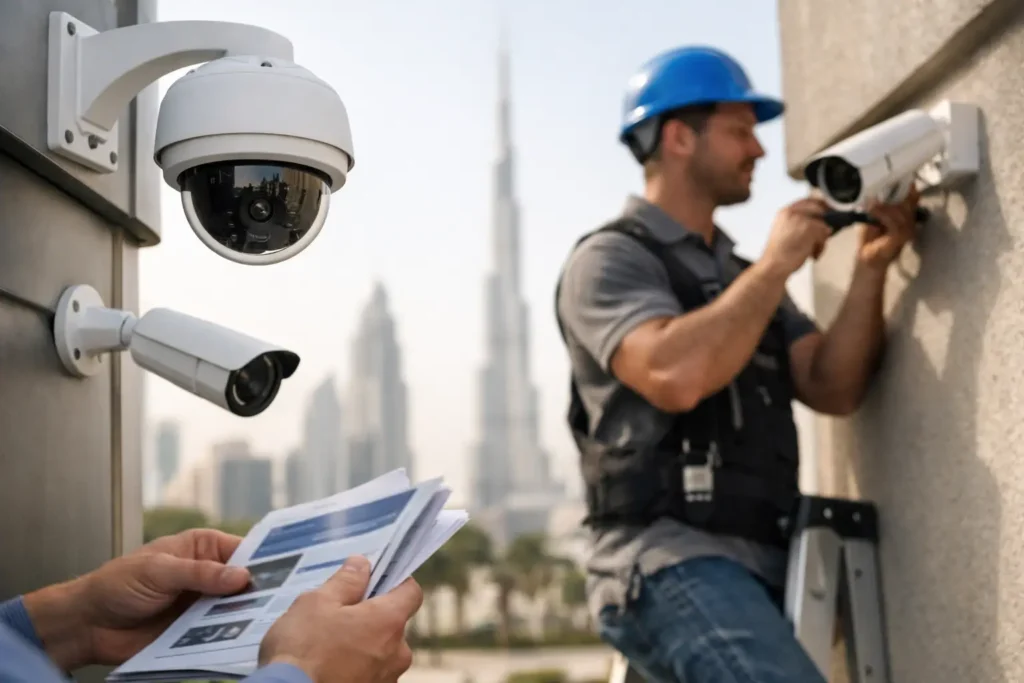
A failed CCTV approval rarely starts with the inspection. It usually starts much earlier – with the wrong contractor, the wrong camera layout, or a system designed without the authority requirements in mind. If you are looking for a CCTV installation company Dubai businesses can rely on, the real question is not just who can install cameras. It is who can deliver a compliant system, get the job approved, and keep it working without disruption.
For commercial sites, warehouses, retail outlets, labor accommodation, industrial facilities, and high-risk environments, CCTV is part security measure and part compliance requirement. That changes how the buying decision should be made. Price matters, but not as much as design accuracy, approval handling, documentation, and long-term support.
What a CCTV installation company in Dubai should actually deliver
A professional contractor should handle more than cabling and camera mounting. In regulated environments, the scope begins with a site survey and ends only when the system is tested, commissioned, approved where required, and handed over properly.
That means the company should be able to assess risk areas, define recording requirements, select suitable cameras for lighting and coverage conditions, and design storage capacity based on operational needs and authority expectations. It should also be able to prepare drawings, equipment submittals, and compliance documentation without pushing that burden back onto the client.
This is where many projects go wrong. Some installers can supply equipment quickly but cannot manage the approval process. Others understand approvals but outsource installation quality. The result is delay, rework, or a system that technically works but fails to meet the standard required for your premises.
Why compliance matters as much as coverage
In Dubai, CCTV is not just a standalone technical system. For many businesses, it is tied directly to approvals and operating continuity. A camera overlooking an entry point may seem straightforward, but approval issues often come down to details such as positioning, resolution, retention period, blind spots, equipment standards, and control room setup.
A contractor that works on compliance-driven projects understands these details before installation starts. That reduces the risk of redesigns, rejected submissions, and wasted spend on equipment that does not meet the requirement.
If your site also connects to wider ELV infrastructure, the stakes are higher. CCTV often needs to work alongside access control, structured cabling, gates, intercoms, and network systems. Poor coordination between vendors can create avoidable delays. A single contractor with end-to-end control usually gives better project discipline and clearer accountability.
How to evaluate a CCTV installation company Dubai decision-makers are considering
The safest choice is usually the company that asks better questions before it gives a quote. A serious contractor will want to know the site type, operating hours, risk profile, authority requirements, retention expectations, monitoring needs, and whether the installation is part of a new fit-out or a live facility.
If the discussion jumps straight to camera count and price, that is a warning sign. Ten cameras can be enough for one site and completely inadequate for another. The layout, lens selection, field of view, night performance, and recorder capacity matter more than a generic package.
It is also worth checking whether the contractor can manage the full project lifecycle. That includes survey, design, equipment supply, installation, testing, approval support, user training, and maintenance. When responsibilities are fragmented, clients often end up coordinating multiple parties during the most time-sensitive stage of the project.
Experience with your sector also matters. A retail chain may need strong entrance coverage, cash handling visibility, and centralized monitoring. A warehouse may need yard surveillance, loading bay coverage, perimeter visibility, and reliable recording in dust and heat. A hotel has different privacy, guest movement, and access control considerations. The right contractor will design around the operational reality of your site, not force every client into the same template.
The difference between installation and project execution
Many companies market CCTV installation. Far fewer can execute a CCTV project properly from first survey to final sign-off. The difference shows up in planning discipline.
Proper execution means camera placements are validated before cabling is finalized. Storage sizing is calculated instead of guessed. Network requirements are reviewed with the client or IT team. The system is labeled, tested, and documented. Operators are trained on playback, export, and incident retrieval. Maintenance terms are defined clearly instead of being treated as an afterthought.
This matters even more in active commercial environments. A poor installation can interrupt operations, create safety issues during works, or leave coverage gaps that are only discovered after an incident. A dependable contractor plans work around your operating schedule and communicates clearly about timelines, access needs, and handover milestones.
What approval-led clients should ask before awarding the job
If compliance is part of your project, ask direct questions. Is the contractor familiar with the relevant authority process for your site? Can they prepare and submit the required documents? Have they completed similar installations for your type of facility? Who handles rectifications if comments come back during approval review?
You should also ask about maintenance response, warranty support, and spare parts availability. CCTV is not a fit-and-forget system. Hard drives fail, cameras get damaged, network changes affect recording, and operational needs evolve. Long-term support should be part of the decision, not something negotiated after handover.
There is also a practical procurement question that gets overlooked: who owns the accountability if something is rejected or delayed? When one company designs, another installs, and a third handles approvals, responsibility becomes blurred. That is exactly when project delays multiply.
Where cheaper quotes become expensive
Low pricing is attractive, especially for large sites with high camera counts. But a cheaper quote often strips out the very parts that keep the project stable – proper survey time, design work, recording capacity, quality cabling, environmental protection, testing, or post-installation support.
In some cases, the lowest bidder assumes the client will absorb hidden costs later, such as additional storage, revised camera placements, approval resubmissions, or emergency maintenance after handover. That is not cost control. It is deferred risk.
A better way to compare proposals is to look at scope completeness. Are approvals included where relevant? Is the retention period defined? Are mounts, cabinets, switches, and UPS requirements covered? Is commissioning part of the price? Are training and documentation included? Once those details are clear, quote comparisons become more meaningful.
Choosing a contractor for growth, not just for handover
The best CCTV systems are designed for current risk and future change. A growing business may add more entrances, more inventory, more vehicles, or more compliance obligations. If the original system has no expansion planning, every upgrade becomes messy and expensive.
That is why scalable design matters. Recorder headroom, network planning, camera zoning, and integration readiness should be considered from day one. This is especially relevant for businesses operating across multiple sites or planning expansion across Dubai, Abu Dhabi, and Sharjah. Standardized execution makes future rollouts easier and support more consistent.
ALNAJAH ALAWAL SECURITY SYSTEMS & EQUIPMENT TRADING L.L.C. works in exactly this project environment – where clients need approved right the first time execution, not just equipment supply. That matters for businesses that cannot afford delays, failed inspections, or weak post-installation support.
When the right partner is worth more than the fastest quote
A CCTV system should do two things at once: protect the site and satisfy the compliance requirement behind it. If either side fails, the project has not been delivered properly.
So when evaluating a CCTV installation company Dubai businesses trust, look beyond the camera brand and the headline price. Focus on design accuracy, approval capability, installation discipline, and support after handover. A contractor that controls the full process reduces risk at every stage.
If your site has operational pressure, authority requirements, or multiple systems that need to work together, the right decision is usually the company that brings structure, accountability, and compliance knowledge to the table from the start. That kind of partner does more than install cameras. It helps you keep your project moving, your site protected, and your business ready for inspection when it counts.