

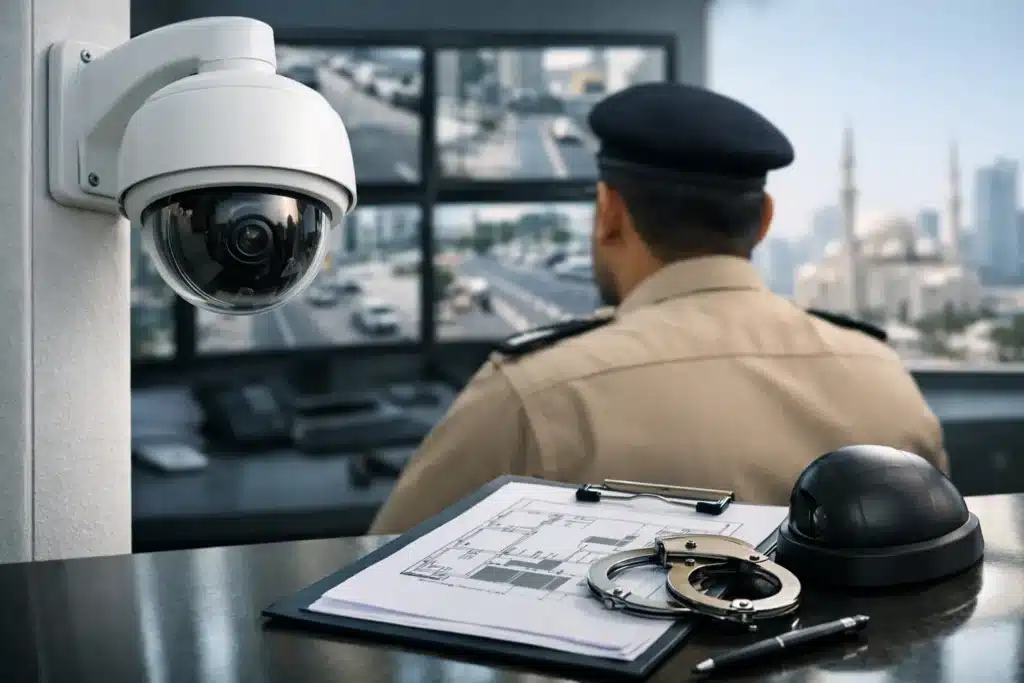
A CCTV system can be installed, powered on, and recording – yet still create a serious problem if it does not meet approval expectations. For business owners, the Sharjah Police CCTV approval requirements for businesses are not simply about placing cameras at entrances. They affect system design, camera coverage, recording capability, equipment selection, documentation, and final inspection readiness.
For warehouses, retail stores, commercial buildings, clinics, hospitality facilities, industrial sites, and labor accommodations, compliance must be planned before installation begins. Correcting blind spots, replacing unsuitable equipment, or redoing cable routes after an inspection can delay opening dates and add avoidable cost. The practical objective is straightforward: install a surveillance system that protects the premises and is approved right the first time.
Why Sharjah Police CCTV Approval Matters
Sharjah Police approval requirements are intended to ensure that a security system can provide useful, reliable evidence when an incident occurs. A camera that produces unclear images, overlooks a key access point, loses recordings too quickly, or cannot be accessed by authorized personnel does not provide the level of protection a commercial facility needs.
The approval process also gives owners and facility managers a clear benchmark. Rather than selecting cameras based only on price or resolution, the project is assessed as a complete security installation. Coverage, camera positioning, recording retention, power protection, network performance, equipment enclosure, and system operation all matter.
The exact scope depends on the type of business, the size of the premises, its risk profile, and the nature of its operations. A jewelry business, for example, requires a different level of detail and coverage than a small office. A logistics warehouse may need extensive perimeter, loading bay, gate, and storage-area monitoring. There is no responsible one-size-fits-all design.
Sharjah Police CCTV Approval Requirements for Businesses
While requirements should always be confirmed for the specific site and current authority guidance, a compliant project generally begins with a detailed security assessment. The system must cover the areas where incidents are most likely to occur and where evidence is most needed.
Camera Coverage Must Match Operational Risk
Cameras are typically required at key entry and exit points, vehicle gates, reception areas, cash-handling locations, public-facing spaces, corridors, loading areas, parking zones, and perimeter access points where applicable. The purpose is not to install the maximum number of cameras. It is to avoid gaps that leave critical activity unrecorded.
Coverage planning must account for what the camera needs to capture. A wide-angle camera may show general movement across a parking area but may not provide sufficient facial or vehicle detail at a gate. Similarly, a camera placed too high, facing direct sunlight, or looking into a poorly lit loading area can produce unusable footage.
A professional site survey identifies practical conditions before equipment is selected. These include lighting changes, reflective surfaces, shelving, ceiling height, access routes, outdoor weather exposure, and vehicle movement patterns. This is where compliant design prevents expensive rework.
Equipment Must Be Suitable for the Location
Commercial CCTV equipment must be fit for purpose. Indoor cameras may be suitable for offices and retail sales floors, while outdoor areas require properly rated cameras and housings that can handle heat, dust, and weather exposure. Low-light performance is particularly important at gates, yards, parking areas, and warehouse exteriors operating after dark.
The recorder, storage devices, network switches, power supply, monitor, and associated accessories are equally important. A high-quality camera connected to an undersized recorder or unreliable network does not create a compliant system. The full installation must operate consistently and retain recorded footage as required.
Equipment selection should also support future servicing. Businesses should be able to retrieve footage, verify camera status, replace a failed component, and expand the system where the facility grows or operational risk changes.
Recording, Storage, and Footage Retrieval Are Critical
CCTV approval is not based only on live viewing. Recorded video must be available when required, clear enough for investigation, and retained for the applicable period. Storage capacity needs to be calculated based on the number of cameras, image quality, frame rate, recording mode, and required retention duration.
This is a common point of failure. A system may appear to have adequate storage at commissioning, then overwrite footage too early because recording settings were changed or extra cameras were added without upgrading hard drive capacity. Storage calculations and final configuration should be documented before handover.
Businesses should also have a clear procedure for authorized footage retrieval. Management or assigned security personnel need to know who can access the system, how footage is exported, and how recordings are preserved following an incident. Access credentials should be controlled rather than shared informally across multiple users.
Installation Quality Affects Approval and Reliability
Poor workmanship can compromise an otherwise well-designed system. Exposed cables, loose connections, overloaded power supplies, unprotected external wiring, badly located network equipment, and unmarked camera points create long-term reliability risks.
A compliant installation should be neat, secure, and maintainable. Camera fields of view must remain stable, cable pathways should be protected, and critical equipment should be installed in suitable locations. Where needed, power backup and surge protection should be considered to reduce recording interruptions caused by electrical issues.
Testing is not a formality. Each camera should be checked in day and night conditions where relevant. The installer should verify live viewing, recording, playback, export functions, camera angles, timestamps, storage health, remote access where permitted, and system alerts. A final walk-through with the client helps confirm that the system supports daily operations without creating blind spots or privacy concerns.
Documentation and Inspection Readiness
Approval processing is easier when the paperwork matches the installed system. Businesses should expect a professional contractor to prepare the relevant design and technical documents required for the project, rather than treating documentation as an afterthought.
Depending on the site and authority process, this may include floor plans showing camera locations and coverage, equipment details, system configuration information, installation drawings, and commissioning records. The submission should accurately reflect what has been installed. Changes made on site must be updated in the documentation before inspection.
Inspection readiness also means ensuring the premises itself is ready. Cameras should be operational, the recorder should contain test footage, equipment rooms should be accessible, and the responsible representative should be available to demonstrate the system if requested. An incomplete project, even with good equipment, can result in a failed inspection or repeat visit.
Common Mistakes That Cause Delays
The most expensive mistakes usually happen before the first camera is installed. Buying consumer-grade equipment because it is cheaper, copying a layout from another property, or relying on a contractor without Sharjah Police approval experience can create gaps that only become visible at inspection.
Another frequent issue is changing the layout after initial planning. A new partition wall, racking system, signboard, or reception desk can block a camera view. Facility managers should notify the security contractor when construction or interior changes affect surveillance coverage.
Businesses should also avoid treating CCTV as a standalone purchase. Access control, gate barriers, intercom systems, intrusion detection, and network infrastructure may affect the final security design. Coordinating these systems early improves installation quality and reduces disruption after occupancy.
Choosing a Sharjah Police-Approved CCTV Contractor
The contractor should be able to manage more than installation labor. Look for a provider that can complete the site survey, develop the camera layout, specify suitable equipment, install and test the system, support approval processing, train users, and provide maintenance after handover.
Ask direct questions before awarding the project: Does the proposed layout address entrances, exits, high-risk areas, and operational blind spots? Has storage been calculated for the required configuration? Who will prepare approval documentation? What happens if an inspection identifies an issue? How quickly can the contractor respond to a camera or recorder failure after commissioning?
ALNAJAH ALAWAL SECURITY SYSTEMS & EQUIPMENT TRADING L.L.C. manages Sharjah Police-approved CCTV projects from survey through installation, testing, approval support, and ongoing maintenance. This approach gives businesses one accountable partner instead of separate suppliers for design, equipment, installation, and compliance coordination.
Keep the System Compliant After Approval
Approval is not the end of the CCTV responsibility. Cameras can drift out of position, lenses can become dirty, hard drives can fail, storage can fill up, and renovations can introduce new blind spots. Regular preventive maintenance keeps the system reliable when it is needed most.
A practical maintenance plan should include camera cleaning, image-quality checks, recorder health verification, playback testing, storage-capacity reviews, time and date checks, cable inspection, and confirmation that access rights remain controlled. Any failed camera should be addressed promptly, not left until the next annual review.
If your business is opening a new facility, expanding a warehouse, renovating a retail branch, or replacing an aging security system, start with a compliance-led site survey. The right design protects your operation, supports approval, and gives your team usable evidence when it matters.