

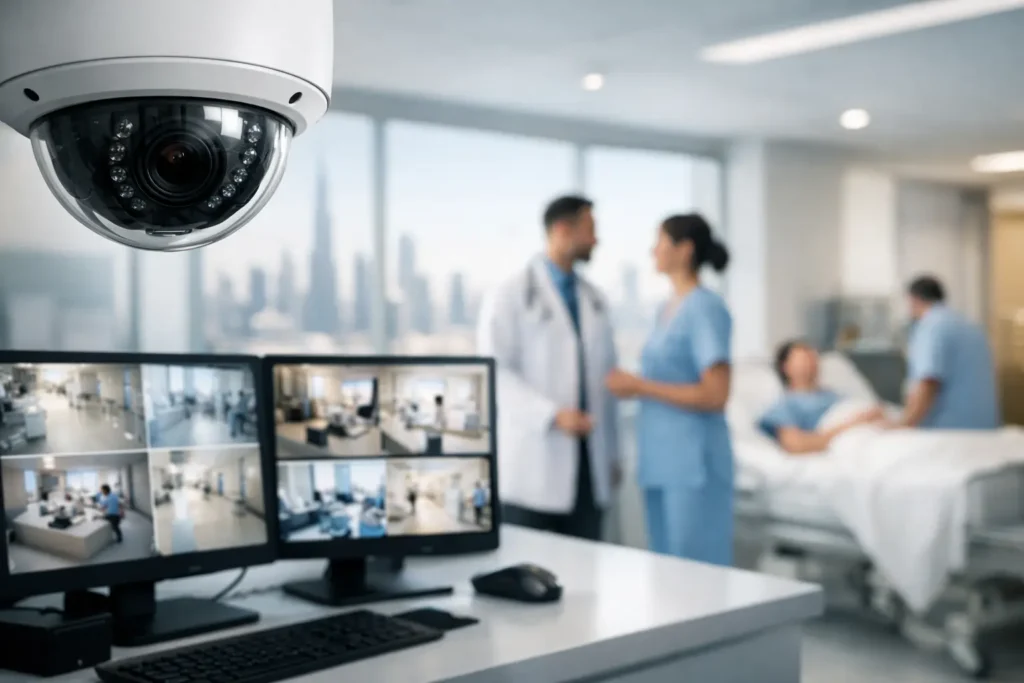
A hospital camera system cannot be designed like a retail store or warehouse installation. It must protect patients, staff, medicines, critical assets, and public areas without compromising clinical privacy or disrupting care. This hospital CCTV standards in Dubai complete guide explains the practical compliance, design, approval, and maintenance factors facility managers must address before installation begins.
For hospitals, clinics, medical centers, and diagnostic facilities, the real risk is not simply a missing camera. It is an incomplete design, poor camera placement, inadequate recording capacity, or an approval delay that affects opening dates and daily operations. The right approach combines regulatory alignment with a clear understanding of how healthcare spaces work.
Why Hospital CCTV Requires a Different Standard
Healthcare facilities operate around the clock and handle sensitive personal information, high-value equipment, controlled medicines, and vulnerable people. A security incident may involve patient safety, staff safety, theft, unauthorized access, a disputed clinical event, or an emergency response. Footage must therefore be clear, available, protected, and managed responsibly.
In Dubai, CCTV compliance is generally assessed against the applicable Security Industry Regulatory Agency requirements and the specific conditions of the project. Requirements can vary according to the facility type, size, risk profile, tenancy arrangement, and whether the building is new, operational, or undergoing renovation. A hospital should not assume that a standard commercial camera package will meet approval expectations.
A compliant system also needs to work after handover. Cameras, network switches, storage, power backup, monitoring displays, and recording software must be selected and configured as one operational system. If any component is undersized, footage may be unavailable when it is needed most.
Hospital CCTV Standards in Dubai: Core Design Areas
A proper design starts with a site survey and a risk-based camera layout. The objective is not to place cameras everywhere. It is to provide meaningful coverage of security-sensitive areas while preserving patient dignity and meeting operational needs.
Entrances, Reception, and Public Circulation
Main entrances, emergency department access points, reception desks, waiting areas, public corridors, lifts, and parking areas typically require well-planned coverage. Cameras at these points should capture usable facial detail at entrances and record movement through key public areas.
Reception coverage can help investigate disputes, manage visitor activity, and support staff safety. However, camera angles should be set carefully to avoid unnecessarily capturing computer screens, patient paperwork, or consultation details. Good design is about visibility with restraint.
Controlled and High-Risk Areas
Pharmacies, medicine storage rooms, controlled-drug areas, laboratories, server rooms, medical stores, loading bays, cash-handling points, and waste handling areas usually need closer attention. These locations often require higher-resolution cameras, tighter viewing angles, and reliable evidence capture.
Access control and CCTV should be coordinated in these areas. When a door event, forced entry alarm, or after-hours access attempt occurs, operators should be able to retrieve the matching video quickly. This reduces investigation time and strengthens accountability.
External Perimeter and Parking Coverage
Perimeter gates, ambulance routes, service entrances, staff parking, visitor parking, and delivery areas should be assessed for day and night conditions. Lighting matters as much as camera specification. A high-resolution camera cannot produce useful evidence if it faces glare, deep shadow, or an unlit driveway.
For vehicle entrances, the design may require a dedicated view for vehicle identification rather than relying on a wide-angle overview camera. The correct solution depends on traffic speed, lane layout, lighting, and the required level of identification.
Privacy Rules Must Shape the Camera Layout
Hospitals must balance security needs with privacy obligations. Cameras should not be installed in places where people reasonably expect privacy, including patient rooms, treatment rooms, examination rooms, changing areas, toilets, and other highly sensitive clinical spaces, unless there is a clearly justified and specifically approved requirement.
Even in permitted areas, camera placement should avoid excessive capture of patient care activities. Audio recording should not be assumed to be acceptable. It adds legal, privacy, and operational complexity and should only be considered where there is a documented need and confirmation that it is permitted.
Access to live views and recorded footage must also be controlled. Not every employee should be able to monitor cameras or export recordings. Hospitals should define who can view footage, who can authorize exports, how requests are recorded, and how footage is securely shared with authorized parties when required.
Recording Retention, Storage, and System Reliability
Recording retention is a central part of compliance planning. The required retention period should be confirmed during the design and approval process, not after cameras have been installed. Storage calculations must account for camera count, resolution, frame rate, compression method, recording mode, retention requirement, and expected future expansion.
A common failure is designing storage around ideal conditions. In practice, hospitals may add cameras, increase image quality, or require longer retention after an incident or audit. Capacity planning should include a sensible allowance for growth.
The recording environment must be protected against power loss, hardware failure, and unauthorized access. Depending on the facility and design, this can include uninterruptible power supplies, secure equipment racks, network segmentation, health monitoring, redundant storage, and clear fault reporting. A camera that appears online but is not recording correctly creates a serious compliance gap.
Installation Quality Affects Approval and Evidence Value
Compliance is not only a drawing or equipment-selection exercise. Installation workmanship directly affects system performance. Camera heights, mounting stability, cable containment, labeling, network configuration, field of view, and image settings all influence whether the final system performs as designed.
Before commissioning, every camera should be tested in realistic conditions. This includes daytime and nighttime image quality, entrance identification, recording playback, export functionality, date and time accuracy, network stability, and coverage of agreed critical areas. Blind spots should be corrected before final handover, not discovered after an incident.
Clear as-built documentation is equally valuable. Facility teams need current camera layouts, device identification, storage details, user access procedures, warranty records, and maintenance schedules. Without these records, future upgrades and fault resolution become slower and more expensive.
Approval Planning Should Start Before Procurement
For a new hospital, clinic fit-out, expansion, or refurbishment, CCTV should be coordinated early with architectural, MEP, IT, access control, fire and life safety, and operations teams. Late changes can lead to exposed cabling, poor camera views, insufficient rack space, missing data points, or delays in authority approvals.
The approval process normally requires accurate drawings, technical submittals, equipment details, and site readiness. Exact documentation and inspection expectations depend on the project. Working with an approved contractor that understands the process helps prevent avoidable resubmissions and last-minute redesigns.
ALNAJAH ALAWAL SECURITY SYSTEMS & EQUIPMENT TRADING L.L.C. supports healthcare projects from site survey and compliant design through installation, testing, approval coordination, training, and long-term maintenance. The goal is straightforward: get the system approved right the first time and keep it working reliably afterward.
Operational Policies Matter After Handover
A hospital can have compliant equipment and still create risk through weak operating procedures. Security and facility teams should establish rules for daily camera checks, incident review, footage export, user permissions, maintenance escalation, and retention management.
Staff training should be role-specific. Security operators need to understand monitoring and incident handling. IT teams need visibility into network and storage health. Facility managers need a simple process for reporting faults and arranging preventive maintenance. Management should know who has authority to access or release footage.
Periodic health checks are essential. Cameras can lose focus, be blocked by signage, fail after power events, or stop recording because storage has reached capacity. A planned maintenance visit identifies these issues before they become an audit finding or an evidence failure.
Questions to Ask Before Appointing a CCTV Contractor
Before selecting a contractor, ask whether the proposed system is designed specifically for the healthcare facility rather than copied from a generic template. Confirm who will manage drawings, authority coordination, installation, commissioning, training, and post-installation support.
Also ask how privacy-sensitive areas will be treated, how recording retention will be calculated, what happens if a recorder or network device fails, and whether the contractor will provide complete handover documentation. The lowest initial quotation can become the most expensive option if it causes approval delays, redesign work, or unreliable recordings.
A hospital CCTV project should deliver more than cameras on walls. It should give the facility a controlled, documented security system that supports patient privacy, staff safety, operational continuity, and regulatory confidence. Start with a professional survey, confirm the applicable requirements early, and build the system around how your hospital actually operates. Stay compliant. Stay protected.