

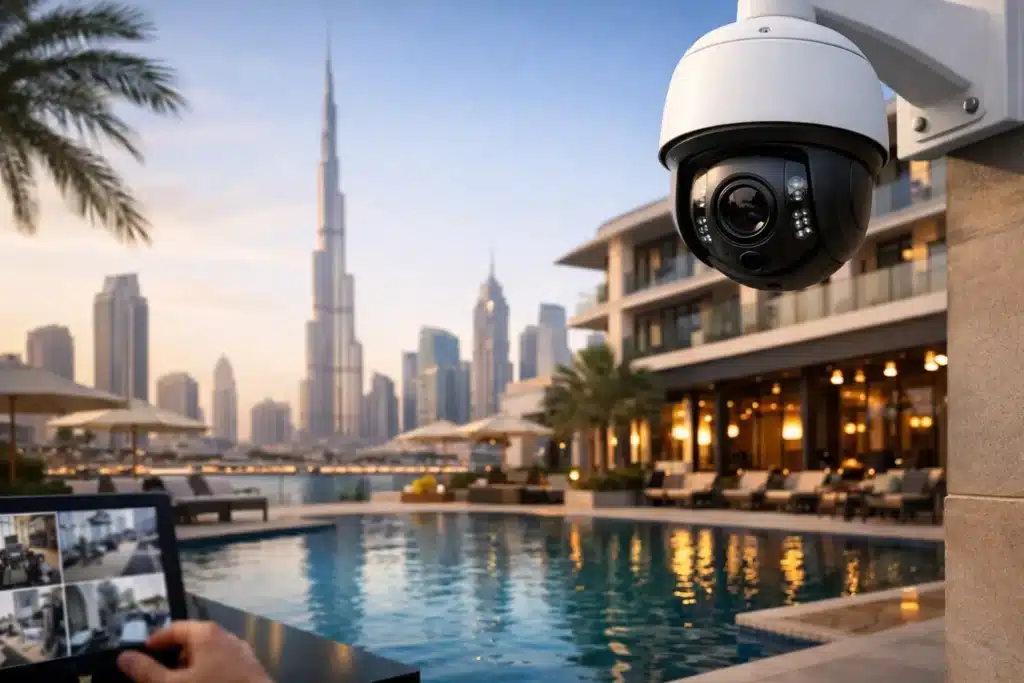
A hotel CCTV project can look complete and still fail at the point that matters most: approval. SIRA CCTV approval for hotels in Dubai depends on more than camera quantity or image quality. The system must be designed around the property’s risk areas, installed to the required standard, documented correctly, and ready for inspection.
For hotel owners, operators, developers, and facility managers, that process affects opening dates, handover schedules, guest safety, and operational continuity. A late redesign or failed inspection can disrupt far more than the security package. The practical objective is clear: install the right system, submit the right documentation, and achieve approval right the first time.
What SIRA Approval Means for a Hotel CCTV System
The Security Industry Regulatory Agency sets security requirements for applicable premises in Dubai. For hotels, the CCTV scope is typically assessed in relation to the building type, access points, public areas, back-of-house operations, parking facilities, and other areas where security visibility is required.
Approval is not simply a certificate attached to a set of cameras. It is the outcome of a compliant project process. The authority needs confidence that the proposed equipment, camera placement, recording arrangement, network infrastructure, and installation quality meet the requirements applicable to the site.
A hotel has a different operating profile from a warehouse, retail outlet, or office. It has guests arriving throughout the day, public-facing reception areas, staff-only corridors, service entrances, loading activities, cash-handling points, and sometimes multiple restaurants, event spaces, pools, and parking levels. The CCTV design must protect the operation without creating blind spots or interfering with the guest experience.
SIRA CCTV Approval for Hotels in Dubai: Key Planning Areas
The most effective time to address compliance is before equipment is ordered or containment work begins. A survey and design review help identify the correct scope early, especially on new-build projects where CCTV must coordinate with access control, structured cabling, IT networks, fire-rated pathways, and interior finishes.
Coverage Must Reflect How the Hotel Operates
Camera coverage should be based on security function, not just floor plans. Main entrances, reception and lobby zones, lift lobbies, corridors, emergency exits, staff access points, vehicle entry and exit lanes, loading areas, and perimeter access are common priorities. Depending on the property, coverage may also be needed around valuables storage, cashier points, kitchens, banquet facilities, health clubs, or other operationally sensitive areas.
Placement matters as much as coverage. A camera facing a bright glass entrance may need careful positioning and the right low-light or wide-dynamic-range capability to capture usable images. A corridor camera installed too high or at the wrong angle may provide movement evidence but fail to identify a person clearly. Design decisions should be made against the purpose of each view.
Guest privacy is also a critical consideration. CCTV should support security and incident investigation without being placed in areas where surveillance would be inappropriate. A qualified contractor balances authority requirements, hotel policies, and practical privacy expectations from the design stage.
Equipment and Recording Cannot Be Selected in Isolation
Hotels often choose cameras based on resolution alone. Higher resolution can improve detail, but it also increases bandwidth, storage demand, and network load. The correct selection depends on the required scene, lighting conditions, identification needs, and retention requirements.
The video management platform, network video recorder, storage drives, monitor setup, operator access permissions, and backup arrangements must work as one system. A camera that produces excellent footage is of limited value if recordings cannot be retrieved quickly after an incident or if the storage capacity is calculated incorrectly.
Approved equipment and correctly specified components are essential. Substituting products late in the project, using unverified models, or mixing incompatible hardware can create approval delays and make future maintenance more difficult.
Installation Quality Is Part of Compliance
Poor cable routing, exposed joints, unsupported containment, incorrect labeling, weak network termination, and unsecured equipment cabinets can undermine an otherwise well-designed CCTV system. Hotel environments add further challenges because work must often be completed around finished interiors, operating departments, and guest areas.
Professional installation includes neat containment, protected cabling, clear labeling, secure equipment mounting, tested power arrangements, and organized rack layouts. These details support inspection readiness and make fault diagnosis faster after handover.
A Practical Approval Process for Hotel Projects
The approval path varies according to the property type, project stage, and authority requirements. However, a controlled process usually follows the same operational sequence.
First, conduct a site survey and confirm the hotel’s security layout. This is where entrances, public zones, restricted areas, parking, service routes, and existing infrastructure are reviewed. For an operating hotel, the survey should also account for access restrictions, noise limits, and work hours.
Next, prepare the CCTV design and supporting submission documents. The package may include drawings, camera schedules, equipment details, storage calculations, and other information needed for review. Accuracy at this stage prevents a common problem: installing to one layout while submitting another.
After design acceptance, installation should proceed according to the approved scope. The contractor should test every camera view, confirm recording performance, verify date and time synchronization, check user access, and ensure live and recorded footage can be retrieved from the required workstations.
The final stage is inspection coordination and closeout. This is where documentation, system readiness, equipment labeling, and actual installed coverage come together. If a discrepancy is found, it should be corrected quickly with clear accountability rather than left for the hotel team to manage.
Common Reasons Hotel CCTV Projects Face Delays
Most delays are avoidable. They usually begin with incomplete planning or a disconnect between the consultant, contractor, IT team, and hotel operator.
One frequent issue is treating CCTV as a late-stage item. By the time cameras are being installed, ceiling access may be limited, decorative finishes may be complete, and network pathways may be unavailable. This can force visible surface cabling, compromised views, or expensive rework.
Another issue is insufficient storage planning. Hotels need a recording strategy that aligns with their applicable requirements and operational needs. Under-sizing storage can create a compliance concern, while over-sizing it without considering server capacity, network throughput, and maintenance creates unnecessary cost.
Projects also slow down when drawings are not updated after site changes. A relocated door, revised lobby layout, added partition, or changed parking flow can affect camera coverage. The installed system and final documentation must match.
Finally, some projects fail because the installer only provides equipment and labor. Approval-focused work requires ownership of the full process: survey, design, supply, installation, testing, commissioning, documentation, inspection support, and maintenance planning.
Choosing the Right CCTV Contractor for a Dubai Hotel
A hotel should look for more than a low installation price. The contractor must understand SIRA compliance, have experience managing authority-facing documentation, and be able to coordinate with the hotel’s project team, IT provider, consultant, and facilities department.
Ask how the contractor will validate camera views before handover, calculate recording storage, protect the system from unauthorized access, and support the site after approval. Confirm who is responsible if an inspection identifies a correction. Clear answers reduce risk.
ALNAJAH ALAWAL SECURITY SYSTEMS & EQUIPMENT TRADING L.L.C. manages SIRA-approved CCTV projects from survey through approval support and long-term maintenance. That single-vendor responsibility gives hotel teams one accountable point of contact instead of multiple parties passing issues between them.
Maintaining Compliance After Approval
Approval is not the end of the hotel’s CCTV responsibility. Cameras can be moved during renovations, lenses can become obstructed, storage drives can fail, and staff changes can leave outdated user accounts active. Regular preventive maintenance helps preserve system performance and protects the hotel’s ability to investigate incidents when it counts.
A maintenance plan should include camera cleaning and view checks, recorder health monitoring, storage verification, time synchronization, playback testing, firmware review where appropriate, and review of user permissions. If the hotel undergoes a major layout change or expansion, CCTV coverage should be reassessed before construction is complete.
The best approach is simple: treat compliance as an operating standard, not a handover task. Start with a site-specific design, use approved equipment, document every stage, and work with a contractor prepared to stand behind the system long after inspection day.