

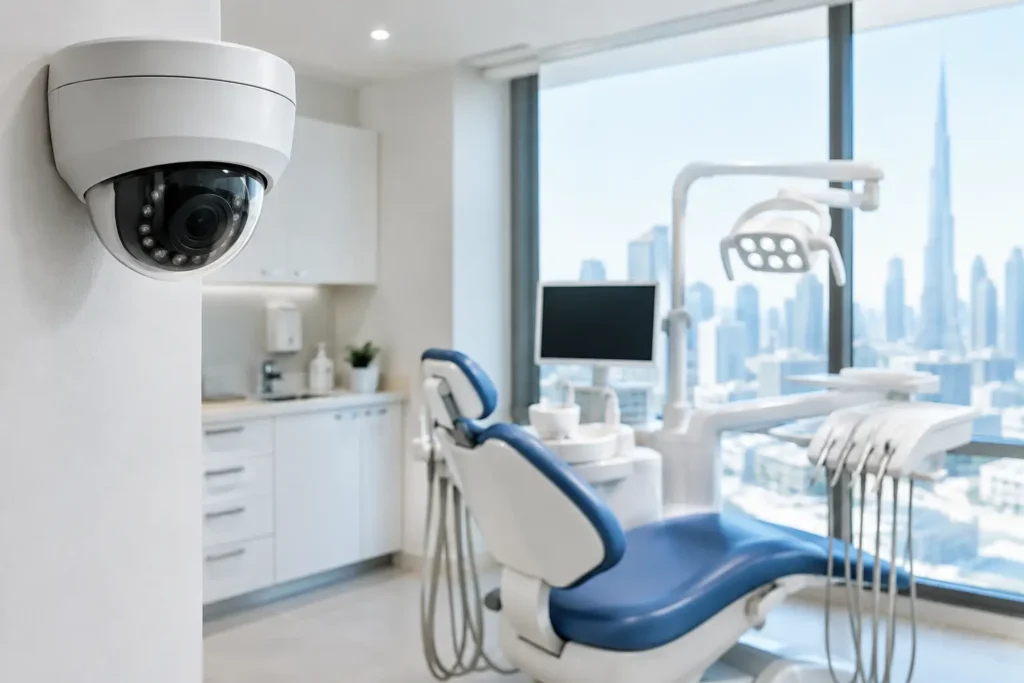
A dental clinic is not secured simply because cameras are mounted at the entrance. To meet cctv requirements for dental clinics in dubai, the system must protect patients, staff, medicines, equipment, and cash-handling areas while respecting clinical privacy and satisfying the applicable authority requirements. A poorly planned installation can create blind spots, expose confidential activity, delay approvals, and require expensive rework.
For clinic owners, practice managers, and fit-out contractors, the right approach starts before equipment is ordered. Camera locations, recording capacity, cable routes, network security, and approval documentation should be planned as one coordinated scope.
CCTV Requirements for Dental Clinics in Dubai: Start With Compliance
Dubai security requirements may be influenced by the type of premises, building classification, clinic location, and the relevant authority overseeing the project. Many commercial CCTV projects require compliance with Security Industry Regulatory Agency (SIRA) requirements, particularly where the property, building management, landlord, or project approval process calls for it. Healthcare operations may also have internal privacy, data-handling, and facility-management obligations that affect the final design.
This is why dental clinics should not rely on a generic retail camera package. A clinic has a different risk profile. Patients expect discretion. Staff need a safe environment. Reception teams manage personal information and payments. Expensive dental equipment, controlled supplies, and medications need protection after hours.
A compliant contractor begins with a site survey and confirms the authority pathway before installation. The survey should identify the clinic boundaries, public and restricted areas, existing building security systems, entry points, evacuation routes, equipment rooms, reception counters, and potential areas of vulnerability. It should also verify whether building management has requirements for containment, access to common areas, or integration with the wider property system.
Where Cameras Should and Should Not Be Installed
Camera placement must deliver useful evidence without invading patient privacy. In most dental clinics, coverage is commonly planned for public access and operational risk areas rather than clinical treatment activity.
The entrance and exit should be clearly covered to record who enters and leaves the clinic. Reception and waiting areas may require coverage to support staff safety, incident review, and monitoring of access to the front desk. Cameras may also be appropriate at cashier points, pharmacy or supply storage areas, equipment rooms, corridors, staff entrances, rear doors, and external approach areas where applicable.
Coverage should be designed around identifiable images, not simply broad views of a room. A camera pointed too high, placed behind strong backlighting, or blocked by décor may record movement without providing usable evidence. Correct lens selection, mounting height, lighting conditions, and field of view matter as much as camera resolution.
Treatment rooms require special care. Recording inside a dental operatory can create significant patient privacy concerns because consultations, treatment procedures, screens, and personal health information may be visible or audible. Cameras should not be placed in clinical spaces simply because equipment is valuable. If coverage is being considered for a specific operational reason, the clinic should first assess privacy implications, obtain any required authorization, and clearly define what the camera will capture.
Cameras must never be installed in bathrooms, changing areas, or any location where privacy is reasonably expected. Audio recording also needs separate consideration. A camera system should not be configured to capture conversations by default without reviewing the legal, privacy, and operational implications.
Design for Coverage, Evidence, and Daily Operation
A compliant design is not about installing the maximum number of cameras. It is about placing the right cameras where they can support a real response. For a small clinic, a focused system may be more effective than an oversized installation with poorly positioned devices and inadequate recording storage.
At a minimum, the design should account for image quality at entrances, faces at reception, activity at payment points, access to restricted storage, and movement through critical corridors. Low-light capability is relevant for clinics that close late or sit within dim parking or service areas. Wide dynamic range can be necessary at glass entrances where bright daylight can otherwise wash out a visitor’s face.
Camera cabling should be installed in protected routes and properly labeled. Exposed or loosely routed cables are easier to damage and make future maintenance harder. Where network cameras are used, the switch capacity, power budget, and network segmentation should be reviewed. Security cameras should not become an unmanaged device group on the same network used for patient records, billing systems, or guest Wi-Fi.
The recording system also needs a secure location. An NVR or DVR placed openly under a reception desk can be unplugged, stolen, or accessed by unauthorized people. It should be housed in a lockable cabinet or controlled equipment area, with suitable ventilation and protected power. A properly designed UPS can help the system continue recording during short power interruptions and reduce the risk of data corruption.
Recording Retention and Access Control
Recording retention is a compliance and operational decision, not an afterthought. The required retention period may depend on the applicable authority requirements and the specific project scope. Storage must be calculated using the actual number of cameras, resolution, frame rate, recording schedule, compression settings, and expected retention period.
A common mistake is selecting storage based only on a supplier estimate. If cameras are later upgraded from standard resolution to higher resolution, or if continuous recording is enabled instead of motion recording, the retention period can fall sharply. The system should be configured and tested to confirm that it meets the required recording duration under live operating conditions.
Access to live views and recorded footage should be restricted to authorized personnel. Individual user accounts are preferable to shared passwords because they create accountability. Strong passwords, controlled administrator access, and an audit trail help the clinic understand who accessed footage and when.
Remote viewing can be useful for owners and managers, but it must be configured securely. Avoid opening unnecessary ports or using default passwords. The person who can view patient-facing areas remotely should be authorized, trained, and aware of the clinic’s privacy policy. Convenience should not override control.
Signage, Documentation, and Approval Readiness
Patients and visitors should be informed when CCTV is in operation in monitored areas. Clear signage supports transparency and helps set expectations before a person enters the camera coverage zone. Signage should not be treated as a substitute for proper privacy controls, but it is an essential part of responsible operation.
Documentation is equally important. A professional CCTV project should include an approved layout or camera plan, equipment specifications, recording calculations, installation records, testing results, user training, and handover details. Where SIRA approval applies, the contractor should manage the required submission process, inspections, and corrections identified during review.
The clinic should also maintain simple internal procedures for footage requests and incident handling. Staff need to know who can export footage, how an incident is logged, where evidence is stored, and when management or authorities should be notified. During a dispute, theft investigation, or staff safety incident, a clear chain of control can be as valuable as the recording itself.
Avoid These Common Compliance Failures
Most avoidable delays come from planning gaps rather than technical faults. Clinics often install cameras after fit-out completion, only to find that cable routes are inaccessible, coverage is blocked by partitions, or the recording equipment has no secure location. Others select consumer-grade devices that do not meet the project specification or cannot support the required recording and user-control functions.
Another failure is treating CCTV as separate from the rest of the clinic infrastructure. Access control, intercoms, fire-rated containment, structured cabling, and power backup can affect the final result. Coordinating these systems during fit-out reduces disruption and avoids visible surface trunking in patient-facing spaces.
It also pays to account for future changes. A clinic may add operatories, move reception, expand medication storage, or introduce a new access-controlled staff area. Allowing capacity for additional cameras and storage can prevent a full system replacement later.
Choose an Approved Contractor That Owns the Process
For dental clinics, the right contractor should be able to survey the site, identify the applicable compliance route, prepare the design, supply approved equipment, install and test the system, support authority approvals, and provide ongoing maintenance. Splitting these responsibilities across multiple vendors often creates gaps when an inspection issue appears or a system fault affects operations.
ALNAJAH ALAWAL SECURITY SYSTEMS & EQUIPMENT TRADING L.L.C. supports compliance-led CCTV projects from site survey through installation, commissioning, approval support, and maintenance. The objective is straightforward: build a system that protects the clinic, respects patient privacy, and is approved right the first time.
Before signing off on a CCTV layout, walk the clinic as a patient would. If the camera design protects the entrance, staff, assets, and restricted areas without intruding on care, it is on the right path. Stay compliant. Stay protected.