

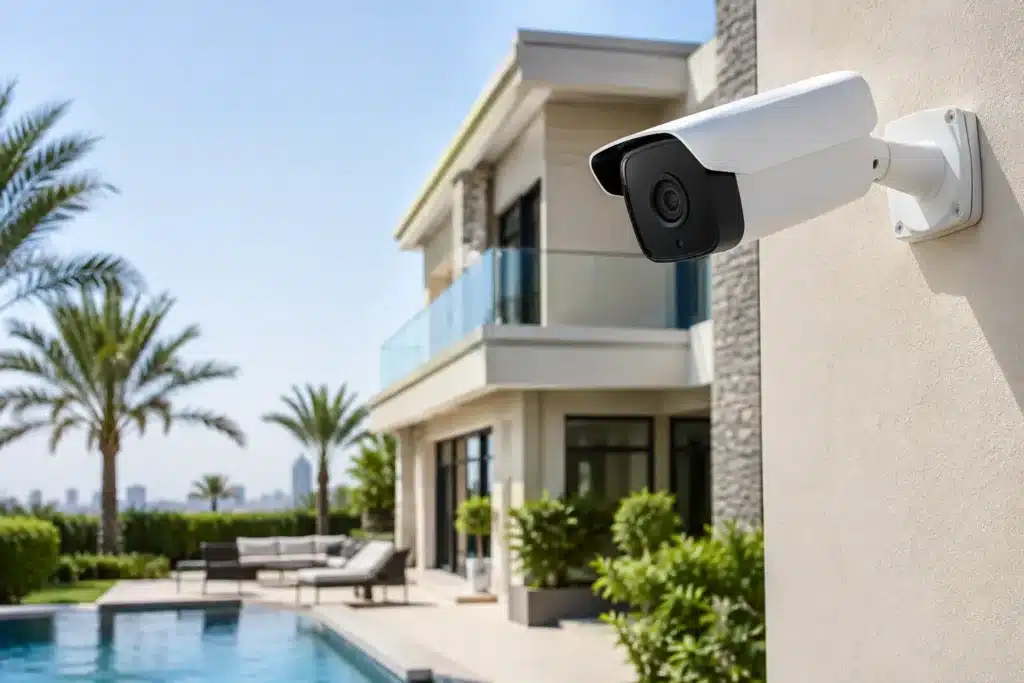
A villa security system succeeds or fails at the planning stage. CCTV for villas in Abu Dhabi requires more than mounting cameras at the gate and front door. The right indoor and outdoor camera placement must create usable coverage of access routes, protect family privacy, withstand heat and dust, and support any applicable authority or community requirements.
For villa owners, developers, and facility managers, the goal is not the highest camera count. It is clear identification at key points, dependable recording when an incident occurs, and a system that remains practical to operate and maintain.
Start With the Villa’s Real Risk Points
Every villa has a different exposure profile. A standalone property with side access, a rear garden, staff accommodation, and multiple vehicle gates needs a different design from a townhouse in a controlled community. A professional site survey should trace how a person, vehicle, or delivery can enter, move through, and leave the property.
Start outside the boundary and work inward. Review pedestrian gates, vehicle gates, perimeter walls, side passages, rear access, roof access where relevant, and any service doors. Then identify high-value or sensitive internal areas such as entry halls, garages, safe rooms, server or network cabinets, and storage spaces.
Camera placement should answer a practical question: if an event occurs, will the footage show what happened clearly enough to identify the person, vehicle, direction of travel, and time? A wide view alone is rarely enough. It can show activity without delivering useful identification.
Outdoor CCTV Placement for Abu Dhabi Villas
Outdoor cameras handle the first line of detection and evidence. They should cover the property perimeter, approach routes, and points where someone can gain access without passing through the main entrance.
Main gate and vehicle entry
Place one camera for an overview of vehicles approaching and entering the gate, and another focused view where driver or passenger identification may be needed. Positioning matters: a camera mounted too high gives a clear view of the vehicle roof but not the faces inside. A camera placed too low may be easy to tamper with.
For larger driveways, a third view may be necessary to cover vehicles after they have entered the property. If license plate recognition is required, it should be designed as a dedicated function. A general-purpose wide-angle camera is not a reliable substitute, particularly at night or when vehicles are moving.
Pedestrian gate and front entrance
The pedestrian gate and main door need complementary coverage. The gate camera records who reaches the property boundary; the entrance camera records who approaches or enters the villa. Install the entrance camera at a height and angle that capture faces, not only the top of a person’s head.
Avoid aiming directly toward strong afternoon sunlight or reflective glass wherever possible. In Abu Dhabi, glare and high-contrast shadows can reduce facial detail even when the camera specification looks strong on paper. Camera position, lens selection, and image settings must work together.
Side passages, rear garden, and service areas
Side access is commonly overlooked because it is less visible from the street. It is also where blind spots develop. A camera at each end of a long passage can provide overlapping coverage and show both direction of travel and a person’s face.
Rear gardens, pool areas, outdoor kitchens, and service yards require a balanced approach. Cameras can protect equipment, doors, and perimeter openings, but they should not unnecessarily record neighboring properties or private areas beyond the boundary. Privacy masking can help where a camera’s field of view includes areas that do not need to be monitored.
Perimeter walls and corners
Do not place cameras only at the center of each wall. Corners often provide better sight lines along two boundaries, but trees, decorative screens, boundary features, and parked vehicles can still create hidden areas. A site survey should test actual viewing angles rather than relying on a drawing alone.
Outdoor equipment must also be suitable for heat, dust, humidity, and occasional heavy rain. Weather-rated housings, protected cable routes, surge protection, and secure mounting are part of the installation standard. A camera with an exposed cable or an unstable bracket can become a security weakness.
Indoor CCTV Placement That Protects Privacy
Indoor cameras should support access control, incident review, and asset protection without turning a home into a monitored private space. Coverage should be purposeful and agreed before installation.
Entry hall, corridors, and stairways
The entry hall is one of the most valuable interior locations because it links the main door to the rest of the villa. A camera covering the approach from the entrance and key routes toward living areas can establish a clear movement record.
Corridors and stairways are useful choke points. One well-positioned camera may cover several room approaches without placing cameras inside private spaces. This is often more effective and more respectful than fitting a camera in every room.
Garage, storage, and technical rooms
Garages should cover the vehicle bay, internal door, and any access to tools, bicycles, or high-value equipment. Storage rooms, network cabinets, and smart-home control areas may also justify coverage, especially in large villas or developer-managed properties.
Technical rooms should be designed with maintenance in mind. Recording equipment, network switches, and power backup should be protected from overheating, unauthorized access, and accidental disconnection. A strong camera layout cannot compensate for a recorder that fails during a power interruption or stores footage for too short a period.
Areas to avoid or handle carefully
Bedrooms, bathrooms, changing areas, and other highly private spaces should not be covered by CCTV. Kitchens, living rooms, and family areas require careful discussion because the need for security varies by household and staffing arrangements. In many cases, coverage of entrances and circulation routes provides the required protection without monitoring private daily life.
If domestic staff work in the villa, clear policies help prevent disputes. Residents should define who can view footage, how long recordings are retained, and what happens when an incident needs to be reviewed. Access should be restricted to authorized users with strong passwords and, where available, audit records.
Camera Height, Lighting, and Overlap Matter
A camera’s location is more than a dot on a floor plan. Mounting height affects facial recognition, tamper resistance, and the amount of ground covered. Generally, cameras should be high enough to discourage interference but low enough to capture meaningful facial detail at doors and gates.
Night performance deserves separate attention. Infrared illumination works well in many conditions, but reflective walls, glass, metal gates, and nearby lights can cause glare or washed-out images. Exterior lighting can improve recording quality, but it should be positioned so it illuminates the subject rather than shining directly into the lens.
Build overlap into critical routes. When one camera records the approach and another records the exit, it is easier to verify identity, movement, and sequence of events. Overlap also provides continuity if one camera is blocked, damaged, or temporarily offline.
Compliance, Recording, and System Design
For CCTV camera placement in Abu Dhabi villas, requirements can depend on the property type, community rules, project scope, and the authority involved. New developments, high-value residences, staff facilities, or properties with integrated access systems may have specific approval or documentation expectations. Confirm the applicable requirements before purchasing equipment or closing ceilings and walls.
A compliant design is not just about camera locations. It includes approved equipment where required, network architecture, storage capacity, labeling, power backup, secure remote access, testing, and handover documentation. Retention periods should be calculated from camera count, resolution, frame rate, recording schedule, and available storage. Guessing at storage is a common and expensive error.
ALNAJAH ALAWAL SECURITY SYSTEMS & EQUIPMENT TRADING L.L.C. approaches villa CCTV projects through site surveys, system design, installation, testing, commissioning, and ongoing maintenance support. This reduces the risk of blind spots, unreliable footage, or late changes caused by overlooked technical and compliance requirements.
A Practical Placement Review Before Installation
Before finalizing the design, walk the site at day and night and confirm that each camera has a defined purpose. The design should show coverage of every gate, door, driveway, side passage, and critical internal route. It should also identify privacy exclusions, cable paths, network locations, recorder placement, and expected retention capacity.
Avoid treating mobile app access as the whole security strategy. Remote viewing is useful, but it must be secured with unique credentials, controlled user permissions, updated firmware, and a properly configured network. Unauthorized access to cameras is a security failure, not a convenience issue.
The right villa CCTV layout is quiet when everything is normal and decisive when it is needed. A detailed survey and placement plan give the property owner confidence that the system will provide clear evidence, respect privacy, and remain ready for the conditions it was installed to handle.