

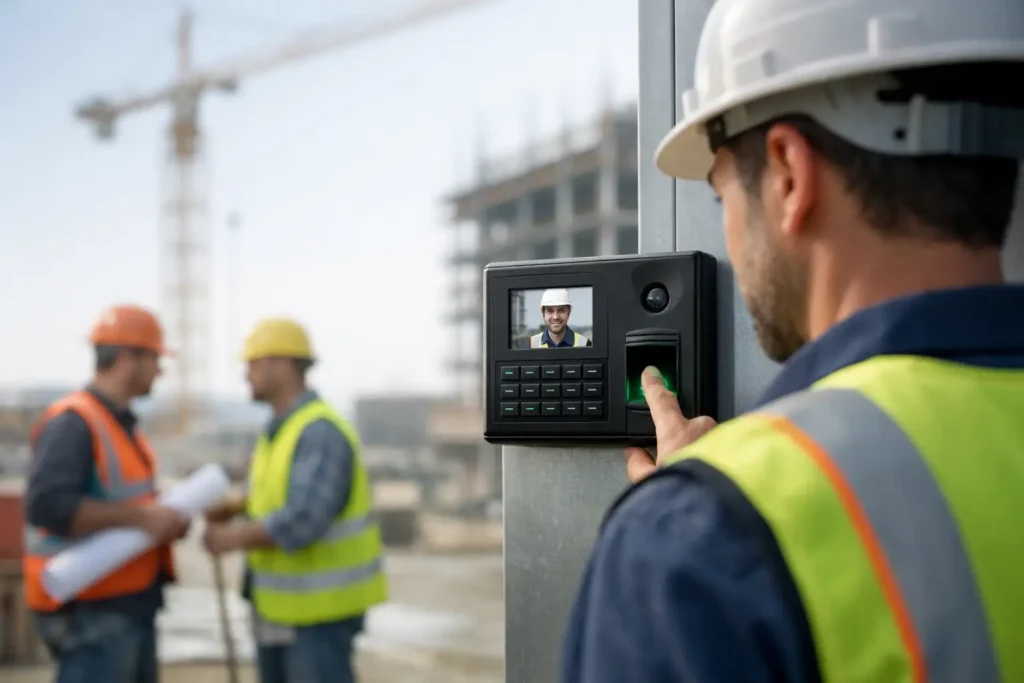
At 6:15 a.m., a site gate can decide whether the day starts under control or in confusion. Workers arrive in waves, subcontractors rotate by phase, and supervisors need an accurate record of who is on-site before work begins. A biometric attendance system for construction site operations solves a problem that paper registers, shared cards, and manual headcounts rarely solve well – reliable proof of presence.
For contractors, developers, and site managers, attendance is not just an HR task. It affects payroll, safety, access control, subcontractor accountability, labor reporting, and dispute handling. If the record is weak, everything built on it becomes harder to verify.
Why construction sites need stricter attendance control
Construction is different from office environments. The workforce changes more often, reporting times are tighter, and the site itself may be active across multiple gates, shifts, and subcontractor teams. In that setting, manual attendance creates predictable failures.
One worker may sign for another. A card may be passed between crews. A supervisor may correct times after the fact based on memory rather than evidence. Even when no one is acting dishonestly, rushed check-ins create gaps. Those gaps lead to payroll errors, confusion during emergency evacuation, and poor visibility over labor deployment.
A biometric attendance system for construction site teams addresses those issues by tying each attendance event to a unique physical identifier, usually a fingerprint or face. That reduces buddy punching and creates a traceable log of entry and exit activity. It also gives management a much clearer picture of actual labor hours by contractor, zone, or shift.
What a biometric attendance system for construction site use should actually do
Not every attendance device is suitable for field conditions. Construction sites are harsher than commercial offices. Dust, heat, gloves, temporary cabins, unstable power, and changing manpower levels all affect system performance.
A practical site solution should do more than record a clock-in. It should verify identity quickly, support access rules, store records reliably, and continue operating even when connectivity is inconsistent. If the system slows down gate movement every morning, adoption will fail no matter how good the software looks in a demo.
The right hardware depends on site conditions
Fingerprint terminals are common because they are cost-effective and easy to deploy. But they are not always ideal on heavy civil or dusty projects where workers have worn fingerprints, dirty hands, or frequent glove use. In those cases, facial recognition can be more practical, especially at high-volume entry points.
That said, facial systems need proper positioning, lighting control, and camera quality. If the terminal is poorly placed at an outdoor gate with harsh backlight, accuracy suffers. This is where site survey and design matter. The best result usually comes from matching the biometric method to the work environment rather than forcing one device type across every project.
Software matters as much as the terminal
Site teams often focus on the reader at the gate, but the real value sits in the software layer. Attendance records need to be searchable, exportable, and usable by payroll, HR, operations, and sometimes compliance teams. If a system captures data but turns reporting into a manual cleanup exercise, it only moves the problem.
A well-designed platform should separate workers by company, trade, project, and shift. It should also support late arrival tracking, overtime calculation, exception handling, and audit trails. For large projects, dashboard visibility by subcontractor can quickly show whether labor promised on paper actually arrived on site.
The operational benefits are real, but they depend on setup
The biggest immediate gain is payroll accuracy. When attendance is linked to verified identity, disputes over hours worked become easier to resolve. This is especially valuable on sites with multiple subcontractors, temporary labor pools, or frequent manpower fluctuations.
The second gain is site control. A biometric attendance system can be linked with access permissions so only authorized workers enter specific zones or active projects. If certifications, inductions, or document validity are part of the access rule, unauthorized entry can be restricted before it becomes a safety issue.
The third gain is emergency accountability. During an evacuation or incident response, management needs a current record of who is inside the site. Manual sign-in sheets are too slow and too unreliable for that purpose. A live attendance log gives a much stronger starting point for roll call and contractor coordination.
Still, it depends on execution. A poorly enrolled workforce, weak gate design, or lack of user training can produce long lines and bad records. The technology is effective when deployment is planned properly, not simply installed quickly.
Common mistakes when deploying biometric attendance on site
Many attendance projects fail for operational reasons rather than technical ones. One common mistake is enrolling workers in a rushed, inconsistent way. If names are entered differently across systems, IDs are duplicated, or subcontractor records are incomplete, reporting quality declines immediately.
Another mistake is ignoring throughput. A device may work well for 30 employees in an office, but a construction gate may need to process hundreds of workers in a short arrival window. If transaction speed, lane layout, and backup procedures are not considered, congestion becomes the main story.
There is also the issue of environment. Outdoor terminals need suitable housing, stable mounting, and power protection. Temporary site offices and gate cabins are often treated as afterthoughts, yet they directly affect system reliability. A compliance-led contractor will account for these details during survey and installation rather than after the first failure.
Compliance, privacy, and workforce trust
Biometric data requires careful handling. That means clear enrollment procedures, controlled access to records, and responsible storage practices. Construction firms should not treat attendance biometrics as just another spreadsheet field. Workers and subcontractors need to understand what is collected, how it is used, and who can access it.
From a governance standpoint, there should be documented processes for onboarding, deletion, exception handling, and system administration. This is particularly important on large or multi-phase projects where labor turnover is high. Good control reduces legal exposure and improves confidence in the system.
For businesses operating in regulated environments such as Dubai, Abu Dhabi, and Sharjah, working with an experienced implementation partner also matters because attendance, access control, CCTV, and site security often overlap. ALNAJAH ALAWAL SECURITY SYSTEMS & EQUIPMENT TRADING L.L.C. approaches these projects with that wider operational view, which is often what keeps installations on schedule and audit-ready.
How to choose the right solution
Start with the site, not the catalog. Ask how many workers will enter during peak periods, whether the gate is indoor or outdoor, how many subcontractors are active, and whether the attendance record needs to connect with payroll or access control. Those answers shape the correct system more than any brand label.
Then look at support. Construction sites change fast. Terminals may need relocation, new labor groups may be onboarded weekly, and reporting requirements may shift as the project progresses. A provider that can survey, install, configure, train, and maintain the system is usually a safer choice than one that only supplies hardware.
Finally, think beyond attendance. The strongest return comes when attendance data supports broader site management – labor planning, access rights, incident response, and contractor oversight. If the system stands alone with no operational integration, its value remains narrower.
When biometric attendance may not be enough on its own
There are cases where biometrics should be part of a larger control structure. On complex sites, attendance may need to work alongside turnstiles, visitor management, CCTV coverage, vehicle tracking, and zone-based access permissions. If the project has multiple compounds, labor buses, equipment yards, or restricted areas, a single attendance terminal at the main gate will not provide full visibility.
That does not mean the system is the wrong choice. It means attendance should be treated as one layer of site control. The right design brings those layers together in a way that supports operations rather than creating separate silos.
A construction site runs on timing, accountability, and clear records. When worker attendance is uncertain, small errors multiply across payroll, safety, and supervision. When it is verified properly, site management becomes faster, cleaner, and easier to defend. The right system does more than record who arrived – it gives the project a firmer grip on the day before the first task even starts.