

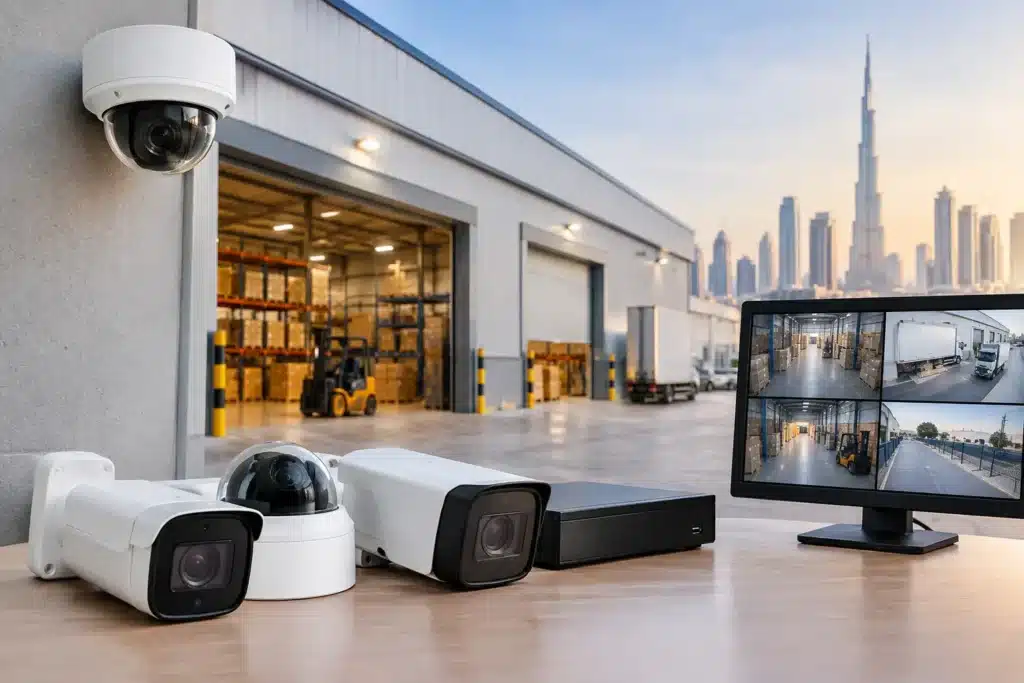
A warehouse camera system fails when it records an incident without providing usable evidence. A blurred face at a loading bay, unreadable pallet movement, or a blind spot around a high-value cage can create loss, disputes, and compliance problems. When evaluating the best CCTV cameras for warehouses in Dubai: Hikvision vs Uniview vs Wisenet, the right answer is not simply the brand with the highest resolution. It is the system that meets site risk, authority requirements, lighting conditions, retention needs, and long-term maintenance expectations.
Hikvision, Uniview, and Wisenet can all support professional warehouse surveillance when specified and installed correctly. The decision should follow a site survey and a compliant design, not a catalog comparison alone.
What a Warehouse CCTV System Must Deliver
Warehouse environments are demanding. Cameras must cover wide aisles, elevated racking, loading docks, entry and exit points, offices, cash-handling areas, perimeter gates, and vehicle circulation zones. They also operate around dust, heat, changing light, forklifts, and frequent activity after business hours.
For most logistics and industrial facilities, the priorities are clear: identify people and vehicles at critical points, track goods movement, deter theft, retain recordings for the required period, and retrieve footage quickly after an incident. A camera placed too high or fitted with the wrong lens may cover a large area but still fail to identify a person or read a plate.
In Dubai, CCTV design may also need to satisfy SIRA requirements. This affects camera placement, coverage, recording capacity, control-room equipment, cabling standards, and approval documentation. Equipment selection must therefore support the approved design rather than drive it.
Hikvision vs Uniview vs Wisenet for Warehouse Security
Hikvision: Broad Product Choice for Scalable Sites
Hikvision is frequently considered for warehouses because its product range covers common operational needs, from fixed turret cameras and varifocal domes to PTZ cameras, thermal devices, ANPR cameras, and video management platforms. This breadth can be useful where one warehouse requires standard coverage while another area needs specialized monitoring.
For large facilities, Hikvision can be a practical choice when the design calls for a high camera count, centralized recording, and a mix of indoor and outdoor camera types. Varifocal cameras are particularly valuable at loading bays and gates because installers can set the field of view precisely for the distance and target size.
The trade-off is specification discipline. A large product range also means significant variation between entry-level and professional models. Selecting cameras based only on megapixels can produce poor low-light performance, unnecessary storage consumption, or features that do not fit the operational requirement. The recorder, storage drives, network switches, and viewing workstation must be sized to match the selected cameras.
Uniview: Strong Value for Well-Defined Requirements
Uniview is often a sensible option for warehouse operators looking for professional IP surveillance without overbuilding the system. Its cameras and recorders can provide the core functions most facilities need: clear fixed coverage, infrared night monitoring, remote viewing, motion or event alerts, and centralized recording.
This brand can suit medium-sized warehouses, distribution centers, workshop facilities, and storage yards where camera locations and objectives are well defined. For example, fixed cameras may cover aisle intersections, receiving areas, dispatch doors, and staff entrances effectively when the installation team has calculated the correct lens and mounting height.
Uniview is not automatically the lower-cost answer in every project. The final installed cost depends on camera type, cabling routes, PoE switching, storage duration, civil works, and approval requirements. Its value is strongest when the system is designed around real risks rather than expanded with unnecessary devices.
Wisenet: Detailed Imaging and Enterprise Integration
Wisenet is a strong consideration for sites where image quality, cybersecurity controls, and enterprise-level system management carry higher weight. Warehouse operators with sensitive inventory, regulated goods, high-value stock, or complex multi-site operations may benefit from a platform designed for detailed video use cases and integration planning.
Wisenet cameras can be well suited to critical identification points such as secure cages, pharmaceutical storage zones, loading checkpoints, and controlled-access doors. In these locations, camera quality should be judged by the ability to identify a person or verify an action, not by wide-angle coverage alone.
The main consideration is budget alignment. Wisenet may be specified where its imaging, analytics, and management capabilities support a clear business or risk-control requirement. It may be excessive for a basic storage facility that only needs dependable perimeter, entry, and aisle coverage. The best design can combine camera types and capabilities across the site while keeping the platform manageable.
Which Brand Is Best for Your Warehouse?
There is no universal winner between Hikvision, Uniview, and Wisenet. Hikvision is often well suited to broad, scalable warehouse deployments that need a wide range of camera options. Uniview can offer a practical fit for clearly scoped industrial and logistics installations. Wisenet can be the stronger choice for critical areas where advanced imaging, management, or integration requirements justify the investment.
The more useful question is: what must each camera prove? At a main gate, you may need vehicle identification. At a dispatch door, you may need evidence of goods handover. Along warehouse aisles, you may need activity coverage and incident investigation. In a high-value area, you may need clear facial identification and controlled access records.
A professional site survey converts these objectives into a camera schedule. It establishes coverage angles, mounting heights, lens selection, infrared performance, network demand, storage capacity, and power requirements before installation begins.
Camera Types That Matter More Than Brand Names
A reliable warehouse system typically uses several camera types instead of one model everywhere. Fixed turret or dome cameras work well for internal aisles, work areas, offices, and receiving zones. Bullet cameras are commonly used outdoors for perimeter lines, entrances, parking areas, and loading bays because their direction is visible and their housings are suited to external conditions.
Varifocal cameras should be considered where distance changes the evidence requirement. A loading dock may need a wider view of vehicle activity while retaining enough detail at the handover point. A fixed-lens camera may not achieve both objectives.
PTZ cameras are useful for large yards and active external areas, but they should not replace fixed cameras at critical points. A PTZ records only where it is looking. Fixed cameras provide continuous evidence at gates, doors, and high-risk zones.
For complete warehouse coverage, consider these requirements during design:
- Adequate resolution based on the required identification distance, not marketing claims alone.
- Low-light and infrared performance for night shifts, shaded loading areas, and yard coverage.
- Weather and dust protection ratings for external cameras and industrial environments.
- Storage capacity that meets required retention periods at the chosen resolution and frame rate.
- Network segmentation and secure user access to protect the surveillance system.
- UPS backup and appropriate surge protection to reduce recording interruptions.
Compliance, Storage, and Cybersecurity Cannot Be Added Later
A warehouse CCTV project can be technically functional and still fail an inspection if the design does not meet authority requirements. In Dubai, SIRA approval should be addressed from the beginning. Changes after installation can mean additional cabling, camera relocation, recorder upgrades, and avoidable project delays.
Storage is another common weak point. Retention time depends on camera count, resolution, bitrate, frame rate, recording mode, and compression settings. Increasing every camera to maximum settings may reduce retention below the required period. Conversely, reducing quality to save storage can leave management with unusable footage. The correct approach is to calculate storage around each camera’s purpose.
Cybersecurity also deserves attention. Change default credentials, limit user permissions, separate surveillance devices from general office networks where appropriate, and maintain controlled remote access. A warehouse CCTV system is part of operational infrastructure, not a consumer device that should be installed and forgotten.
Make the Selection After a Site Survey
The best warehouse surveillance project starts with operational questions: Where do losses occur? Which doors, bays, or zones create disputes? What must be visible at night? Who needs access to footage? What approvals apply? The answers determine the design and then the brand selection.
ALNAJAH ALAWAL SECURITY SYSTEMS & EQUIPMENT TRADING L.L.C. plans warehouse CCTV installations around coverage, compliance, installation quality, testing, commissioning, and ongoing support. This reduces the risk of approval issues and ensures the footage has value when an incident occurs.
Choose Hikvision, Uniview, or Wisenet only after confirming that the proposed cameras can meet the required scene detail, recording retention, and regulatory standard. A correctly designed system protects stock, supports investigations, and keeps warehouse operations moving without avoidable delays. Stay compliant. Stay protected.