

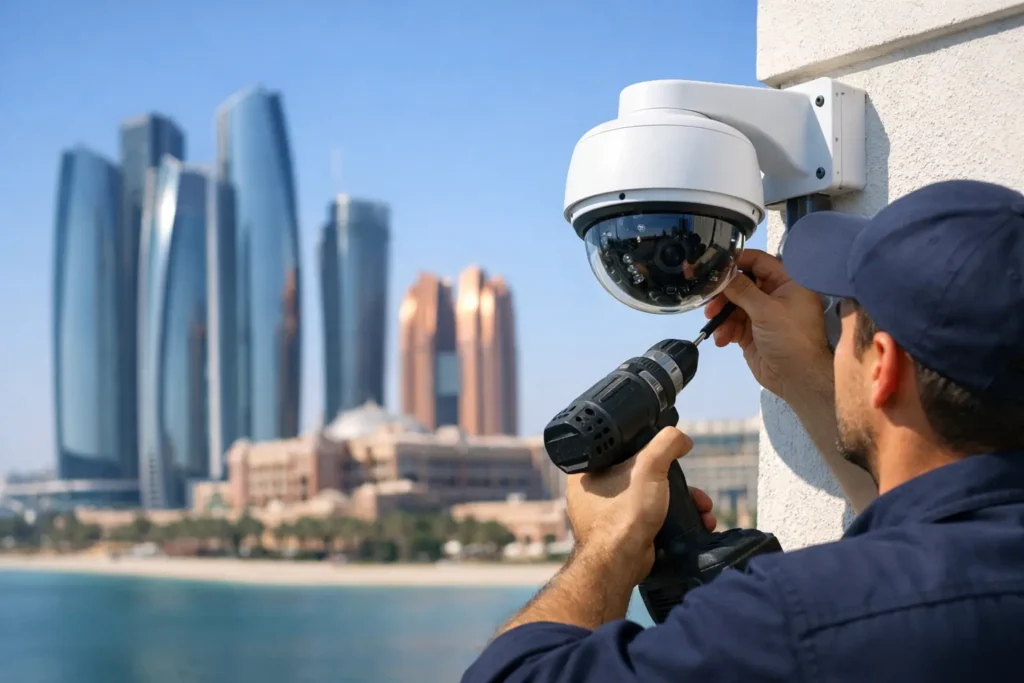
A failed CCTV inspection in Abu Dhabi rarely happens because a camera was missing. More often, the problem starts much earlier – the layout was not designed to match site risk, the technical scope missed authority requirements, or the approval process was treated as an afterthought. That is why admcc cctv installation abu dhabi projects need more than hardware supply. They need compliance-led planning from day one.
For warehouse operators, retail chains, facility managers, developers, and industrial businesses, the stakes are practical. If the system is not approved, handover can stall. If coverage is poor, incidents become harder to investigate. If installation quality is weak, maintenance costs show up fast. A compliant CCTV project is not just about security. It protects operations, timelines, and accountability.
What ADMCC CCTV installation in Abu Dhabi actually involves
ADMCC CCTV installation in Abu Dhabi is a regulated process, not a simple electrical job. The system must be designed, installed, tested, and documented in a way that aligns with local authority expectations. That includes camera placement, recording capability, storage, monitoring provisions, cabling standards, and final approval requirements.
The exact scope depends on the facility. A warehouse with loading bays, perimeter access, and dispatch zones has different surveillance priorities than a retail outlet, labor accommodation, clinic, or office tower. The right design starts with risk exposure and site use, then works backward into technical decisions. When contractors skip that step, they often end up adjusting the system later at extra cost.
This is also where business owners lose time. Many assume any CCTV installer can complete an authority-compliant project. In reality, compliance work requires familiarity with submission processes, documentation, inspection expectations, and the common reasons approvals get delayed.
Why compliance-first design matters
A compliant system is usually more efficient than a rushed one. That may sound counterintuitive, especially when some contractors sell speed by offering a quick quote with a camera count and little else. But without a proper survey and design review, the project risk goes up.
A compliance-first approach looks at entrance and exit points, operational blind spots, cash handling areas, perimeter exposure, internal circulation, parking, and critical assets. It also considers practical issues such as lighting conditions, mounting height, bandwidth, recorder capacity, and retention needs. These are not minor details. They determine whether footage is usable when an incident occurs.
There is always a trade-off between budget and performance, but cutting the wrong corner creates expensive rework. A cheaper camera with weak low-light performance may satisfy a purchase target while failing an operational one. Undersized storage may reduce upfront cost but create non-compliance later. Good system design keeps those trade-offs visible before installation begins.
The most common reasons CCTV projects get delayed
In Abu Dhabi, delays usually come from coordination failures rather than product shortages. One contractor handles cabling, another supplies equipment, a third party is expected to manage approvals, and no one owns the full process. When that happens, mistakes slip through quickly.
The first issue is incomplete site assessment. If ceiling conditions, power availability, network pathways, and camera fields of view are not checked early, the installation team ends up improvising on site. That affects finish quality and often changes the approved design.
The second issue is poor documentation. Approval-driven projects depend on accurate drawings, equipment details, and submission records. Missing or inconsistent paperwork slows progress even when the physical work is already finished.
The third issue is treating testing and commissioning as the last step instead of part of the plan. If recording quality, coverage, and system functionality are only reviewed at the end, defects appear when the deadline is already close.
How to evaluate an ADMCC CCTV installation contractor in Abu Dhabi
The best contractor is not necessarily the one with the lowest quote or the fastest promised delivery. For compliance-focused projects, the better question is whether the contractor can control the full chain from survey to approval.
Start with execution capability. Can the contractor perform the survey, prepare the design, supply approved equipment, complete installation, handle testing, support authority processing, and stay involved until sign-off? If the answer is fragmented, risk increases.
Then look at sector experience. A contractor who understands warehouses and logistics sites will think differently from one focused only on small shops. The same applies to hospitality, healthcare, education, and industrial facilities. Each environment has its own operational pressure points, and the CCTV design should reflect them.
Finally, ask how post-installation support works. A compliant handover is not the end of the system lifecycle. Businesses need maintenance response, recorder checks, camera health monitoring, and help when layouts change or additional coverage is needed. A contractor that disappears after installation creates long-term exposure.
What a well-managed CCTV project should look like
A professional admcc cctv installation abu dhabi project follows a clear sequence. First comes the site survey, where the team reviews the operational layout, access points, risks, and technical conditions. Then comes system design, where camera positions, equipment selection, storage, and network architecture are planned against site use and compliance requirements.
After that, the approval and documentation stage should move in parallel with procurement and scheduling. Installation should not begin as a guess-and-fix exercise. It should follow a defined design with clear quality control. Once the system is installed, testing and commissioning verify image quality, recording, playback, retention, remote access where applicable, and overall functionality.
The final stage is the one many clients care about most – approval without disruption. When the system has been designed and documented correctly, this stage moves faster and with fewer surprises.
Different sites need different CCTV priorities
No two facilities in Abu Dhabi have the same surveillance requirement, even when their floor areas look similar on paper. A logistics yard may need strong vehicle movement coverage, gate monitoring, loading dock visibility, and perimeter review. A retail business may prioritize customer areas, POS zones, entrances, and stock rooms. A commercial tower may focus more on lobby activity, parking access, service corridors, and tenant common areas.
That is why standard packages often underperform in real operations. They assume every facility needs the same camera density and the same hardware class. In practice, some sites need higher image detail in critical zones and simpler coverage elsewhere. Others need stronger recording resilience because investigation risk is higher. Matching the design to the site is what keeps costs rational without compromising compliance.
Why single-vendor execution reduces project risk
For regulated security work, single-vendor execution has a practical advantage: accountability stays in one place. The same provider manages survey, design, supply, installation, testing, approvals, and support. That means fewer handover gaps, fewer conflicting decisions, and less time spent chasing updates between subcontractors.
This matters most on active business sites. If you are managing a warehouse, hotel, clinic, retail branch, or mixed-use property, disruption has a direct cost. You need work completed on schedule, with clean documentation and a team that can answer authority questions without escalating the problem into a delay. That is the model ALNAJAH ALAWAL SECURITY SYSTEMS & EQUIPMENT TRADING L.L.C. is built around – approved right the first time, with execution controlled from start to finish.
Before you start an ADMCC CCTV installation in Abu Dhabi
If you are planning a new facility, fitting out a commercial unit, upgrading an old surveillance system, or preparing for inspection, start with the survey – not the shopping list. The right first step is to assess the site, the compliance requirement, and the operational risk together.
Ask for a realistic scope, not an optimistic one. Confirm who handles drawings and approvals. Check whether the proposed storage, camera coverage, and system architecture actually fit your facility. And make sure maintenance is part of the conversation before the system goes live, not after a recorder failure or blind spot complaint.
Security projects go wrong when they are treated as simple procurement. They go right when they are managed as compliance-critical infrastructure. If your business depends on uninterrupted operations, that distinction matters more than the camera brand on the box.
The smartest CCTV investment in Abu Dhabi is the one that clears approval, captures usable evidence, and keeps working long after handover day.