

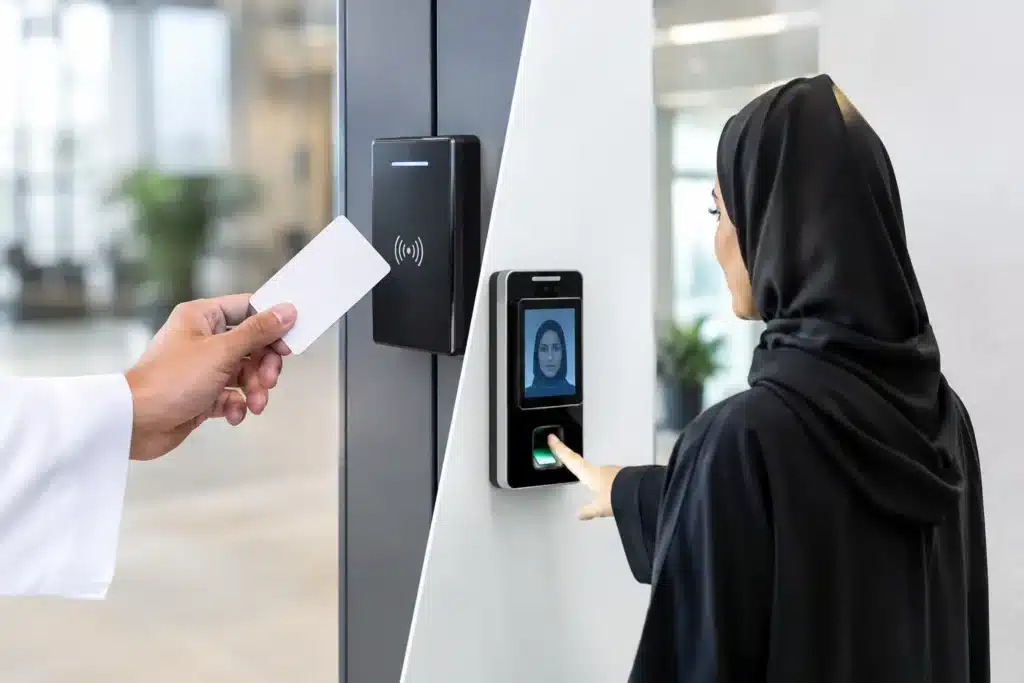
A staff member badges in for a colleague, a fingerprint reader fails after a dusty shift, or a payroll dispute begins because the attendance record does not match the actual time on site. These are practical reasons why the RFID vs biometric attendance decision matters. For warehouses, construction sites, retail branches, offices, labor accommodation, and industrial facilities, the right choice affects payroll accuracy, access control, compliance, and daily operations.
Neither technology is automatically better. RFID is fast, familiar, and cost-effective at scale. Biometric attendance provides stronger identity verification and reduces proxy attendance. The correct system depends on your site conditions, workforce size, privacy policy, operational risk, and whether attendance needs to work alongside door access and security monitoring.
RFID vs Biometric Attendance: The Core Difference
RFID attendance uses a card, key fob, or tag that employees present to a reader. Each credential has a unique identifier linked to an employee record in the attendance software. The reader records the time, location, and sometimes the direction of movement, such as entry or exit.
Biometric attendance identifies the person rather than a credential. Depending on the system, it may use fingerprints, facial recognition, palm recognition, or iris recognition. When the employee checks in, the system compares the captured biometric data against an enrolled template.
The difference is simple but significant: RFID confirms that a registered card or tag is present. Biometrics are designed to confirm that the registered individual is present. That distinction directly affects time theft risk, payroll control, and the level of oversight required at the site.
When RFID Attendance Is the Practical Choice
RFID is often the right starting point for organizations that need dependable, rapid attendance capture across many employees or entrances. A worker can tap a card in seconds, and contactless readers can maintain a steady flow during shift changes. This is useful where hundreds of employees arrive within a short window.
For multi-site organizations, RFID also offers straightforward credential management. The same card can be configured for attendance, office doors, parking barriers, staff-only areas, lockers, and canteen access. When an employee leaves, the credential can be disabled immediately. When access rights change, administrators can update permissions without replacing the reader infrastructure.
RFID works particularly well in clean office environments, retail outlets, hotels, schools, and commercial properties where card issuance and control are easy to manage. It is also a practical option where workers wear gloves, masks, safety equipment, or have hands affected by dust, grease, chemicals, or physical labor.
The limitation is that an RFID card can be shared, lost, borrowed, or used by another person. A system may accurately record a card transaction while still failing to prove who carried the card. If proxy attendance is a recurring problem, RFID alone may not provide the level of accountability the business needs.
Where Biometric Attendance Delivers More Control
Biometric attendance is built for sites where identity certainty has a direct financial, operational, or security value. It helps reduce buddy punching because an employee cannot normally clock in with another employee’s fingerprint or face. For businesses with hourly teams, rotating shifts, subcontractors, or high payroll exposure, this can produce cleaner attendance records and fewer disputes.
A biometric terminal is also useful at sensitive locations where attendance and access must support a stronger security process. For example, a warehouse may use biometrics at a controlled entry point, while access rights restrict who can enter inventory areas, server rooms, fuel storage zones, or management offices.
Facial recognition systems can be especially effective for high-throughput entrances because they can authenticate employees without a card or physical touch. This may suit reception points, healthcare environments, or facilities that want to avoid shared contact surfaces. However, camera position, lighting, enrollment quality, head coverings, and the use of personal protective equipment should be assessed during site design.
Fingerprint systems can provide strong value, but they are not ideal for every workforce. Dust, moisture, worn fingerprints, gloves, and frequent manual work can reduce first-attempt recognition rates. A professional installation should include practical fallback rules, such as supervisor verification or a controlled backup credential, so that a reader issue does not delay an entire shift.
Compare the Operational Trade-Offs
The decision should not be made on device price alone. Attendance equipment is part of a wider process involving employee records, work schedules, payroll rules, visitor management, access permissions, and reporting.
RFID systems generally have lower enrollment effort. Issuing a credential is quick, replacement cards are inexpensive, and workers do not need to submit biometric data. This can make RFID easier to deploy for temporary staff, contractors, and large workforces with frequent turnover.
Biometric systems require more careful enrollment and policy management. The organization should explain why biometric data is collected, how it is stored, who can access it, how long it is retained, and what happens when an employee leaves. A properly designed system stores protected biometric templates rather than ordinary image files, but data handling still requires clear governance and restricted administrative access.
Speed also depends on setup, not just technology. An RFID reader can process a large queue rapidly, while a biometric terminal may require employees to approach in an orderly manner for reliable recognition. At busy sites, multiple devices or separate entry lanes may be necessary. The right design prevents bottlenecks at shift start and maintains accurate time records.
Integration is another deciding factor. Both technologies can connect with payroll and HR platforms, but the integration must be planned around the business rules that matter: overtime, break times, grace periods, split shifts, late arrivals, off-site work, and approval workflows. A reader that captures time correctly is only one part of an attendance solution. The reports and exception handling determine whether management can act on the information.
A Hybrid System Can Be the Best Answer
Many sites do not need to choose one technology for every door and every employee. A hybrid design can use RFID for routine access and biometric verification at higher-risk points or during attendance clock-in. This approach keeps daily movement fast while applying stronger identity checks where they provide the most value.
For example, a commercial facility may issue RFID cards for parking, elevators, common doors, and staff areas. Biometric devices can then be installed at the main employee entrance or payroll clocking point. A logistics operator may use RFID for vehicle gate access and biometrics for warehouse staff attendance. The system design should follow the actual flow of people, vehicles, and goods through the site.
Hybrid systems also provide continuity. If a biometric reader needs maintenance, a controlled RFID fallback can keep operations moving while preserving an audit trail. The key is to configure exceptions carefully so that a fallback process does not become an easy way to bypass identity checks.
Questions to Ask Before You Install
Start with the risk you are trying to control. If the main objective is quick, reliable time capture and integrated door access, RFID may be sufficient. If false clock-ins, payroll leakage, or identity verification are major concerns, biometrics deserve serious consideration.
Then assess the environment. Will workers wear gloves? Is the entrance exposed to dust, sunlight, humidity, or heavy traffic? Are employees likely to carry cards consistently? Does the site need contactless authentication? These conditions influence reader selection, mounting position, network design, and the number of devices required.
Finally, establish the rules before installation. Define who can edit attendance records, who approves exceptions, how missed punches are handled, and how long records are retained. For compliance-led facilities, ensure the system supports auditable reporting and aligns with the organization’s HR, privacy, and site-security procedures.
Installation Quality Determines the Result
An attendance terminal cannot solve a weak process or poor site planning. Devices must be placed at logical control points, connected to reliable power and network infrastructure, configured with correct schedules, and tested against real shift conditions. Staff also need clear instructions, especially when biometric enrollment or access policies are introduced.
For facilities in Dubai, Abu Dhabi, and Sharjah, ALNAJAH ALAWAL can assess attendance requirements alongside access control, CCTV, and broader ELV infrastructure. A coordinated survey helps prevent isolated systems, duplicated cabling, and avoidable changes after installation.
Choose RFID when speed, cost control, and flexible credential-based access are the priority. Choose biometrics when proof of identity carries greater weight. The strongest decision is the one that fits your people, site conditions, and operational controls – and keeps your workforce moving without compromising accountability.