

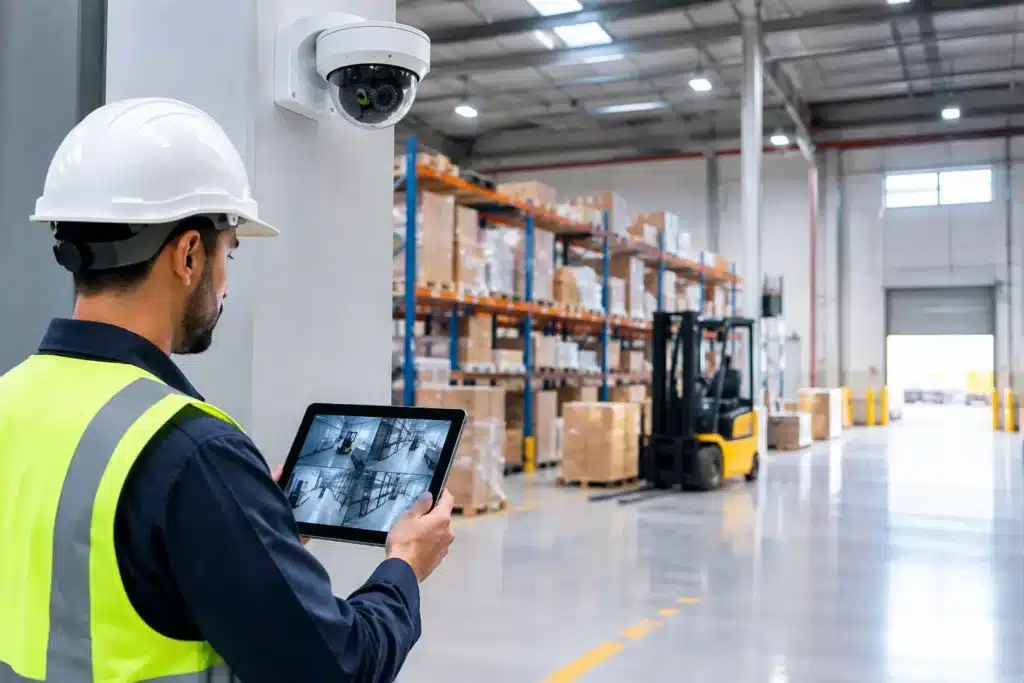
A loading-bay door left open after a late dispatch can create more than a theft risk. It can expose inventory, allow unauthorized access, compromise a compliance inspection, and interrupt the next day’s operations. Essential warehouse security upgrades address these practical weak points by giving operators visibility, control, and a clear record of what happened across the facility.
For warehouses, distribution centers, and industrial yards, security is not a single camera at the gate. It is a coordinated system covering people, vehicles, inventory, restricted areas, and the network that supports them. The right investment depends on the site layout, stored goods, operating hours, authority requirements, and existing infrastructure.
Why Essential Warehouse Security Upgrades Start With Risk
Warehouse risks rarely sit in one location. High-value stock may be vulnerable in racking aisles, while unauthorized entry is more likely at staff doors, perimeter gates, loading bays, or contractor access points. A site with 24-hour dispatch activity has different exposure from a warehouse that closes every evening. Before selecting equipment, identify where loss, safety incidents, access failures, and operational delays are most likely to occur.
A professional site survey should map vehicle entry and exit routes, pedestrian movement, blind spots, camera mounting positions, lighting conditions, network pathways, and the location of sensitive stock. It should also assess whether the facility must meet SIRA, Abu Dhabi monitoring and control authority, Sharjah Police, landlord, insurer, or customer security requirements. Designing first and correcting gaps later is expensive. It can also delay approvals and handover.
The goal is not to install the most equipment. It is to create usable evidence, restrict access where it matters, and ensure that the system continues to work when the warehouse is busiest.
Upgrade CCTV From General Coverage to Usable Evidence
CCTV remains the foundation of warehouse security, but camera quantity alone does not protect a site. Footage must clearly show the relevant person, vehicle, activity, or stock movement when an incident occurs. A wide-angle camera can provide useful context across a loading yard, but it may not identify a driver’s face or capture a license plate at speed. These are different requirements and should be designed accordingly.
Prioritize coverage at external gates, perimeter lines, loading docks, dispatch and receiving zones, high-value storage, server or control rooms, staff entrances, cash-handling points, and areas where forklifts and pedestrians interact. Cameras should be selected for the environment. Dust, heat, glare, low light, vibration, and large changes between indoor and outdoor lighting all affect image quality.
Storage capacity is equally critical. If an incident is discovered weeks later, short retention periods can leave the operator without evidence. Retention requirements should be set during design, based on local regulations, business risk, camera resolution, recording activity, and available storage. Higher-resolution cameras improve detail but consume more bandwidth and storage. This trade-off must be calculated rather than guessed.
For compliance-led projects in Dubai, Abu Dhabi, and Sharjah, camera locations, recording specifications, control-room arrangements, and documentation may need to align with the applicable authority’s requirements. An approved design, correct installation, testing, and commissioning reduce the risk of failed inspections and rework.
Do Not Ignore Lighting and Camera Health
A well-positioned camera cannot compensate for a dark loading yard or direct sunlight behind a subject. Upgrade lighting where required, particularly around gates, docks, walkways, and external storage. Lighting should support safe work as well as surveillance, without creating glare for drivers or neighboring properties.
Camera health monitoring is also necessary. A camera that has lost focus, been knocked out of position, or stopped recording is often discovered only after an incident. System alerts for offline devices, storage faults, and network failure give facilities teams a chance to act before coverage is lost.
Control Who Can Enter Sensitive Areas
Keys create an accountability problem. They can be copied, passed between shifts, or retained by former employees and contractors. Access control replaces uncertainty with records. It allows warehouse management to decide who can enter a particular area, at what time, and under what conditions.
Start with doors that separate public, staff, and restricted zones. This may include administrative offices, IT rooms, inventory cages, pharmaceutical or high-value storage, maintenance rooms, and dispatch offices. Card, fob, mobile credential, biometric, or PIN-based access can be appropriate depending on the workforce, hygiene requirements, throughput, and required level of assurance.
Access control should also support the operation rather than slow it down. Emergency egress, fire alarm interfaces, door hardware, power backup, and visitor procedures all need to be considered. A door that is secure but prevents safe evacuation is not a successful installation. Similarly, a biometric reader may provide stronger identity verification, but it can create queues at a busy shift change if entry lanes are not planned properly.
Visitor and contractor access deserves the same attention. Temporary credentials with expiry times are easier to control than shared keys or informal sign-in sheets. Pairing access records with CCTV footage creates a clearer audit trail when stock discrepancies or unauthorized activity are investigated.
Secure the Perimeter and Loading Yard
The perimeter is often where a small weakness becomes a major loss. Fencing, gates, barriers, intercoms, security lighting, CCTV, and intrusion detection should work together. A camera records an event, but it does not necessarily stop it. A gate controls vehicle entry, but it needs a process for confirming who is authorized to enter.
At larger facilities, automated vehicle barriers and gate intercoms can reduce reliance on manual checks. License plate recognition may be useful for controlled fleets and frequent suppliers, although it requires clear plate visibility, suitable lane design, and a process for handling exceptions. It is not a replacement for guard procedures where cargo, visitor identity, or delivery documents must be verified.
For warehouses with exposed yards or valuable outdoor assets, consider intrusion detection along vulnerable boundaries and around isolated structures. The best technology depends on the perimeter length, terrain, false-alarm risk, guard response capability, and nearby traffic. A poorly configured detection system that generates repeated false alarms will soon be ignored.
Protect the Network Behind the Security System
Modern surveillance and access control systems rely on the network. If switches, recorders, cabling, passwords, or power supplies are poorly managed, a physical security upgrade can still fail. Warehouses should use secured equipment cabinets, structured cabling, appropriate network segmentation, controlled user permissions, and backup power for critical devices.
Cybersecurity is part of physical security. Default passwords, shared administrator accounts, outdated firmware, and remote access without proper controls can expose cameras and access systems to misuse. Establish named user accounts, limit permissions by role, keep an asset register, and define who is authorized to view, export, or delete footage.
Power resilience also matters. Short outages can disrupt recording, release controlled doors, or take gate systems offline. The appropriate backup arrangement depends on the risk assessment and expected outage duration. Critical systems may require uninterruptible power supplies, while broader continuity planning may include generator support.
Extend Security to Vehicles, Fuel, and Mobile Assets
A warehouse security plan should not stop at the building line. Delivery vehicles, forklifts, trailers, generators, and fuel tanks can represent a major source of operational loss. GPS vehicle tracking helps fleet managers verify route activity, driver behavior, idle time, and vehicle utilization. Geofencing can alert management when a vehicle enters or leaves a warehouse, customer site, or restricted area.
Fuel monitoring is especially valuable where fleets, equipment, or onsite tanks operate at scale. It can highlight unusual consumption, suspected fuel theft, and discrepancies between fuel issued and vehicle activity. These tools are most effective when alerts are assigned to a responsible team member and reviewed through a defined process. Data without ownership does not improve control.
Prioritize Upgrades in the Right Order
If budget or operational timing requires a phased rollout, address the weaknesses that create the greatest exposure first. In most warehouses, the practical order is:
- Cover gates, loading bays, perimeter access points, and high-value inventory with correctly designed CCTV.
- Replace uncontrolled keys at sensitive doors with access control and clear credential management.
- Improve yard lighting, gate procedures, barriers, and intrusion detection where perimeter risk is high.
- Protect recording, network, and power infrastructure so security systems remain available.
- Add fleet tracking and fuel monitoring where vehicles, mobile assets, or fuel represent measurable loss.
This order may change for a site with a known fuel issue, frequent vehicle incidents, or a pending authority inspection. The risk assessment should determine the sequence, not a generic product list.
Installation Quality Determines the Outcome
Security equipment performs only as well as its design, installation, testing, and ongoing maintenance. Poor camera angles, inadequate cabling, unlabelled devices, unsupported storage calculations, and incomplete documentation create problems long after handover. They also make future expansion more difficult.
ALNAJAH ALAWAL SECURITY SYSTEMS & EQUIPMENT TRADING L.L.C. manages warehouse security projects from survey and compliant system design through installation, testing, commissioning, approval support, training, and maintenance. That approach gives warehouse operators one accountable partner across the project rather than separate suppliers for equipment, installation, and compliance processing.
Start with a site survey that measures real operational risks and authority requirements. A warehouse security upgrade should make daily work easier to control, evidence easier to retrieve, and compliance easier to maintain – without interrupting the flow of goods that keeps the business moving.