

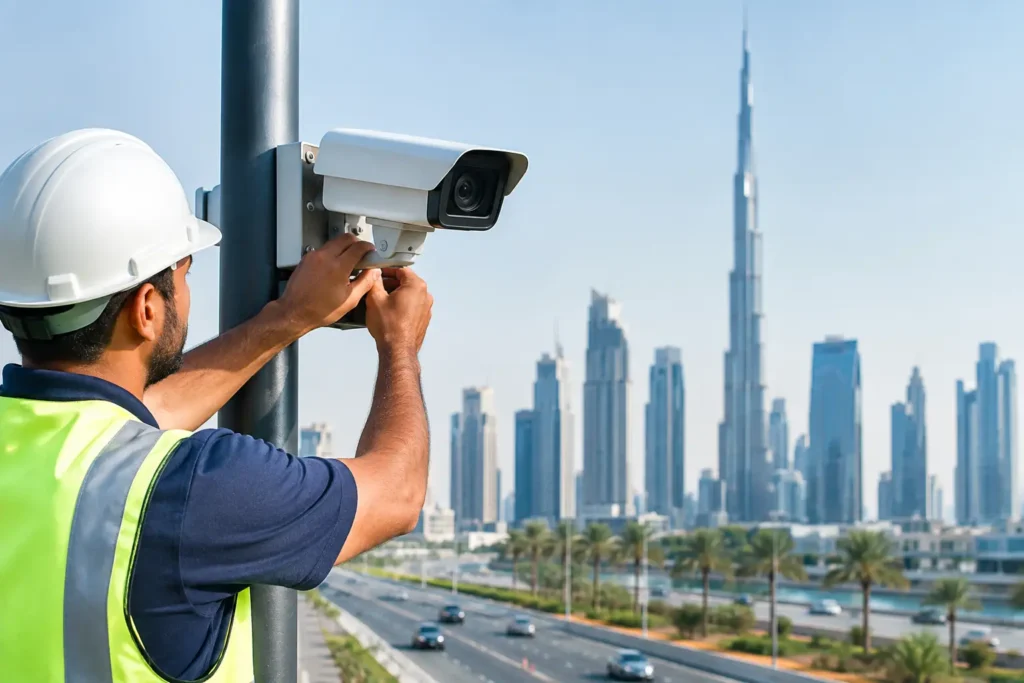
A vehicle gate is often the first point of exposure for a warehouse, tower, hotel, retail site, or industrial facility. If plates are not captured clearly, barriers open without a verified record, and visitor logs rely on manual input, the site has a security and accountability gap. For an ANPR camera installation Dubai businesses can rely on, the focus must be on usable plate data, correct integration, and a design that satisfies site operations as well as authority requirements.
ANPR, or Automatic Number Plate Recognition, is not simply a CCTV camera pointed at a driveway. It is a purpose-built vehicle identification solution that reads license plates, records the event, and can trigger an action such as opening a barrier, alerting security, or logging a vehicle entry. The installation details determine whether it performs reliably or becomes another system that needs manual correction.
What an ANPR System Should Deliver
A correctly designed ANPR system gives security and operations teams a dependable record of vehicle movement. At a minimum, it should identify plates at the required entry and exit points, capture supporting vehicle footage, and retain searchable records for incident reviews or access investigations.
For many commercial sites, ANPR also supports controlled access. Authorized staff, suppliers, tenant vehicles, or fleet vehicles can be placed on an approved list. Vehicles that are blocked, unknown, or arriving outside permitted hours can create an alert or remain subject to guard verification. This reduces unnecessary barrier operation while preserving a clear audit trail.
The right outcome depends on the site. A residential development may prioritize visitor access and resident convenience. A logistics yard may need to identify trucks at multiple lanes, connect arrivals to dispatch activity, and retain evidence of loading-bay movements. A fuel facility or high-value retail location may require tighter rules, immediate alerts, and clear footage that supports investigation.
ANPR Camera Installation in Dubai Starts With a Site Survey
The camera should be selected after the lane and traffic conditions are assessed, not before. Plate-reading performance is affected by vehicle approach angle, mounting height, lane width, travel speed, lighting, reflective surfaces, and the distance between the camera and the plate. A general surveillance camera may provide useful overview footage but may not deliver consistent recognition results at a busy gate.
A professional survey identifies where vehicles stop, turn, queue, and accelerate. It also confirms whether there is a single lane or multiple lanes, whether a barrier is already installed, and whether the site requires separate entry and exit coverage. These details influence lens selection, camera position, lighting, network cabling, storage capacity, and the required processing hardware.
Lighting deserves particular attention. Bright sun at a driveway, vehicle headlights at night, tinted plate covers, and shadows from canopies can all affect capture quality. An ANPR camera may use infrared illumination or specialized exposure settings, but it still needs a clean field of view and proper alignment. The goal is not merely to see a vehicle. The goal is to read the plate accurately when it matters.
Camera Placement Is Not a Guessing Exercise
A camera mounted too high, too far from the lane, or at a steep angle can create distorted plate images. A camera that covers two uncontrolled lanes may struggle when vehicles overlap or pass side by side. In high-traffic locations, a dedicated camera per lane is often the more reliable choice.
Installation teams should also consider physical protection. Cameras at gates, loading yards, and industrial entrances may be exposed to dust, heat, vibration, vehicle impact, or tampering. Appropriate housings, mounting structures, cable containment, grounding, and weather-rated equipment protect system performance over time.
Integrating ANPR With Gates, CCTV, and Access Control
ANPR produces more value when it works with the rest of the security environment. Integration can link a recognized license plate to a barrier controller, access control platform, intercom, visitor management process, or video management system. The result is one operational sequence rather than separate systems that guards must manage manually.
For example, an approved delivery vehicle can be recognized at the service gate, its arrival recorded, and the barrier opened according to the permitted schedule. If the same vehicle arrives after hours or appears on a watchlist, the system can notify the security desk and retain the associated video. This supports faster decisions without removing human control where it is needed.
There are trade-offs. Fully automated barrier opening is suitable only when plate data, authorization rules, safety devices, and traffic flow have been properly tested. Some sites should use ANPR as a verification tool while the guard confirms entry through an intercom or access credential. This is common where visitor identities, cargo documentation, or high-security protocols matter as much as the vehicle plate.
For fleet operators, ANPR can complement GPS vehicle tracking. The gate event provides a verified arrival or departure record, while the tracking platform provides route, trip, driver behavior, and vehicle utilization data. Together, they give managers a clearer view of operational movement without depending entirely on manual logs.
Compliance Must Be Built Into the Design
Dubai projects may require CCTV design and installation to align with SIRA requirements, while sites in Abu Dhabi and Sharjah can be subject to their own authority and police requirements. The applicable standard depends on the location, property type, risk profile, and scope of the security system.
ANPR cameras should therefore be included in the wider security design from the beginning. Camera locations, coverage, recording, retention, equipment specifications, network layout, and monitoring arrangements must be coordinated with the project requirements. Adding an ANPR camera late in construction can lead to cable-routing problems, incomplete coverage, unsuitable mounting points, or approval delays.
A compliance-led contractor manages this process through survey, design, equipment supply, installation, testing, commissioning, and approval documentation. ALNAJAH ALAWAL SECURITY SYSTEMS & EQUIPMENT TRADING L.L.C. supports this end-to-end approach for SIRA-approved CCTV projects and other authority-driven security installations across the UAE. The objective is straightforward: get the installation configured correctly and avoid costly rework before inspection.
Testing Determines Whether the System Is Ready
An ANPR system is not complete when the camera powers on. It must be tested under the conditions the site will actually face. This includes daytime and nighttime plate capture, authorized and unrecognized vehicles, barrier activation, alert delivery, footage retrieval, and recording retention.
Testing should also cover realistic operating behavior. Can the system read a plate when a vehicle stops slightly short of the barrier? What happens if a truck approaches at an angle? Does recognition remain consistent during glare, rain, or heavy evening traffic? Can a security supervisor quickly search a plate number and retrieve the correct event?
The answers may require adjustments to camera angle, focus, exposure settings, recognition rules, or lane controls. That is normal. Commissioning is the stage where those adjustments turn a technical installation into an operational system.
Plan for Ongoing Use, Not Just Handover
Security teams need clear instructions for managing approved lists, blocked plates, visitor exceptions, and alarm events. Facility managers need to know who can change access rules and how records are retained. IT teams may need visibility into network requirements, user permissions, and cybersecurity controls.
Maintenance also matters. Dirty lenses, shifted camera brackets, damaged cabling, unplanned lane changes, and software configuration issues can reduce recognition performance. Periodic checks help keep the system aligned with how the property operates. If vehicle patterns change after a tenant move-in, expansion, or revised delivery process, the ANPR configuration may need to change as well.
Before selecting equipment, arrange a site survey that looks beyond the gate itself. Confirm traffic flow, authority requirements, camera coverage, barrier safety, integration needs, and the records your team must retrieve later. A well-planned ANPR installation gives your site more than a plate number on screen. It gives your team a defensible record of every vehicle decision at the point of entry.