

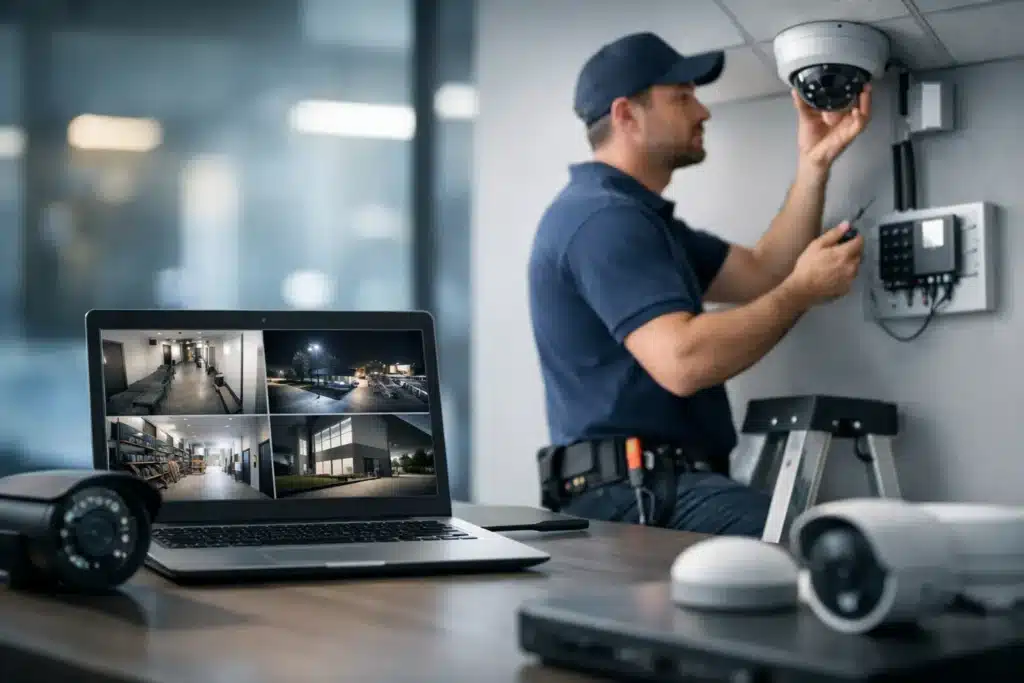
A camera that stops recording overnight, an access door that fails during a shift change, or a network switch that drops critical devices can quickly become more than a technical issue. For commercial sites, 24 7 security system maintenance is the operational discipline that keeps security equipment recording, communicating, and ready for inspection when it matters.
Security systems are often treated as complete once installation and approval are finished. That approach creates risk. CCTV, access control, intrusion alarms, intercoms, GPS tracking platforms, and ELV networks all require ongoing attention. Equipment ages, site conditions change, software is updated, and minor faults can develop into coverage gaps or compliance concerns if they are not addressed promptly.
Why 24 7 Security System Maintenance Is a Business Requirement
A security system is only effective when every critical component works together. Cameras must capture usable footage. Recorders must retain it for the required period. Access control readers must grant or deny entry accurately. Power supplies, storage devices, network equipment, and monitoring connections must remain stable.
For a warehouse, a failed camera near a loading bay may leave vehicle movements and stock handling unverified. For a retail store, a recorder fault may mean an incident cannot be investigated. For a property manager, unreliable door access can affect tenant safety and daily operations. In regulated environments, the consequences may also include failed inspections, delayed approvals, corrective work, or operational disruption.
Continuous maintenance does not mean a technician must be physically on site every hour. It means there is a defined support structure for remote health checks, scheduled preventive visits, fault response, spare-part coordination, and clear accountability. The right level of coverage depends on the site, its risk profile, and the authority requirements that apply.
What a Proper Maintenance Scope Should Cover
A maintenance contract should be specific. A vague promise to “check the system” does not protect a business when an incident occurs. The scope should identify the equipment covered, service frequency, response expectations, reporting process, exclusions, and escalation procedure.
CCTV and Video Surveillance
CCTV maintenance starts with image quality. Technicians should verify that cameras are online, correctly positioned, clean, focused, and delivering the required field of view. They should inspect housings, brackets, cabling, junction boxes, power connections, and signs of water ingress or physical damage.
Recording performance requires equal attention. A live camera feed is not enough if footage cannot be retrieved later. Maintenance should confirm recorder status, hard-drive health, retention capacity, timestamps, playback function, user access, and backup settings where applicable. Remote viewing should also be tested under authorized conditions.
For sites subject to SIRA, Abu Dhabi monitoring and control authority, or Sharjah Police requirements, the maintenance process should preserve the approved design and operating condition. Replacing equipment, changing camera views, or altering recording settings without considering compliance can create avoidable issues during inspection.
Access Control, Intercom, and Alarm Systems
Access control systems depend on more than card readers. Door locks, emergency break-glass units, exit buttons, door contacts, controllers, batteries, and software permissions all affect reliability. A preventive visit should test normal access, unauthorized access denial, forced-door alerts, fire alarm release interfaces where installed, and event logging.
Intercom maintenance should include audio clarity, call routing, power supply checks, and outdoor station condition. Alarm systems require device testing, battery inspection, panel health checks, communication-path verification, and review of false-alarm causes. Repeated false alarms are not merely inconvenient. They can reduce staff confidence and hide genuine events.
Network, Power, and ELV Infrastructure
Many security failures begin outside the camera or reader itself. A weak network connection, overloaded switch, failed UPS battery, damaged fiber link, or poorly labeled cabinet can take multiple devices offline at once.
Maintenance should inspect network switches, PoE capacity, rack ventilation, patch leads, cabinet security, grounding, power distribution, and UPS performance. Firmware and cybersecurity updates should be managed carefully. Updating equipment without checking compatibility can interrupt recording or integrations, while never updating it can expose systems to known risks. The correct approach is controlled change management with testing and documented rollback options.
Preventive Maintenance Reduces Emergency Callouts
Reactive support has a place. If a recorder fails or a gate controller goes offline, a rapid response is necessary. But emergency repairs are usually more expensive, more disruptive, and more difficult to schedule than planned maintenance.
Preventive maintenance identifies warning signs before they become failures. A hard drive may show errors before it stops recording. An outdoor camera may need cleaning before dust and heat degrade image quality. A UPS battery may need replacement before a power interruption takes down surveillance coverage. These are manageable issues when identified early.
For high-activity sites such as logistics facilities, industrial plants, malls, hotels, and fuel stations, maintenance frequency should reflect operating conditions. Dust, heat, vibration, heavy vehicle movement, and 24-hour operations place more pressure on equipment than a low-traffic office environment. A one-size-fits-all schedule is rarely the right answer.
Set Clear Priorities for 24 7 Security System Maintenance
Not every fault has the same operational impact. A well-managed support plan classifies issues by urgency. A complete loss of recording at a high-risk entrance requires a faster response than a single camera with a minor viewing-angle adjustment. Likewise, a failed access door at a critical server room has a different priority from a reader at a low-use internal door.
Your service provider should agree on what constitutes a critical, high, medium, or routine issue. The plan should state how faults are reported, who can authorize work, how after-hours calls are handled, and when temporary measures will be used if a permanent repair requires parts.
Businesses should also nominate internal contacts who understand the system and can confirm whether a fault affects operations. This reduces delays when technicians need access to security rooms, roof areas, electrical closets, or restricted zones.
Documentation Is Part of Protection
Maintenance without records is difficult to prove and difficult to improve. Each visit should produce a clear report showing the devices checked, faults found, actions completed, recommendations, and any equipment that needs replacement.
Accurate documentation supports facility teams in several ways. It creates a fault history, helps budget for lifecycle replacement, confirms maintenance activity for management, and provides evidence of responsible system management during audits or inspections. For multi-site operators, consistent reporting also makes it easier to identify repeated problems across locations.
Keep current copies of camera layouts, network diagrams, device lists, user-access records, warranty details, and approval documents. When a new contractor or facility manager takes over, missing information can turn a straightforward repair into a time-consuming investigation.
When Repair Is Not the Best Decision
Maintenance extends system life, but it cannot make obsolete equipment suitable forever. Older analog cameras, undersized recorders, unsupported software, degraded cabling, and storage systems with limited capacity may repeatedly create risk. Frequent callouts can cost more over time than a planned upgrade.
The decision to repair or replace should be based on performance, compliance, availability of parts, cybersecurity exposure, and the operational cost of downtime. A phased upgrade can often protect the budget while improving the most critical areas first. For example, a business may replace failing recorders and priority cameras while retaining serviceable infrastructure during the next budget cycle.
A qualified contractor should explain these trade-offs directly. The goal is not to replace equipment unnecessarily. It is to ensure the site remains protected, operational, and compliant.
Choose a Maintenance Partner That Owns the Outcome
The best maintenance provider understands both field conditions and the system’s approval obligations. They should be able to diagnose faults across surveillance, access control, alarms, networking, and power infrastructure rather than shifting responsibility between multiple vendors.
ALNAJAH ALAWAL SECURITY SYSTEMS & EQUIPMENT TRADING L.L.C. provides end-to-end support for security and ELV environments, from compliant system design and installation to ongoing maintenance and fault response. For businesses operating in Dubai, Abu Dhabi, and Sharjah, that integrated responsibility helps reduce approval risk and avoids the delays that occur when suppliers, installers, and maintenance teams work separately.
Before signing a contract, ask for the maintenance schedule, covered equipment list, response process, reporting format, and exclusions in writing. Confirm that the provider can support your site’s specific authority requirements and can respond appropriately when a critical device fails outside normal hours.
Security maintenance works best when it is treated as an operating standard, not an occasional repair request. A documented plan, tested equipment, and accountable support give facility teams the confidence to keep working while their security systems continue doing their job. Stay compliant. Stay protected.