

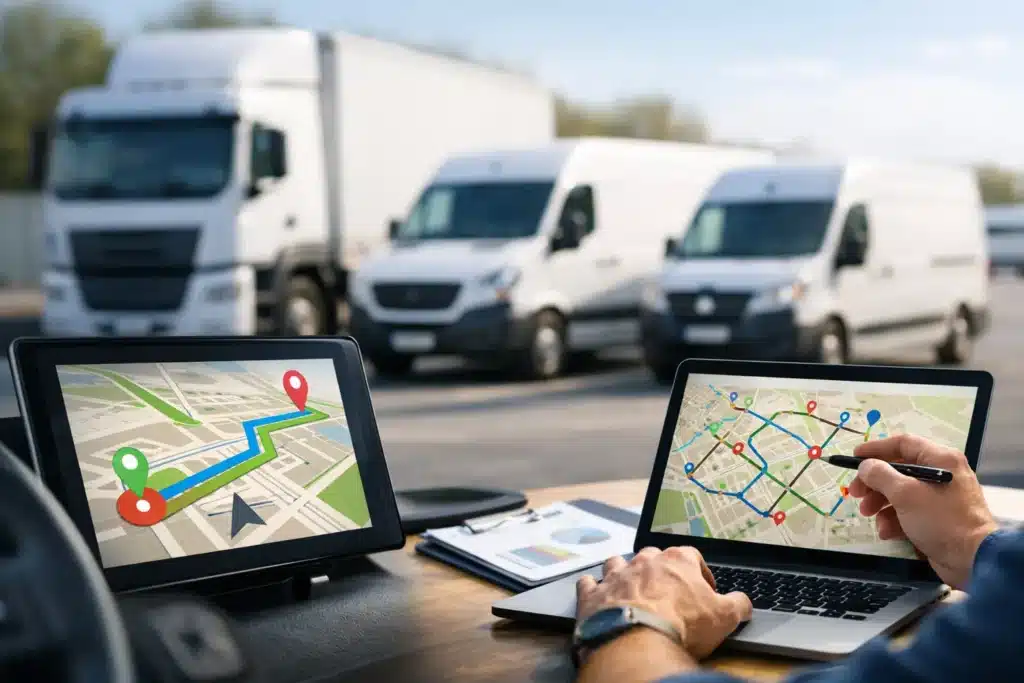
A delivery vehicle can look productive on a map while quietly losing money every hour. A route may be longer than necessary, a driver may be idling at a customer location, or two vehicles may be covering the same area. This fleet route optimization case study shows how a representative UAE logistics operation can use GPS tracking, dispatch controls, and fuel data to identify those losses and act on them.
The objective is not simply to show drivers a shorter path. Effective route optimization gives fleet managers control over planned versus actual trips, service timing, fuel use, driver behavior, and vehicle capacity. For operators managing time-sensitive deliveries, site visits, transport vehicles, or field-service teams, that control protects margins and customer commitments.
The Operating Problem: Vehicles Were Moving, but Efficiency Was Unclear
Consider a mid-sized distribution business operating 32 light commercial vehicles across Dubai, Sharjah, and surrounding industrial areas. The fleet completed daily deliveries to retail outlets, warehouses, and project sites. Dispatchers assigned jobs by phone and relied on drivers’ local knowledge to select routes.
The business did not have a confirmed benchmark for daily mileage per vehicle, actual stop duration, route deviations, or fuel consumed per delivery. Fuel spending had increased over several months, while customers were reporting inconsistent arrival times. Management could see the total fuel bill, but not the operational reason behind it.
This is a common issue. A fleet can have experienced drivers and a busy dispatch team yet still operate with avoidable cost. Without verified trip data, managers are left to make decisions based on assumptions: traffic was bad, a customer kept the driver waiting, the route was unavoidable, or the vehicle needed more fuel. Some explanations are valid. The problem is that they cannot be measured or separated from preventable waste.
Fleet Route Optimization Case Study: The Control Plan
The first step was not to change every route at once. The fleet was assessed to establish a reliable baseline. GPS tracking units were installed and configured to report live location, ignition status, speed, geofence entry and exit, trip history, and extended idling. The system was paired with fuel monitoring and consumption reporting for selected high-use vehicles.
Dispatchers then defined the locations that mattered: the main warehouse, frequent customer delivery points, approved fueling stations, workshop locations, and restricted areas. Each location was set as a geofence, allowing management to confirm when a vehicle arrived, how long it remained, and whether it traveled outside the planned service area.
For a four-week baseline period, the team reviewed route performance without immediately imposing aggressive restrictions. That gave the business enough data to distinguish a one-off disruption from a repeated pattern. It also reduced resistance from drivers, who could see that route decisions were being reviewed against actual road conditions and job requirements, not just straight-line map distance.
What the Data Revealed
The results showed that the main problem was not one major route failure. It was a combination of smaller losses repeated across the fleet.
Several vehicles were leaving the warehouse before loads and delivery priorities were fully organized. This led to return trips, cross-city routing, and last-minute dispatch changes. In a few cases, two vehicles served nearby customers within the same time window because jobs had been assigned vehicle by vehicle rather than by delivery zone.
The GPS reports also identified recurring idling near customer sites and during driver breaks. Not every idle event was avoidable. Refrigerated loads, security procedures, loading queues, and extreme weather can require an engine to remain on. However, repeated idle periods outside approved conditions required review.
Fuel reports added a second level of accountability. A vehicle with excess route distance and high idling was also using more fuel per completed delivery. That made the issue operationally clear: route planning, driver behavior, and fuel cost were connected.
The Changes That Produced Measurable Improvement
With the baseline confirmed, the business implemented practical controls. Dispatch grouped deliveries by area and delivery window before vehicles left the warehouse. Routes were planned to reduce backtracking and avoid sending partial loads into the same zone multiple times a day.
Drivers received clear daily trip expectations, including the assigned delivery sequence, approved fueling locations, and guidance for reporting road closures, customer delays, or urgent route changes. The goal was accountability, not unrealistic rigidity. A driver must be able to respond safely to traffic, access restrictions, and customer instructions. The requirement is to document the change so dispatch can evaluate it.
Management also introduced exception reports. Instead of reviewing every trip manually, supervisors focused on events that needed attention: unauthorized route deviations, extended stops, excessive idling, speeding, missed geofences, and unusual fuel consumption. This allowed the fleet manager to address risks quickly without spending hours interpreting map trails.
After eight weeks of active monitoring and route controls, the representative operation recorded measurable improvements:
- Total weekly mileage fell by 11% without reducing the number of completed deliveries.
- Fuel used per delivery dropped by 9%, supported by lower idling and reduced backtracking.
- On-time delivery performance improved from 82% to 93%.
- Unplanned vehicle use outside working hours was identified and stopped through geofence and ignition alerts.
- Dispatchers reduced daily route-related calls because drivers had clearer schedules and verified stop information.
These figures are not a guaranteed outcome for every operator. Results depend on fleet size, delivery density, driver practices, vehicle type, traffic conditions, load requirements, and the quality of existing dispatch processes. Still, the pattern is consistent: when a company measures actual movement against a practical plan, it can remove waste that previously went unnoticed.
Why GPS Tracking Alone Is Not Route Optimization
Many businesses install GPS tracking and expect automatic savings. GPS provides the evidence, but it does not replace fleet management decisions. A map can show the nearest route, but it may not account for a truck’s load, delivery appointment, customer access rules, toll preferences, vehicle restrictions, or the need to collect goods on the return journey.
Route optimization works when live vehicle data is tied to operating rules. That includes defining service zones, assigning realistic delivery windows, maintaining accurate customer locations, and deciding what exceptions require approval. It also requires a supervisor who reviews trends and acts on them.
For example, a shorter route is not always the best route. A slightly longer road may be safer for a loaded vehicle, more suitable for a larger truck, or more reliable during peak traffic. The correct decision is the one that balances cost, safety, service timing, and compliance.
Building Accountability Without Damaging Driver Trust
Drivers are central to a successful fleet program. If tracking is introduced only as a disciplinary tool, teams may resist the system or stop reporting legitimate route issues. A stronger approach is to explain the purpose from the start: protect drivers, improve job planning, verify customer delays, reduce unnecessary calls, and prevent unfair blame when traffic or site access causes disruption.
Policies should be specific. Drivers need to know how route changes are approved, what counts as excessive idling, when personal vehicle use is prohibited, and how fuel transactions are checked. Supervisors should apply those rules consistently and investigate the context before making a decision.
This matters particularly for companies with mixed operations. A construction support vehicle, a delivery van, and an executive transport vehicle should not be assessed by the same route benchmark. Vehicle groups need their own operating standards and reporting thresholds.
What Fleet Managers Should Measure Each Week
A useful weekly review should connect activity to outcomes. Start with total mileage, trips completed, on-time arrivals, idle time, fuel consumed, fuel consumed per kilometer, and fuel consumed per delivery. Then review exceptions: route deviations, unauthorized stops, speeding events, after-hours use, and missed customer locations.
The most valuable metric is often not the fleet-wide average. It is the exception that repeats. If one delivery zone consistently generates long delays, the solution may be a different delivery time. If one vehicle consumes significantly more fuel than comparable vehicles, the cause may be driving behavior, maintenance, load handling, or a fuel-control issue. Data identifies where to investigate; it does not eliminate the need for operational judgment.
Turning Data Into a Controlled Fleet Operation
Route optimization is most effective when it is treated as an ongoing management process, not a one-time software setup. Routes change, customers move, traffic patterns shift, and delivery volumes fluctuate. Monthly reviews keep the route plan aligned with real operating conditions and make it easier to prove where costs are being controlled.
For fleet operators in Dubai, Abu Dhabi, and Sharjah, the right system should provide reliable GPS visibility, meaningful reports, fuel monitoring where required, and practical support after installation. ALNAJAH ALAWAL helps businesses assess fleet risks, deploy the appropriate tracking and fuel management technology, and establish reporting that managers can use every day. Start with the vehicles creating the highest fuel cost or the most delivery uncertainty. A clear baseline will show where the next improvement should come from.