

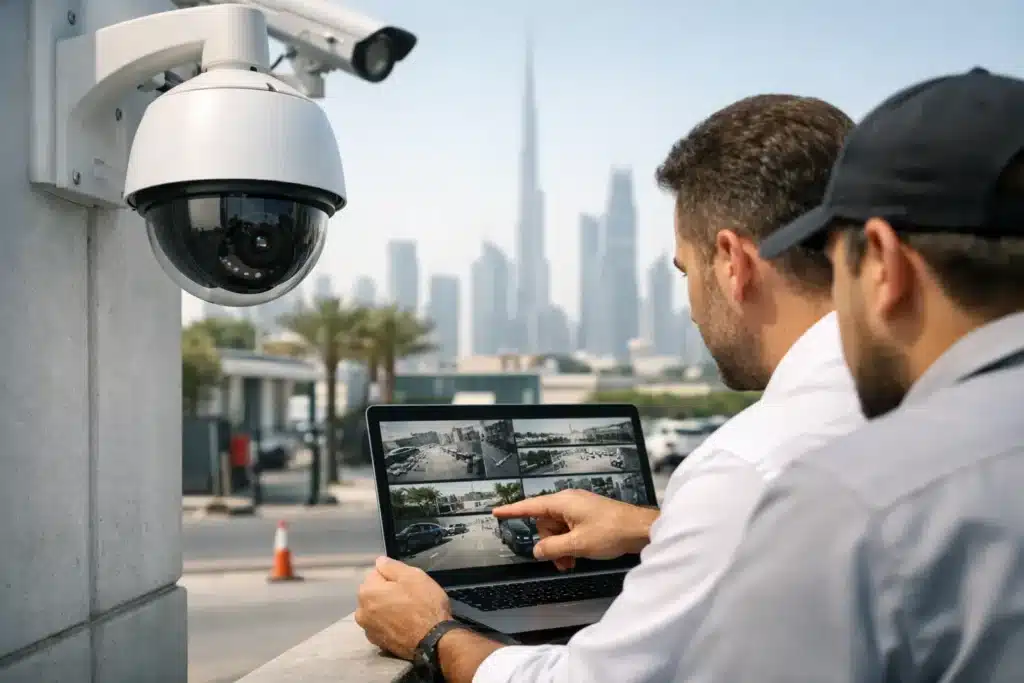
A missing camera view rarely becomes obvious during a normal workday. It becomes obvious after a vehicle strike in a loading bay, a stock loss in a warehouse aisle, an access dispute at a staff entrance, or an inspection that identifies a gap in required coverage. A CCTV blind spot audit is the practical process of finding those gaps before they create an operational, security, or compliance problem.
For businesses across Dubai, Abu Dhabi, and Sharjah, the audit is not simply about adding more cameras. It is about confirming that each critical area is visible at the level required for its purpose, that recorded footage is usable, and that the system supports the applicable authority requirements. A camera pointed at an area is not automatically providing meaningful coverage.
What a CCTV Blind Spot Audit Actually Checks
A blind spot is any location, route, activity, or event that cannot be captured clearly enough by the existing surveillance system. It may be an area with no camera coverage at all. More often, it is an area that appears to be covered on a site plan but fails in real conditions because of poor camera angle, limited identification detail, glare, darkness, obstructions, or recording issues.
A proper audit reviews the entire surveillance chain: the physical environment, camera placement, camera settings, network performance, recording quality, storage retention, and operator access to footage. This matters because a camera can be online and still fail to provide evidence that is useful after an incident.
For example, a fixed camera may show that a person entered a warehouse corridor but not provide enough facial detail to identify them. A loading yard camera may cover vehicle movement in daylight but lose key detail after sunset due to headlights and shadows. A camera at a cash counter may have the correct direction but be partially blocked by promotional displays installed after the original CCTV project was completed.
Why Blind Spots Create More Than Security Risk
The immediate concern is usually theft, intrusion, vandalism, or unauthorized access. In commercial and industrial facilities, however, blind spots can affect much more than loss prevention. They can weaken incident investigations, delay insurance documentation, create disputes with contractors or suppliers, and limit a facility manager’s ability to verify health and safety events.
For regulated sites, the risk also includes approval delays and corrective work. CCTV requirements set by SIRA, Abu Dhabi monitoring and control authorities, or Sharjah Police can involve coverage expectations for entrances, perimeters, cash-handling areas, access points, parking zones, and other site-specific locations. Requirements depend on the facility type, risk profile, and authority jurisdiction. An audit helps identify whether the installed layout continues to align with the approved design and current site operations.
Changes to the building often create the problem. New partitions, racking, temporary storage, landscaping, signage, tenant fit-outs, and parked fleet vehicles can all obstruct a view that was clear at commissioning. A system that passed inspection two years ago may no longer be effective today.
Start With the Areas That Matter Most
An effective audit begins with operations, not the camera map. The assessor should understand how people, vehicles, visitors, goods, and sensitive assets move through the premises. This establishes where clear video evidence is most valuable.
High-priority areas commonly include vehicle gates, pedestrian entrances, reception points, emergency exits, loading and unloading zones, warehouse aisles, server rooms, stock rooms, cash points, elevator lobbies, perimeter boundaries, and parking areas. In fleet yards, attention should also be given to fueling points, vehicle handover areas, driver entry routes, and locations where cargo or equipment is transferred.
The objective differs by area. At a main entrance, the system may need to capture a recognizable face. At a loading dock, it may need to show vehicle registration details, cargo handling activity, and the sequence of events. At a perimeter, early detection may be the priority. Treating every camera location the same leads to wasted equipment and unresolved risk.
How a Professional Audit Is Carried Out
The strongest audits combine a physical site survey with live system testing. Reviewing drawings alone is not enough because plans do not show current obstructions, changing light conditions, or actual image quality.
A qualified technician will usually walk the site, review each camera’s field of view, and compare coverage against critical routes and assets. They should check live images and recorded playback, not just the live stream. Recorded footage may reveal compression issues, dropped frames, insufficient retention, incorrect time settings, or a recorder that is not saving at the required quality.
The assessment should include these five checks:
- Camera location, mounting height, direction, lens selection, and overlap between cameras.
- Image usability during daytime, nighttime, low-light conditions, and changing weather where relevant.
- Obstructions caused by racking, doors, parked vehicles, fixtures, signs, trees, or later construction work.
- Video recorder health, retention period, storage capacity, timestamps, remote viewing permissions, and event retrieval.
- Coverage alignment with site operations and applicable authority or project approval requirements.
Testing should reflect how the site actually works. A technician may walk common routes, enter through controlled doors, move through loading areas, or check a vehicle approach to verify whether the camera captures the required detail. This is especially valuable in large warehouses and compounds, where a small change in angle can leave a major route unobserved.
Common Blind Spots Found on Commercial Sites
One frequent issue is overreliance on wide-angle cameras. They can show a large area, but the farther a person or object is from the camera, the less useful the detail becomes. Wide coverage is valuable for situational awareness, while identification often requires a more targeted view. The right answer may be a second camera rather than a different angle alone.
Lighting is another common failure point. Bright external light behind a doorway can turn subjects into silhouettes. Headlights can wash out images near gates. Infrared illumination can reflect off glass, polished floors, or nearby walls and reduce clarity. Camera positioning, lighting improvements, and suitable camera technology must be considered together.
Storage is often overlooked. If a facility needs footage from an event several weeks ago but the recorder overwrites video after a few days, the camera system has not met its operational purpose. Retention requirements should be verified against the site category, authority expectations, recording settings, and available storage capacity.
Network limitations can also create hidden gaps. Cameras may display correctly in live view but record at a lower frame rate or resolution when bandwidth is under pressure. Regular health checks identify these issues before they compromise an investigation.
Correcting Gaps Without Overbuilding the System
The goal of a CCTV blind spot audit is not to recommend the maximum number of cameras. It is to deliver the right coverage with a layout that is practical to install, maintain, and approve. In some cases, repositioning an existing camera, adjusting a lens, clearing an obstruction, or changing recording settings resolves the issue. In other cases, additional cameras, improved lighting, network upgrades, or storage expansion are necessary.
There are trade-offs. A higher-resolution camera may improve detail but require more bandwidth and storage. A camera mounted lower may capture better identification images but be more vulnerable to damage. Pan-tilt-zoom cameras offer flexibility, but they cannot watch every direction at the same time and should not replace fixed coverage for critical areas. The correct solution depends on the risk, activity, environment, and compliance requirement at each location.
Any corrective work should be documented with updated camera layouts, coverage notes, and test results. This gives facility managers a clear record of what changed, why it changed, and how the system now supports operations. It also makes future maintenance, expansion, and authority inspections easier to manage.
When to Schedule an Audit
A full audit is sensible before a regulatory inspection, after a burglary or disputed incident, during a tenant handover, and before expanding a warehouse, retail branch, hotel, or industrial site. It is also advisable after major layout changes, new racking installation, perimeter modifications, or a CCTV system upgrade.
For high-activity facilities, periodic reviews are more effective than waiting for a failure. Warehouses, logistics yards, fuel facilities, retail sites, and multi-tenant buildings change quickly. A planned review can catch a blocked camera or weak recording setting while the correction is still straightforward.
ALNAJAH ALAWAL approaches audits as an execution and compliance exercise: assess the real site conditions, identify the gaps, define corrective action, and support the project through testing and approval requirements where applicable. The result is not just a better camera layout. It is a system that is easier to rely on when accountability matters.
A clear view of the right event, at the right time, can prevent a minor operational issue from becoming a costly dispute. Schedule the audit before the next incident or inspection exposes what the cameras missed.