

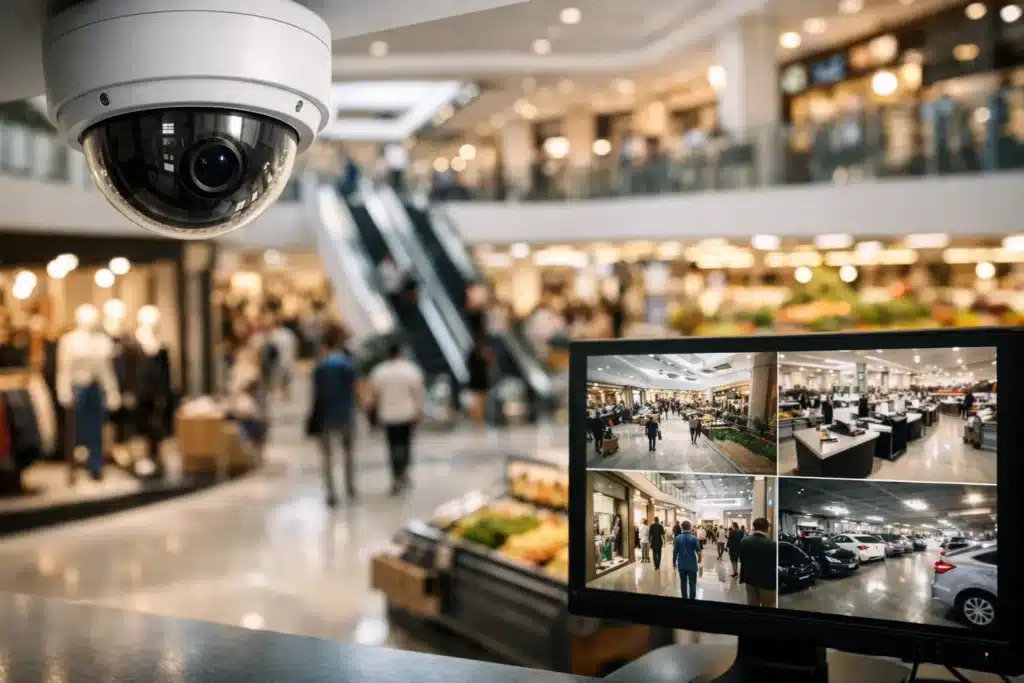
A camera gap at a mall entrance, a blind spot near a cash office, or footage that cannot be retrieved when requested can create far more than a security issue. It can delay approvals, disrupt operations, and expose mall management to avoidable risk. SIRA CCTV compliance for shopping malls and hypermarkets requires a planned surveillance system that supports both regulatory approval and the practical realities of a busy retail environment.
For retail property owners, facility managers, tenants, and project teams, the objective is clear: install the right system, secure approval without rework, and keep the site protected after handover. That requires more than placing cameras around the building. It requires compliant design, approved equipment, correct coverage, reliable recording, documented testing, and ongoing maintenance.
Why retail CCTV compliance needs a site-specific design
Shopping malls and hypermarkets have complex security demands. They combine high visitor traffic, multiple public entrances, retail units, loading docks, parking areas, cash-handling locations, service corridors, and restricted back-of-house spaces. Each area presents a different risk profile and a different requirement for camera placement, image quality, and monitoring.
A generic camera layout often fails because it treats the site as one open space. In reality, a hypermarket may need detailed coverage around tills, customer service counters, receiving bays, stockrooms, and delivery access points. A mall may require coordinated surveillance across common areas, escalators, elevators, parking entrances, management offices, and perimeter gates.
The design must also account for lighting changes, ceiling heights, reflections from storefront glass, crowded walkways, and obstructions caused by seasonal displays or promotional stands. A camera may be technically installed but still fail to provide usable footage if its field of view is blocked or its image quality is inadequate for the intended purpose.
What SIRA CCTV compliance means for malls and hypermarkets
SIRA compliance is not achieved simply by purchasing cameras described as approved. The complete installation must meet current authority requirements and be submitted through the proper approval process. The system design, device selection, camera coverage, recording capacity, network configuration, installation quality, and documentation all matter.
For shopping malls and hypermarkets in Dubai, a compliant project typically begins with a detailed site survey. The survey identifies access points, high-risk areas, existing security infrastructure, monitoring requirements, and installation constraints. It also confirms whether the project is a new fit-out, a renovation, tenant expansion, system replacement, or an upgrade to an existing CCTV network.
From there, the contractor prepares drawings and a technical proposal aligned with the applicable SIRA requirements. This is the stage where weak planning causes the most expensive delays. If camera positions, cable routes, storage arrangements, or equipment specifications are not confirmed before procurement and installation, the project can require rework during inspection.
Coverage must support real operational risk
Retail surveillance is not only about observing shoppers. It must support incident investigation, loss prevention, staff safety, access control, and operational accountability. Clear coverage is usually required at critical entry and exit locations, public circulation areas, payment zones, receiving and delivery points, parking facilities, and restricted rooms.
The right coverage level depends on the area. A wide-angle camera may be appropriate for a large public concourse, while a cash office or loading gate may require a more focused view. The goal is not to install the maximum number of cameras. It is to install cameras that provide useful, reliable evidence where it is needed.
Recording and storage cannot be treated as an afterthought
A CCTV system is only valuable when footage can be retrieved quickly and played back clearly. Storage requirements must be calculated based on the number of cameras, resolution, frame rate, recording mode, retention period, and expected operating conditions.
Under-sizing storage may reduce recording retention and create a compliance problem. Over-sizing it without considering network capacity, recorder performance, and future expansion can waste budget without improving the result. A qualified design balances compliance, usability, and lifecycle cost.
The system should also have controlled access to live views and recorded footage. Mall operators need clear user permissions, secure credentials, and procedures for exporting footage when an incident occurs. This protects sensitive recordings while allowing authorized teams to act quickly.
The areas that commonly create approval delays
Most compliance setbacks are preventable. They usually begin before the first cable is installed, when projects move forward without a complete survey, approved design, or coordinated submission plan.
Common problems include cameras with poor coverage of entrances or cash-handling areas, unapproved equipment, missing or inaccurate drawings, inadequate recording storage, poor labeling, and incomplete testing records. Installation quality also matters. Untidy containment, unsupported cables, poorly positioned cameras, and inaccessible equipment locations can affect reliability and inspection readiness.
Retail fit-out projects create another challenge: coordination. CCTV installation must work alongside ceiling contractors, electrical teams, IT providers, fire and life safety systems, access control installers, shopfitters, and mall management. If the CCTV contractor is brought in late, camera locations may conflict with finished ceilings, signage, lighting fixtures, or tenant design elements.
A compliance-led contractor should coordinate early, confirm cable pathways before finishes are closed, and identify power and network requirements before commissioning. This reduces disruption to tenants and helps keep the opening schedule on track.
A practical compliance process for retail sites
The most reliable path is to manage CCTV as an approval project, not as an equipment purchase. The process should begin with a survey and risk review, followed by compliant drawings, equipment selection, authority submission, installation, testing, commissioning, and final handover.
During installation, every camera should be tested for framing, focus, day and night performance, and recorder visibility. The team should verify that camera names, locations, and views correspond with approved drawings. This makes operation easier for security personnel and prevents confusion when footage is needed after an incident.
Before inspection or final approval, the contractor should confirm that the site is ready. That means equipment is installed correctly, recording is active, documentation is complete, and the responsible team understands basic system operation. Rushing this stage may save a day on the schedule but can cost much more if an inspection identifies issues that require revisiting finished areas.
For larger malls, phased delivery may be the right approach. A new wing, parking expansion, or hypermarket fit-out may need to open before the full property is complete. In these cases, each phase should be designed and documented clearly so temporary arrangements do not compromise the final compliant system.
Maintenance protects compliance after handover
Approval is a milestone, not the end of the responsibility. Cameras can lose focus, become obstructed, fail after power events, or stop recording because of a storage or network issue. Retail sites are particularly exposed because they operate long hours and frequently change layouts, signage, displays, and tenant spaces.
Preventive maintenance helps identify faults before they affect an investigation or inspection. A proper maintenance visit should check camera views, recording playback, time synchronization, storage health, power supplies, network connectivity, physical condition, and system alerts. Any changes to store layouts, access routes, or restricted areas should also trigger a review of camera coverage.
This is especially relevant for hypermarkets, where merchandising changes can block camera views without anyone noticing. A promotional display placed below a camera can create a blind spot at precisely the time foot traffic increases.
Choosing the right CCTV partner
For compliance-driven retail projects, the lowest initial quotation is not always the lowest project cost. A contractor that overlooks authority requirements, installs unsuitable equipment, or cannot support documentation may create delays that affect tenant openings and daily operations.
Choose a contractor that can manage survey, design, supply, installation, testing, approval coordination, training, and maintenance under one accountable scope. Ask how the provider handles changes during construction, what documentation will be provided, and how quickly faults can be addressed after handover.
ALNAJAH ALAWAL SECURITY SYSTEMS & EQUIPMENT TRADING L.L.C. supports retail clients with SIRA-approved CCTV installation and approval-focused project delivery across Dubai. The focus is straightforward: get the system designed correctly, installed correctly, and ready for approval without unnecessary disruption.
A mall or hypermarket cannot afford security coverage that only looks complete on a drawing. Start with a professional site survey, address compliance requirements before procurement, and keep the system maintained as the property evolves. Stay compliant. Stay protected.