

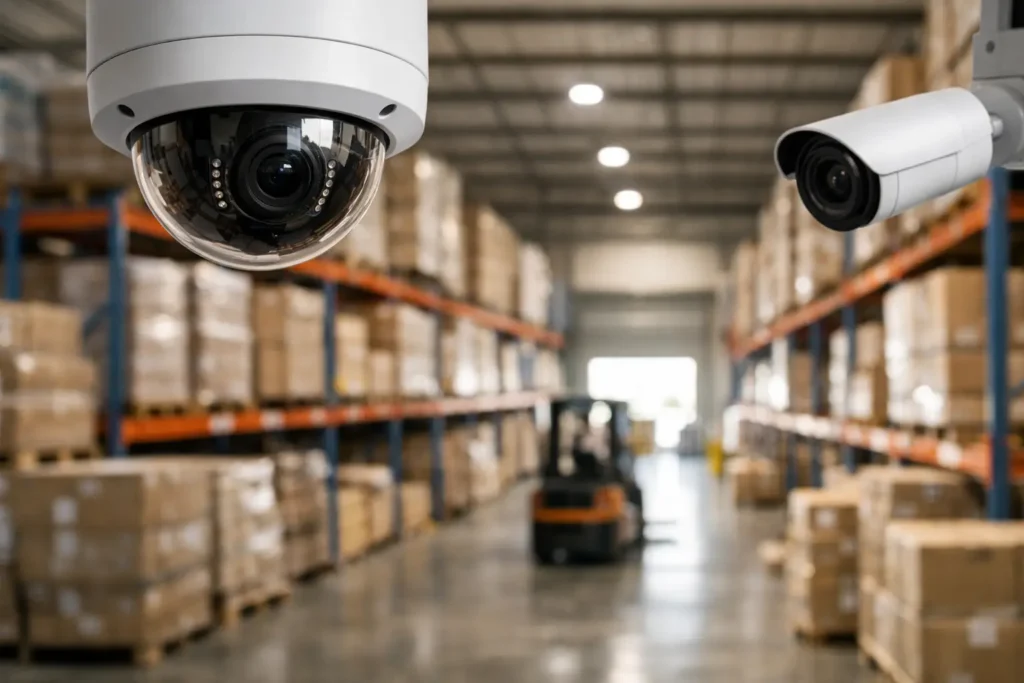
A warehouse camera system fails long before a camera stops recording. It fails when loading bays have blind spots, faces are unusable in low light, footage cannot be retrieved during an incident, or the installation does not meet the authority’s requirements. Choosing the best CCTV cameras for warehouses means designing for real operations, not simply placing cameras at convenient ceiling points.
For warehouse operators, logistics managers, and facility owners, CCTV must protect stock, support investigations, improve dispatch accountability, and maintain compliance. The right system combines suitable camera types, correct coverage, reliable recording, and professional commissioning.
What Makes the Best CCTV Cameras for Warehouses?
There is no single camera model that suits every warehouse. A compact storage facility, a high-volume distribution center, and a temperature-controlled industrial warehouse have different risks, lighting conditions, and operational workflows. The best solution is usually a mixed camera system, with each camera selected for a defined purpose.
Image quality matters, but resolution alone is not the answer. A high-megapixel camera installed too high or aimed across a wide loading yard may still fail to identify a person or vehicle. Lens selection, mounting height, lighting, scene angle, and video retention all determine whether footage is useful when it matters.
A properly designed warehouse system should answer practical questions: Can management verify a pallet handover? Can security identify unauthorized access at a fire exit? Can supervisors review vehicle movements at the gate? Can footage be exported quickly and clearly after a claim, shortage, or accident?
Camera Types That Work in Warehouse Environments
Fixed dome cameras for internal coverage
Fixed dome cameras are a dependable choice for offices, packing areas, corridors, entrances, and internal storage aisles. Their compact enclosure makes them harder to redirect, while vandal-resistant versions provide added protection in accessible areas.
For most indoor zones, a camera with strong low-light performance and wide dynamic range is more valuable than excessive resolution. Wide dynamic range helps when a camera faces roller shutters, skylights, or bright loading-bay doors, where ordinary cameras can produce dark subjects against a bright background.
Bullet cameras for yards and loading bays
Bullet cameras are commonly used on external walls, vehicle gates, loading docks, and perimeter routes. Their visible form can act as a deterrent, and their housing is well suited to outdoor mounting when correctly rated for heat, dust, and rain.
For loading bays, camera placement should capture both the vehicle approach and the handover point. One wide view may show overall activity, but a second, tighter view is often necessary to identify drivers, read container numbers, or review the movement of high-value goods.
Varifocal cameras for critical entry points
Varifocal cameras allow the installer to adjust the field of view during commissioning. This is particularly useful at gates, receiving desks, dispatch counters, secure cages, and cash-handling areas, where the target area is known and clear identification is required.
A fixed wide-angle camera may cover more space, but it spreads pixels over a larger scene. A varifocal camera can be set to prioritize detail at the point where it is needed. This trade-off is central to effective warehouse surveillance design.
PTZ cameras for large external areas
Pan-tilt-zoom, or PTZ, cameras can monitor expansive yards, truck staging areas, and perimeter boundaries. They allow operators to follow an incident or inspect activity at a distance. However, they should not be treated as a replacement for fixed cameras.
A PTZ camera can only look in one direction at a time. Fixed cameras should provide continuous coverage of key routes and access points, while PTZ units add operational flexibility for large or high-risk sites.
License plate and specialized cameras
Vehicle gates may require dedicated cameras designed to capture license plates. These should be positioned and configured specifically for lane direction, vehicle speed, headlight glare, and gate lighting. Standard overview cameras rarely provide reliable plate evidence by themselves.
Some facilities also benefit from thermal cameras for perimeter detection, fisheye cameras for open internal zones, or explosion-protected cameras in hazardous environments. These are specialist applications and should be selected following a site survey and risk assessment.
Coverage Should Follow Warehouse Operations
Warehouse surveillance works best when camera locations follow the movement of people, goods, and vehicles. Start with the areas where loss, disputes, safety incidents, or unauthorized entry are most likely to occur.
Critical coverage normally includes vehicle entrances and exits, pedestrian access points, loading and unloading bays, receiving areas, dispatch zones, high-value inventory locations, emergency exits, server or control rooms, and perimeter boundaries. Internal aisles may also need coverage, especially where stock picking, pallet movement, or restricted inventory is handled.
Do not overlook blind spots created by racking. Tall shelving can block views across the warehouse floor, and a camera that looks effective before operations begin may become ineffective once stock is stored. Camera positions must account for final rack height, aisle layout, forklift routes, and expected stock movement.
It is also essential to separate overview coverage from identification coverage. Overview cameras document activity across a broad area. Identification cameras are placed at controlled points where faces, actions, labels, or plates need to be captured clearly. Trying to make one camera do both jobs usually produces weak evidence.
Low-Light Performance and Lighting Design
Many warehouse incidents occur outside normal office hours. Night shifts, reduced lighting, closed loading docks, and external yards all create conditions where basic cameras struggle.
Choose cameras with tested low-light capability and infrared illumination where appropriate. Infrared can provide clear black-and-white images in darkness, but its effective range depends on the environment. Large yards, reflective surfaces, dust, rain, and vehicle headlights can reduce performance.
In some areas, adding controlled white light is a better security decision than relying only on infrared. It supports color video, improves operational safety, and can discourage unauthorized activity. The right approach depends on the site, neighboring properties, working hours, and local requirements.
Storage, Network Capacity, and Video Retrieval
A camera system is only useful if recordings are available when needed. Before installation, calculate storage based on camera quantity, resolution, frame rate, recording schedule, video compression, and required retention period. A system designed without these calculations may overwrite important footage too soon.
Continuous recording is often appropriate for entry points, loading bays, and high-risk zones. Motion-based recording can reduce storage demand in low-activity areas, but it must be configured carefully. Poor motion settings may miss activity in low light or create excessive false recordings from moving shadows, insects, or rain.
Network design also matters. High-resolution cameras generate significant data, particularly in large warehouses. Managed switches, suitable cabling, power backup, protected network cabinets, and properly sized recording hardware are part of the security system, not optional extras.
Warehouse teams should also be trained to retrieve footage, export it securely, and preserve incident records. Fast retrieval is critical when responding to customer disputes, insurance matters, internal investigations, or authority requests.
Compliance Must Be Considered Before Installation
For warehouses in Dubai, Abu Dhabi, and Sharjah, CCTV requirements may be governed by the relevant local security authority and project conditions. Camera specifications, coverage points, recorder capacity, signage, cabling methods, monitoring arrangements, and documentation can all affect approval.
Installing equipment first and checking compliance later creates avoidable risk. It can lead to redesign, delayed handover, additional cost, and operational disruption. A compliance-led contractor assesses the site, prepares the design, supplies approved equipment where required, manages installation, and supports testing and approval processing.
ALNAJAH ALAWAL SECURITY SYSTEMS & EQUIPMENT TRADING L.L.C. approaches warehouse CCTV as an end-to-end project: site survey, compliant design, supply, installation, testing, commissioning, training, and ongoing maintenance. The objective is clear: approved right the first time, with coverage that supports daily operations.
How to Choose the Right Warehouse CCTV Partner
The best CCTV cameras for warehouses will not deliver results if the system is poorly designed or unsupported after handover. Select a contractor that understands warehouse workflows as well as camera specifications. They should ask about operating hours, stock value, vehicle movement, lighting, rack layout, access control, and authority requirements before recommending equipment.
Look for clear drawings, defined camera coverage, storage calculations, equipment documentation, and a realistic project schedule. Maintenance support should include health checks, camera cleaning where necessary, recorder monitoring, fault response, and firmware or configuration management. Dust, vibration, heat, and outdoor exposure can affect camera performance over time.
A warehouse security system should give management visibility without interrupting operations. Start with a professional survey, define the evidence each area must provide, and build the system around that requirement. Stay compliant. Stay protected.