

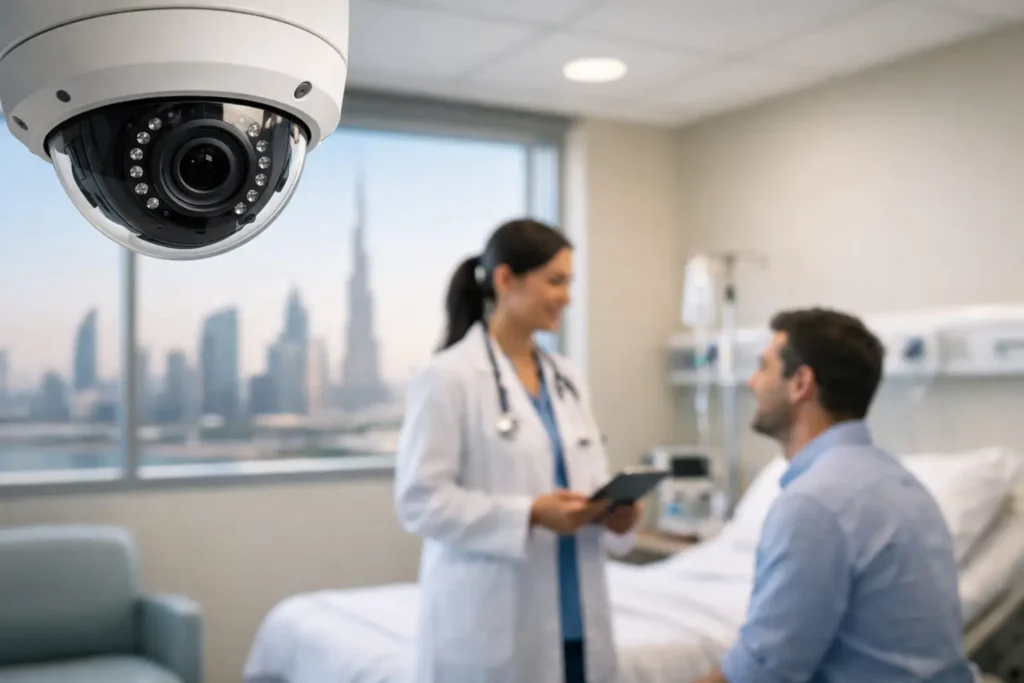
A clinic can have excellent doctors, modern equipment, and a strong patient experience, yet still face opening delays if its CCTV system fails a SIRA review. The SIRA CCTV requirements for clinics in Dubai (2026 guide) are not simply about mounting cameras at the entrance. They affect the system design, camera coverage, recording setup, equipment selection, documentation, installation quality, and approval process.
For clinic owners, healthcare operators, facility managers, and fit-out contractors, the practical objective is clear: install a surveillance system that protects people and property without compromising patient privacy, then secure approval without costly rework. Approved right the first time means treating compliance as part of the clinic design, not a task left until handover.
Why SIRA Compliance Matters for Dubai Clinics
Dubai clinics handle high footfall, sensitive patient information, controlled medicines, medical equipment, staff access, and cash or payment transactions. CCTV helps establish accountability when there is a safety incident, dispute, theft allegation, unauthorized entry, or operational concern. SIRA compliance provides the regulatory framework for how that surveillance system should be planned and operated.
A non-compliant system can hold up a new clinic opening, complicate tenancy handover, or require equipment and cabling to be changed after ceilings and finishes are complete. That is why a site survey before construction or renovation is usually the lowest-risk option. It allows camera positions, cable routes, network cabinets, recording equipment, and power requirements to be coordinated with the clinic layout.
The exact requirements may vary based on the clinic’s size, location, operating hours, services, risk profile, and whether it sits within a medical center, commercial tower, mall, or standalone property. A small outpatient clinic does not necessarily need the same design as a multi-specialty center with a pharmacy, laboratory, diagnostic rooms, and multiple public entrances.
SIRA CCTV Requirements for Clinics in Dubai: Core Coverage
The starting point is coverage of areas where people enter, move through, transact, access controlled assets, or may require incident review. Cameras should provide usable identification-quality images where identification is needed, not just a wide view of a hallway.
For most clinics, the CCTV design should address public entrances and exits, reception and waiting areas, main corridors, access points to staff-only spaces, and external approaches where applicable. Coverage may also be needed at pharmacy counters, cash handling points, medical stores, loading or service access, and other areas identified during the risk assessment.
Reception deserves special attention. It is often where patient flow, payments, visitor access, and disputes converge. The camera angle must capture activity clearly without being blocked by signage, decorative features, queue barriers, or strong backlighting from glass doors.
Protect Patient Privacy While Maintaining Coverage
A compliant clinic CCTV design must balance security monitoring with privacy. Cameras are generally positioned to secure entrances, circulation areas, counters, and restricted zones rather than to record private consultations or clinical examinations. Consultation rooms, treatment rooms, changing areas, washrooms, and other highly sensitive spaces require careful assessment and should not be treated like ordinary commercial rooms.
This is where generic camera layouts create risk. A contractor that installs the same layout used for a retail unit may create unnecessary privacy concerns or leave important operational areas uncovered. Camera placement should be justified by the function of each space, with the clinic operator involved in the review.
Camera Quality, Positioning, and Lighting
SIRA approval is not achieved by camera quantity alone. The system must produce useful footage. A camera installed too high, pointed into bright sunlight, aimed at reflective glass, or blocked by an open door may meet a drawing requirement while failing in real conditions.
Camera selection should match the environment. Indoor dome cameras may suit reception and hallways, while weather-rated cameras may be needed for exterior entrances, parking areas, or service access. Low-light performance, wide dynamic range, lens angle, resolution, and tamper resistance should be selected based on what the camera must capture.
During design, consider whether the camera needs to identify a person, observe a general area, monitor movement, or document a transaction. These are different surveillance objectives. A wide-angle camera can cover a waiting room, but it may not provide enough facial detail at a distant reception desk. In some cases, two properly positioned cameras are more effective than one high-resolution camera trying to cover everything.
Recording, Retention, and System Security
Video retention is a central compliance consideration. Clinics need sufficient recording storage to meet the applicable SIRA retention period, with capacity calculated using camera count, resolution, frame rate, recording mode, and expected image quality. Storage should be designed with a margin rather than calculated at the absolute minimum.
For example, increasing camera resolution or moving from motion recording to continuous recording can materially increase storage demand. If the recorder runs out of capacity early, the clinic may lose footage needed for an investigation and fall short of the required retention period.
The recording equipment should be installed in a secure location with controlled access. A network video recorder or server placed openly at reception is vulnerable to tampering and is poor operational practice. The cabinet or room should be protected, ventilated where needed, clearly labeled, and supported by appropriate power backup.
Cybersecurity also matters. CCTV systems are network-connected assets and should not be left with default passwords, exposed remote access, or unmanaged user accounts. Restrict access to authorized personnel, use strong credentials, document administrator access, and keep the system configuration controlled. Remote viewing can be useful for clinic management, but convenience should not weaken security.
Installation Standards That Affect Approval
A compliant design can still fail at the installation stage. Poor cable containment, unsecured junctions, unlabeled cameras, untidy racks, unsupported conduits, or inaccessible equipment can trigger corrective work and delay inspection.
The installation should be clean, tested, and documented. Every camera should be correctly labeled and mapped to the recorder. Network switches, power supplies, patch panels, and storage equipment should be arranged for service access. Where the system depends on network infrastructure, bandwidth and power-over-Ethernet capacity must be checked before commissioning.
Before the approval inspection, the contractor should confirm that all cameras are online, date and time settings are accurate, live views are clear, recording playback works, storage is available, and user access has been configured. A camera that displays live video but does not record correctly is not a completed system.
Documentation and SIRA Approval Coordination
The approval process usually requires more than a completed installation. Clinic operators should expect a structured workflow that includes site information, drawings or camera layouts, equipment details, installation records, testing, and authority submission requirements. The precise documents depend on the project and current authority procedures.
The most common source of delay is a mismatch between the submitted design and the installed system. This can happen when site conditions change during fit-out, walls are moved, a reception desk is relocated, or cameras are substituted without updating the approval file. Changes should be controlled and reflected in the final layout before inspection.
Working with a SIRA-approved contractor reduces this risk because compliance, installation, testing, and approval coordination are managed as one process. ALNAJAH ALAWAL SECURITY SYSTEMS & EQUIPMENT TRADING L.L.C. supports clinic projects from survey and design through installation, commissioning, and approval processing, helping operators avoid fragmented responsibility between multiple vendors.
What Clinic Managers Should Confirm Before Handover
Before accepting the system, the clinic manager should confirm that the camera views match the approved layout and that critical entrances, reception activity, restricted areas, and external approaches are visible. The team should also know how to retrieve footage, export an incident clip, check recording health, and report a fault.
Ask for practical handover records, including final camera locations, recorder details, user access arrangements, warranty information, and maintenance contacts. Training matters because footage is only useful when authorized staff can find it quickly and preserve it correctly after an incident.
Ongoing maintenance is part of staying compliant. Cameras can drift out of position, lenses can become dusty, storage drives can fail, and network changes can take devices offline without immediate notice. Scheduled health checks help prevent these issues from becoming inspection failures or operational blind spots.
A clinic CCTV project should be planned with the same discipline used for medical equipment, fire safety, and access control. Start with a compliant site survey, protect privacy through intelligent camera placement, verify recording capacity, and complete testing before the inspection date. Stay compliant. Stay protected.