

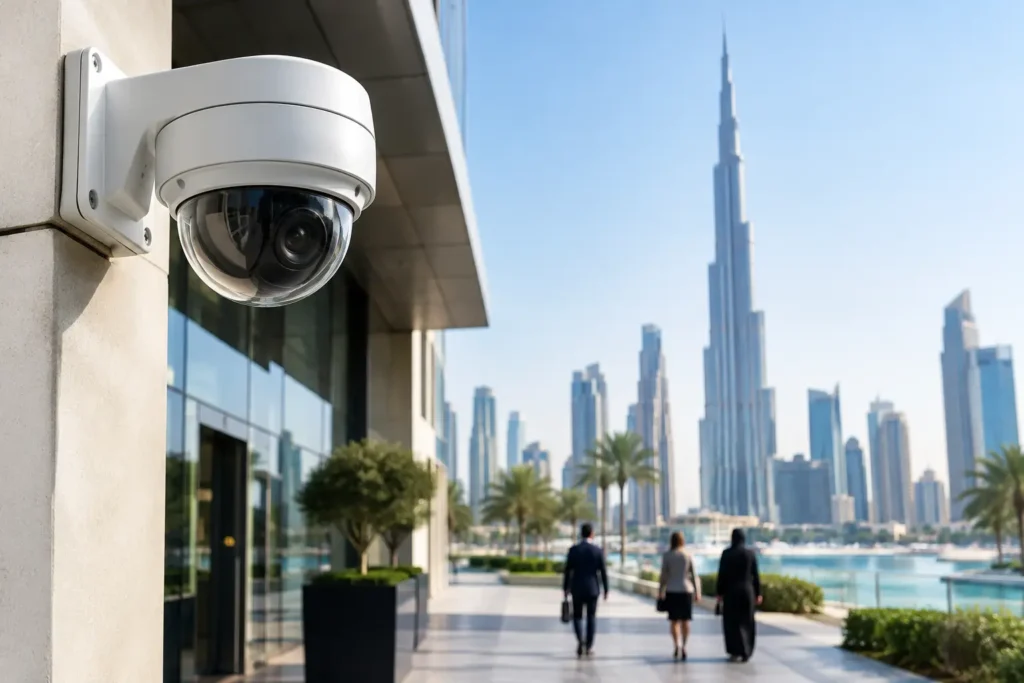
A new store fit-out, warehouse handover, clinic opening, or tower management contract can stall for one avoidable reason: the CCTV scope was treated as an equipment purchase rather than a compliance requirement. When asking which businesses must install CCTV in Dubai – retail, warehouses, clinics, hotels, and residential towers – the practical answer is that requirements depend on the activity, premises, licensing conditions, risk profile, and the authority reviewing the site.
For many commercial and residential properties, CCTV is not optional once security approval requirements apply. The question is not simply whether cameras are needed. It is where they must be installed, what they must cover, how recordings are stored, and whether the design can be approved before the business opens or the building is handed over.
Which Dubai businesses must install CCTV?
Dubai security requirements commonly affect businesses and facilities where public access, valuable stock, sensitive records, high visitor volume, or shared premises create a clear security need. Retail outlets, warehouses, healthcare facilities, hotels, and residential towers are among the most common project types requiring a properly designed surveillance system.
However, no responsible contractor should promise that every site needs the same number of cameras or identical coverage. A small office, a high-value jewelry retailer, and a multi-building logistics hub have very different risk exposure and approval requirements. The relevant authority, business activity, building layout, and site use determine the final scope.
A compliant project starts with a site survey. This identifies entry and exit points, blind spots, public areas, restricted zones, loading operations, cash handling points, server or storage rooms, and the practical routes for cabling and network equipment. It also prevents a common and expensive mistake: installing cameras first, then discovering the layout does not meet the required coverage or recording standards.
Retail stores, malls, and high-value outlets
Retail businesses often need CCTV because they handle customer traffic, stock movement, staff access, deliveries, and sometimes cash or high-value merchandise. Cameras may be required at entrances, sales floors, cashier counters, stockrooms, delivery doors, and other areas identified during the security design process.
A clothing shop inside a mall will not have the same security needs as a supermarket, pharmacy, electronics retailer, or gold and jewelry store. Higher-risk operations generally need more detailed coverage, stronger evidence quality, and closer attention to camera placement around display cases, safes, transaction areas, and receiving locations.
Retail operators should also avoid installing cameras purely for loss prevention without considering approval and privacy implications. Camera views should support the approved purpose and should not unnecessarily capture private areas. Staff facilities, changing rooms, and other sensitive locations require careful treatment. Clear planning protects both the business and the people using the premises.
Warehouses, logistics facilities, and industrial sites
Warehouses are a frequent focus for CCTV installation because the risk is operational as much as security-related. Goods enter and leave through loading bays, staff and vehicles move across large sites, and disputes can arise over delivery condition, inventory access, vehicle damage, or unauthorized entry.
A warehouse CCTV design typically considers perimeter access, gates, loading docks, dispatch and receiving areas, storage aisles, high-value cages, parking areas, and control rooms. Large facilities may also require camera coverage that works in difficult conditions, including low light, dust, heat, long viewing distances, and vehicle movement.
The trade-off is clear. More cameras do not automatically create better security. Poorly positioned cameras can produce unusable footage, while insufficient network capacity or inadequate storage can compromise the system when evidence is needed. The design must match the operational flow of the facility, with recording retention, image quality, power backup, and monitoring arrangements planned from the start.
For logistics operators, CCTV can also support accountability alongside fleet and access-control systems. A coordinated setup helps management investigate incidents with a clearer record of who accessed a site, when a vehicle arrived, and what occurred at a loading point.
Clinics and healthcare facilities
Clinics must balance security coverage with patient privacy. Surveillance is often needed around building entrances, reception areas, waiting rooms, payment counters, public corridors, pharmacy or medicine storage areas, parking, and external access points. Cameras can help protect staff, visitors, controlled medicines, equipment, and records-related spaces.
Clinical consultation rooms, examination rooms, treatment areas, and other highly sensitive spaces demand special consideration. Surveillance should never be treated as a standard template. The clinic operator must assess the privacy impact, the purpose of each camera, and any applicable requirements from the relevant health, licensing, and security authorities.
For clinic owners, the safest approach is to coordinate CCTV planning before final fit-out. This allows camera locations, containment, network racks, power supplies, and signage to be integrated without disrupting patient operations later. It also reduces the risk of a last-minute redesign before opening.
Hotels and hospitality properties
Hotels operate around the clock and manage a changing mix of guests, visitors, employees, suppliers, and contractors. CCTV is typically central to protecting public areas and supporting incident investigation. Common coverage areas include entrances, lobbies, reception, corridors, elevators where appropriate, parking areas, back-of-house corridors, loading points, service entrances, and cash handling locations.
Guest privacy is non-negotiable. Cameras should not be installed inside guest rooms, bathrooms, changing rooms, or other private spaces. Hotel operators need a security design that protects people and assets while respecting privacy and maintaining the guest experience.
The scale of the hotel matters. A boutique property may need a focused system, while a resort, serviced-apartment complex, or large hotel with restaurants, event spaces, and multiple access points needs broader planning. In both cases, the installation should be designed around actual operations rather than a generic camera count.
Residential towers and managed communities
Residential towers commonly require CCTV across shared and controlled areas. This can include main entrances, reception or lobby spaces, access points, elevators and lift lobbies, parking levels, common corridors, amenity areas, service entrances, waste rooms, and perimeter locations.
For developers, owners’ associations, and facility managers, camera coverage supports more than incident response. It helps manage access, investigate property damage, monitor contractor activity, and improve accountability in common areas. It can also support security personnel by giving them visibility across a large building without placing guards at every point.
Apartment interiors and private spaces must remain outside the surveillance scope. In addition, residential projects should account for ongoing maintenance. A system that passes handover but has failed cameras, incorrect time settings, full storage, or no documented maintenance plan will create problems when footage is needed.
What compliance-ready CCTV installation involves
Approval-ready CCTV is a complete process, not a box of cameras. The project must account for the approved design, suitable equipment, camera angles, recording capacity, cabling quality, network configuration, equipment-room setup, testing, documentation, and authority coordination where required.
A compliant installation may also involve site drawings, camera schedules, coverage plans, equipment specifications, testing records, and support during inspections. Requirements can change based on the site category and authority direction, which is why using unverified equipment or copying a previous project’s design can lead to rejection and delay.
ALNAJAH ALAWAL SECURITY SYSTEMS & EQUIPMENT TRADING L.L.C. manages CCTV projects from site survey and system design through installation, commissioning, approval support, and maintenance. As a SIRA-approved contractor, the team helps Dubai clients plan systems that are designed for compliance before work begins.
Plan before the inspection date
The best time to address CCTV requirements is before construction is complete, a lease is finalized, or an opening date is announced. Early planning gives the project team time to resolve cable routes, camera positions, storage requirements, and authority comments without reopening finished ceilings or walls.
If you operate a retail store, warehouse, clinic, hotel, or residential tower, start with a professional site assessment and confirm the exact requirements that apply to your premises. Approved right the first time means fewer delays, better coverage, and a security system that remains useful long after handover.