

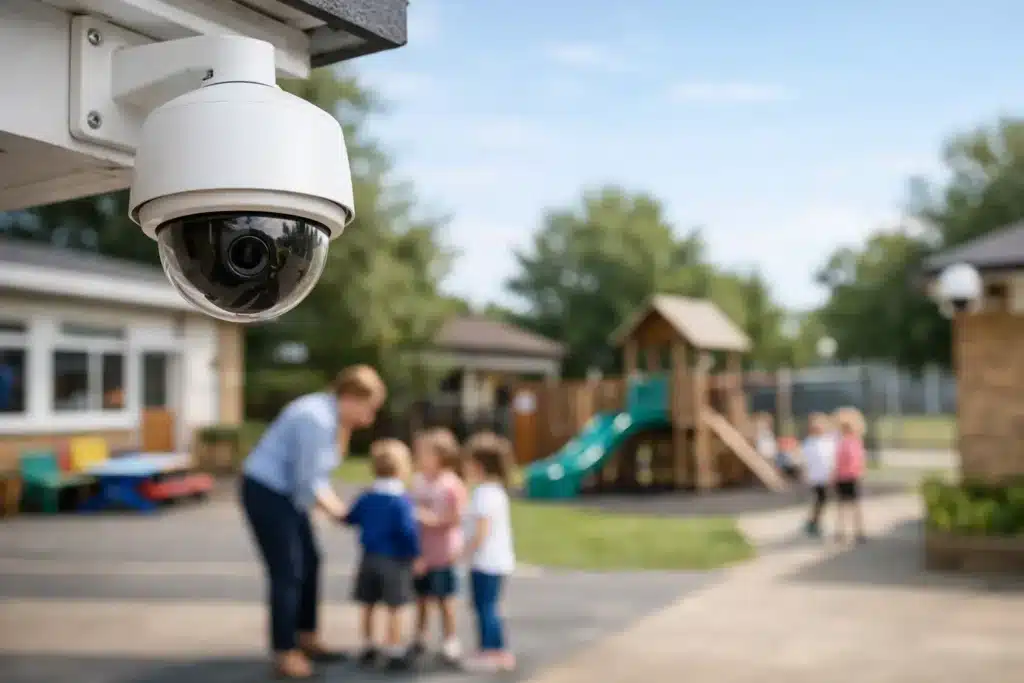
A school CCTV project can fail approval even when every camera is working. The usual cause is not equipment quality. It is a gap between the installed system, the approved design, site conditions, and the documentation required for inspection. Understanding SIRA CCTV requirements for schools and nurseries early helps operators protect children, staff, visitors, and the continuity of their license and operations.
For education facilities in Dubai, surveillance must be planned as a compliance system, not treated as a last-minute purchase. Camera positioning, image quality, recording storage, network design, access to footage, and approval coordination all need to support the Security Industry Regulatory Agency process.
Why school and nursery CCTV needs a different approach
Schools and nurseries are sensitive environments. They have multiple entry points, changing visitor traffic, outdoor play areas, buses, classrooms, administrative offices, and areas where privacy must be handled carefully. A generic commercial camera layout rarely addresses all of these needs.
The objective is clear visibility of security-critical activity without placing cameras where they create inappropriate privacy concerns. Management also needs a system that can retrieve usable footage quickly after an incident, parent inquiry, access-control event, or authority request.
Requirements can differ based on the size of the premises, building configuration, risk profile, authority direction, and the latest applicable SIRA guidance. For that reason, a site survey and approved design should determine the final scope. Do not rely on an old drawing from another school or a basic camera count supplied without a physical assessment.
SIRA CCTV requirements for schools and nurseries: core planning areas
A compliant project starts with coverage. Cameras should be positioned to monitor the locations that matter operationally: main gates, reception and visitor points, entrances and exits, corridors, stairwells, parking areas, perimeter access points, and other designated common areas. Outdoor recreation zones and bus loading areas may also require coverage where applicable.
Each camera must produce an image that is useful for its intended purpose. A wide-angle view may show activity across a playground, for example, but a narrower, correctly placed camera may be necessary at an entrance to support identification. Poor mounting height, backlight from glass doors, inadequate nighttime illumination, or an obstructed field of view can turn an apparently complete design into unusable evidence.
Camera placement must respect privacy
Surveillance improves safeguarding, but it should not remove reasonable expectations of privacy. Cameras should not be installed in bathrooms, changing areas, or other private spaces. In sensitive locations, the approved design should clearly show what is covered, why it is covered, and how views are controlled.
Classroom coverage requires particular care. The need, position, viewing angle, and policy should be evaluated against the facility’s safeguarding procedures and authority expectations. The right answer depends on the school type, age group, operational risks, and approved design – not a one-size-fits-all rule.
Recording, retention, and retrieval
Cameras alone do not create a compliant CCTV system. The recording platform must retain footage for the period required by the applicable approval conditions and site classification. Storage calculations should be based on the real configuration, including camera resolution, frame rate, compression, recording mode, number of cameras, and retention period.
This is where underdesigned systems often fail. A contractor may quote a recorder with nominal storage capacity but not calculate what happens when all cameras record at their configured quality. The result can be a system that overwrites footage too early or reduces image quality without the operator realizing it.
Footage should be date and time stamped accurately, searchable, and exportable when an investigation requires it. Access to live views and recordings should be limited to authorized personnel. Clear user accounts, password controls, and an auditable process for reviewing or exporting recordings reduce misuse and help management respond with confidence.
Equipment, cabling, and power design
The system design should use equipment suitable for the approved scope and installed in a way that supports reliable operation. This includes cameras, network video recorders or servers, switches, cabinets, monitors, storage drives, cabling, containment, and power protection.
A camera may meet technical specifications yet still create a compliance problem if its cable route is exposed, its network cabinet is unsecured, or it loses operation during a short power interruption. Equipment rooms and CCTV cabinets should be controlled, tidy, labeled, and accessible for authorized maintenance. Power backup requirements and network resilience should be considered during design, particularly for larger campuses or facilities with multiple buildings.
The approval process starts before installation
Approval is easier when compliance is managed from the first survey. The process normally involves defining the scope, preparing drawings and technical documentation, submitting the required information through the relevant process, installing the approved design, testing the system, and arranging inspection or final approval steps as applicable.
The precise submission and inspection requirements can change. Schools should therefore work from current authority guidance and obtain confirmation from a qualified, approved contractor before ordering equipment or starting civil works. Changes made during construction – such as a relocated gate, a new partition, or an additional entrance – should be reflected in the CCTV plan rather than left undocumented.
A practical pre-installation review should confirm these points:
- The site layout identifies all entrances, exits, access routes, and security-sensitive zones.
- Camera views are designed for detection, observation, or identification as needed at each location.
- Storage capacity matches the required retention period at the planned recording settings.
- Network, power, containment, and cabinet locations are coordinated with the building and IT teams.
- Drawings, camera schedules, product details, and site information are ready for the required approval process.
This coordination is especially valuable for new schools, fit-outs, and expansions. Installing cameras after ceilings are closed or landscaping is complete can increase cost, delay handover, and leave avoidable coverage gaps.
Common reasons education facilities face delays
The most common issue is designing by quantity instead of purpose. Ten cameras placed without a coverage strategy may cost less initially, but they can leave blind spots at gates, corridors, or visitor areas and require redesign later.
Another issue is treating the CCTV network as separate from the rest of the building. IT teams may restrict network access, power points may not be available where required, or the recorder may be placed in an unsuitable location. Early coordination avoids disruption to school operations and reduces rework.
Documentation also matters. Incorrect camera labels, outdated drawings, missing storage calculations, or equipment substitutions can slow an inspection even when the installation itself looks complete. The installed system must match the approved and documented scope.
Finally, many facilities overlook ongoing compliance. A system that passed at handover can become unreliable when cameras are moved, hard drives fail, time settings drift, passwords are shared, or added buildings are not incorporated into the original design.
Maintenance is part of compliance, not an optional extra
A school should have a defined maintenance routine. This includes checking camera views, cleaning lenses and housings, confirming recording status, verifying date and time accuracy, reviewing storage health, testing playback and export, and confirming that power backup and network devices are operating correctly.
Staff should also know who is authorized to access footage and what to do after an incident. A simple written procedure can prevent delays: preserve the relevant recording, document the date and time, limit access, and escalate according to the school’s safeguarding and management process.
For facilities that need a single accountable contractor, ALNAJAH ALAWAL can manage the survey, compliant system design, installation, testing, approval coordination, and ongoing maintenance under one scope. That reduces the risk of gaps between the security installer, IT provider, and project team.
Plan for usable evidence, not just visible cameras
The best school CCTV system is not the one with the highest camera count. It is the one that provides the right view at the right location, retains footage when it is needed, respects privacy, and remains aligned with the approved design as the facility changes.
Before committing to a quotation, ask for a site-specific coverage plan, storage calculation, equipment schedule, and clear responsibility for approval documentation. That preparation keeps the project moving, supports safer daily operations, and helps ensure the system is approved right the first time.