

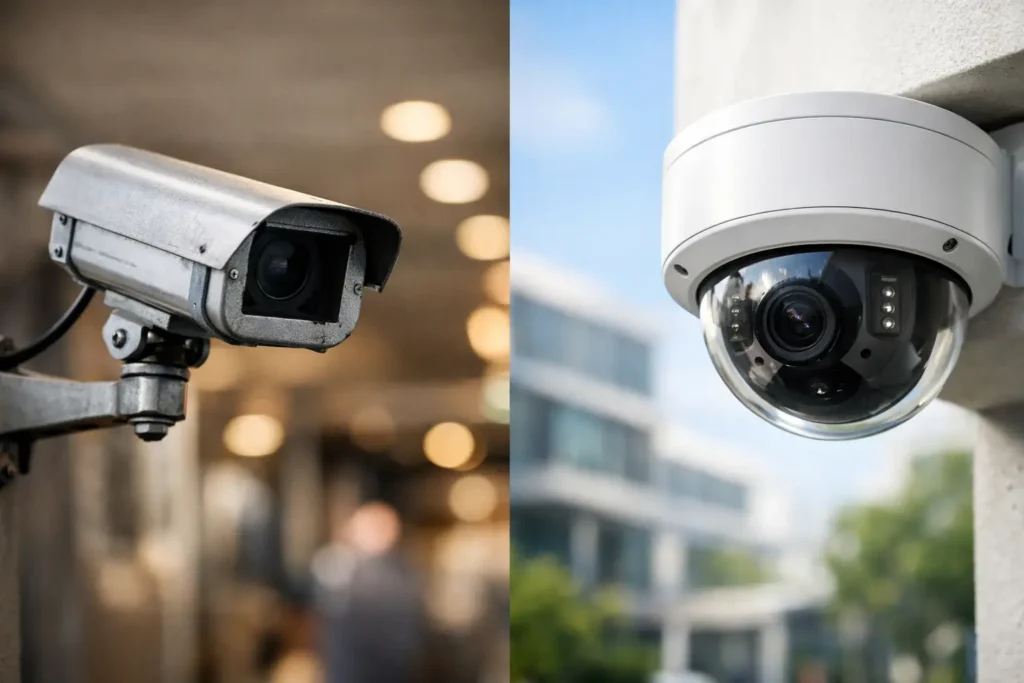
A camera system can pass or fail a security project long before the first camera is mounted. In the analog vs IP cameras decision, the correct choice depends on your site layout, required coverage, authority requirements, network condition, retention needs, and long-term operating plan. The lowest equipment price is rarely the lowest project cost when missed detail, approval delays, or future expansion are considered.
For warehouses, retail branches, construction sites, hotels, commercial buildings, and industrial facilities, surveillance must do more than record footage. It must deliver usable evidence, support the required monitoring layout, and remain reliable after handover. That is why camera selection should follow a professional survey and system design, not a catalog comparison.
Analog vs IP Cameras: The Core Difference
Analog cameras send video over coaxial cable to a digital video recorder, commonly called a DVR. Modern HD analog formats can produce clear high-definition footage and are a practical option where suitable coaxial cabling already exists. The recorder handles video processing, storage, and remote viewing.
IP cameras are network devices. They transmit digital video through an Ethernet network to a network video recorder, or NVR, and in some designs directly to a server or managed recording platform. An IP camera can receive power and data through one network cable when Power over Ethernet is used, reducing the need for a local power supply at each camera location.
This difference affects almost every project decision: image resolution, cable routes, switch capacity, cybersecurity, expansion options, installation disruption, and cost. Neither technology is automatically right for every property.
Image Quality Is About Identification, Not Camera Specs
IP cameras generally offer a wider range of resolutions and advanced functions. Higher pixel counts can help operators identify faces, vehicle plates, product movement, or activity across larger areas. Features such as intelligent motion detection, line crossing alerts, people counting, heat mapping, and object classification are also more common in IP systems.
However, more megapixels do not guarantee better evidence. A high-resolution camera installed too high, aimed into strong backlight, or fitted with the wrong lens may still fail to capture usable identification. Poor lighting can also reduce results, particularly at gates, loading areas, parking zones, and entrances operating around the clock.
Modern HD analog cameras can provide effective coverage for corridors, small retail areas, offices, residential common areas, and defined perimeter points. When the required viewing distance is short and the scene is controlled, analog can produce a very good result at a lower upfront cost.
The correct question is not, “Which camera has the highest resolution?” It is, “What must this camera prove, at what distance, under what lighting conditions?” A professional design maps camera position and lens selection to the operational purpose of each view.
Where IP cameras have a clear advantage
IP cameras are usually the stronger choice for large sites, high-risk areas, wide outdoor zones, multi-branch operations, and locations that require detailed analytics. They support higher resolution options, flexible integration, and more precise monitoring when they are designed on a capable network.
For example, a logistics facility may need readable vehicle plates at an entry point, wide-angle coverage of loading bays, and event alerts for restricted areas. These are separate tasks, and they may require different IP camera types, lenses, and recording settings. One general-purpose camera cannot reliably cover all three.
Where analog remains a practical choice
Analog is often appropriate for upgrades of existing systems with usable coaxial infrastructure. Reusing compliant cable pathways can reduce installation time, avoid disruptive civil work, and preserve budget for better recorder capacity, storage, lighting, or additional camera positions.
It can also suit smaller standalone properties that need dependable recording and straightforward remote access without extensive analytics. The key is to verify cable condition, distance limitations, power arrangements, and recorder compatibility before committing to an upgrade.
Installation Cost Is More Than Equipment Price
An analog camera may cost less than a comparable IP camera, but the total installed cost can vary in either direction. A site with existing coaxial cabling may favor analog. A new development with structured cabling, network racks, and planned PoE switches may favor IP because the installation can be organized around the building’s low-voltage infrastructure.
IP systems require proper network planning. Each camera consumes bandwidth and storage, particularly when higher resolutions, continuous recording, multiple streams, or analytics are used. Switches must have sufficient PoE power budget. Network cabinets need adequate ventilation, labeling, backup power, and access control. Recorder specifications must match the total camera load rather than only the number of channels.
Analog systems have their own design requirements. Long cable runs can affect signal quality, and each camera normally needs a power arrangement. Poor joints, unsuitable connectors, and unprotected outdoor cabling create faults that may only become visible after installation. A low-cost installation with weak containment and poor termination becomes expensive when repeated service visits are required.
Compliance Must Lead the Design
For regulated facilities, camera technology is secondary to compliance. A system must meet the applicable camera placement, image quality, recording retention, storage, monitoring, and documentation requirements. In Dubai, this may involve SIRA requirements. Projects in Abu Dhabi or Sharjah may be subject to separate authority standards and approval processes.
Choosing a camera before confirming the required coverage can cause costly redesign. A camera may be technically excellent but unsuitable if it does not provide the required view of an entry point, cash-handling area, perimeter, elevator lobby, parking access, or other mandated location. Likewise, a recorder with insufficient retention capacity can create an approval issue even when every camera is working.
Compliance also depends on execution. Camera views must be tested and documented. Network equipment, recorders, monitors, and power backup must be installed correctly. Drawings, labeling, and handover records should match the completed system. These details protect the client during inspection, maintenance, incident investigation, and future expansion.
ALNAJAH ALAWAL approaches CCTV projects from this operational perspective: survey the site, confirm the applicable requirements, design the system, install it correctly, complete testing, and support approval processing. The objective is simple: approved right the first time.
Cybersecurity and Reliability for IP Systems
An IP camera is part of your network environment, which means cybersecurity cannot be treated as an optional extra. Default passwords, exposed remote access, outdated firmware, and poorly separated networks can create unnecessary risk. A properly designed IP system uses strong credentials, controlled user permissions, secure remote viewing methods, updated firmware, and network segmentation where appropriate.
Reliability also matters. If an NVR, switch, or uplink fails, multiple cameras may be affected. Good designs account for this through quality equipment, suitable power backup, protected cabinets, and sensible distribution of cameras across network infrastructure. For critical facilities, redundancy may be justified.
Analog systems are not free from risk. DVR user access, remote viewing accounts, recorder firmware, and physical cable protection still require attention. The difference is that IP projects need a more deliberate coordination between the security contractor and the site’s IT environment.
Storage Planning Determines Whether Footage Is Useful
Storage is often underestimated in both analog and IP projects. Camera count alone does not determine recorder capacity. Required retention time, recording schedule, resolution, frame rate, compression method, scene activity, and analytics all affect storage consumption.
A busy loading yard produces far more recorded data than a quiet internal corridor. Continuous 24-hour recording may be necessary for one camera, while event-based recording may be acceptable for another. Reducing frame rate or bitrate can save storage, but excessive compression may make critical details unusable when an incident occurs.
Before installation, define what must be recorded, how long it must be retained, and who needs access. Then size the DVR or NVR accordingly. This avoids the common failure of discovering, after an incident, that footage has already been overwritten.
How to Make the Right Choice
Choose analog when existing coaxial cabling is in good condition, coverage needs are straightforward, budget is tightly controlled, and the required image detail can be achieved with modern HD analog equipment. It is a sensible route for many retrofit projects when it is designed and installed to the right standard.
Choose IP when the project needs high-detail coverage, analytics, scalable expansion, centralized management, modern structured cabling, or integration with access control and other building systems. It is often the better long-term platform for complex commercial and industrial sites, provided network and storage infrastructure are planned properly.
A hybrid approach can also be effective. Existing analog cameras may remain in lower-risk areas while IP cameras are added at entrances, cash points, gates, perimeters, and operationally critical zones. This can protect capital investment while improving the views that matter most.
The right system is the one that captures the required evidence, meets authority requirements, fits the site infrastructure, and can be maintained without disruption. Start with a site survey and a compliance-led design. That is how security projects stay protected, operational, and ready for approval.