

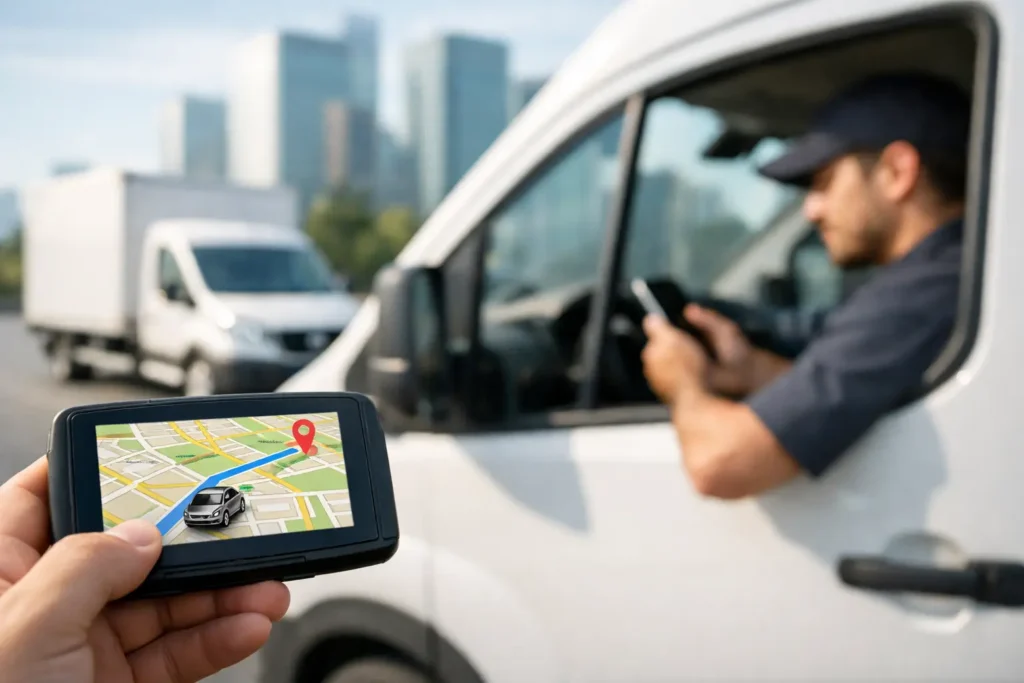
A delivery customer does not judge your operation by how many vehicles you own. They judge it by whether the order arrives when promised, in good condition, and with clear communication when plans change. GPS tracking for delivery vehicles gives fleet managers the live operational visibility needed to protect that promise, control costs, and respond before a minor delay becomes a customer complaint.
For fleets handling last-mile deliveries, distribution runs, service calls, food transport, or high-value goods, vehicle location is only the starting point. The right system turns location data into accountable routes, driver behavior records, arrival evidence, and decisions that improve daily performance.
Why GPS Tracking for Delivery Vehicles Matters
Delivery operations work against tight margins. A few unnecessary kilometers per route, extended idling at several stops, unauthorized vehicle use, or repeated late arrivals can quickly affect fuel spend, labor costs, asset availability, and customer retention. Without reliable data, managers are often forced to rely on driver calls, paper logs, or assumptions after an issue has already occurred.
A professionally installed GPS tracking system provides a live view of each vehicle’s location, direction, speed, ignition status, and route history. Fleet managers can see whether a driver is moving toward the next delivery, waiting at a customer site, stopped unexpectedly, or diverted from the assigned route. That visibility supports faster dispatch decisions and more accurate customer updates.
The value is especially clear when there is a dispute. If a customer reports a missed delivery, the fleet team can review arrival and departure times, the vehicle’s location, and the route traveled. If management receives a complaint about reckless driving, speed and harsh braking events can be reviewed against the exact time and location. Facts replace guesswork.
The Operational Results That Matter
GPS tracking is most effective when it is tied to clear operational objectives. The objective is not to watch a moving icon on a map. It is to improve the reliability and cost control of every delivery run.
More Accurate Dispatch and Route Control
Dispatchers need to know which vehicle is actually best positioned for an urgent job. The nearest vehicle is not always the correct choice. A vehicle may be close on the map but carrying an incompatible load, approaching the end of a shift, or moving in the wrong direction.
Live tracking helps dispatch teams assign work based on real vehicle status and route progress. Historical route reports also reveal recurring bottlenecks, inefficient stop sequences, and areas where delivery windows are consistently missed. This information helps managers redesign routes using evidence rather than habit.
Route optimization has limits. The fastest route on a map may not be appropriate for a large vehicle, temperature-sensitive goods, restricted roads, or a driver who has already reached working-hour limits. Fleet rules and local operating conditions must remain part of every routing decision.
Better Driver Accountability Without Micromanagement
Professional drivers are central to delivery performance. A GPS platform can support them by reducing unnecessary check-in calls and giving dispatchers a clearer understanding of traffic delays, loading delays, and customer site access issues.
It also identifies behavior that requires attention, including speeding, excessive idling, harsh acceleration, harsh braking, extended unauthorized stops, and out-of-hours vehicle use. Used correctly, this data supports fair coaching. Managers can review trends, discuss the reason behind an event, and set measurable improvement targets instead of making broad accusations.
A tracking policy should be clearly communicated to drivers before rollout. Explain what is monitored, why the data is collected, who can access it, and how long records are retained. Clear rules protect the business and build confidence that the system is being used for safety, service quality, and legitimate fleet control.
Stronger Customer Communication and Delivery Evidence
Customers expect realistic arrival information, particularly when they are coordinating receiving staff, retail operations, construction activity, or refrigerated deliveries. GPS data allows customer service teams to provide credible estimated arrival updates instead of vague promises.
Geofencing adds another useful layer. A geofence is a virtual boundary around a warehouse, customer site, delivery zone, fuel station, or restricted area. The system can record when a vehicle enters and exits that location. This creates reliable evidence of time on site and can trigger notifications for early arrival, late departure, or unplanned entry into a restricted zone.
Geofencing should complement, not replace, proof-of-delivery procedures. A vehicle arriving at a site does not confirm that the correct goods were handed over. For stronger accountability, combine vehicle tracking with delivery documentation, signatures, barcode scans, or photos where appropriate.
Lower Fuel Waste and Improved Asset Use
Fuel is a major operating cost, and delivery fleets often lose money through issues that appear small in isolation. Long idling periods, unauthorized trips, poor route planning, aggressive driving, and fuel theft can all increase consumption.
GPS tracking helps identify the vehicle activity behind fuel use. When combined with fuel monitoring equipment, managers can compare refueling records, fuel levels, distance traveled, engine hours, and idle time. Unusual consumption patterns can then be investigated promptly.
Not every fleet requires the same level of monitoring. A small urban delivery fleet may begin with location, ignition, speed, and geofence alerts. A larger logistics operation, fuel transporter, or fleet with high monthly consumption may benefit from integrated fuel sensors and more detailed reporting. The correct design depends on the risk, vehicle type, delivery model, and reporting requirements.
What to Specify Before Installation
A fleet tracking project should start with an operational review, not a device purchase. The equipment and platform must match the way vehicles are used, the reports managers need, and the level of control required.
First, define the outcomes. This may include reducing late deliveries, verifying service visits, preventing unauthorized use, cutting idle time, monitoring cold-chain vehicles, or improving fuel accountability. These priorities determine which alerts, sensors, and reports should be configured.
Next, consider the vehicle mix. Cars, vans, trucks, motorcycles, refrigerated units, and specialized equipment may require different installation methods and accessories. A discreet hardwired tracker may be suitable for a company car, while a delivery truck may need additional connections for ignition status, door monitoring, temperature sensors, panic buttons, or fuel-level monitoring.
Reporting also needs attention. A system can produce large volumes of data, but managers need concise reports that lead to action. Useful daily and weekly reports commonly cover route history, total distance, idle time, speeding events, geofence visits, after-hours movement, engine hours, and fuel exceptions. Set thresholds that reflect real fleet policy. Excessive alerts are ignored; well-configured alerts are acted on.
Installation Quality Affects Data Quality
Poor installation creates poor fleet data. Devices that are incorrectly wired, poorly positioned, inadequately secured, or installed without vehicle-specific care can result in missed ignition records, unreliable tracking, battery drain concerns, or equipment failure.
A qualified provider should inspect the fleet, recommend suitable hardware, install devices safely, test each unit, and verify that live data is reporting correctly before handover. Training is equally important. Dispatchers, managers, and authorized users should know how to view routes, respond to alerts, export reports, and escalate technical issues.
For UAE fleet operators, ALNAJAH ALAWAL SECURITY SYSTEMS & EQUIPMENT TRADING L.L.C. can support the full process from fleet assessment and system design through installation, testing, training, and ongoing maintenance. This matters when vehicle tracking must work reliably alongside wider security, fuel monitoring, and operational control requirements.
A Practical Rollout Plan for Delivery Fleets
Start with a pilot group if the fleet is large or operationally complex. Select vehicles that represent typical delivery patterns, then measure baseline performance for route completion, idle time, late arrivals, fuel use, and unauthorized movement. This gives management a meaningful comparison after the system is active.
During the pilot, confirm that geofences match actual site entrances, delivery zones, and loading areas. Review alert settings with dispatch staff. A notification that sounds useful in a meeting can become disruptive if it triggers hundreds of times each day.
Once the system is deployed across the fleet, review performance regularly. The first few weeks often reveal route practices, vehicle-use patterns, and training gaps that were not visible before. Use the findings to improve processes, recognize good driving, and correct repeated issues early.
The best tracking system is not the one with the longest feature list. It is the one that gives your team reliable information, clear accountability, and enough control to keep every delivery moving as planned.