

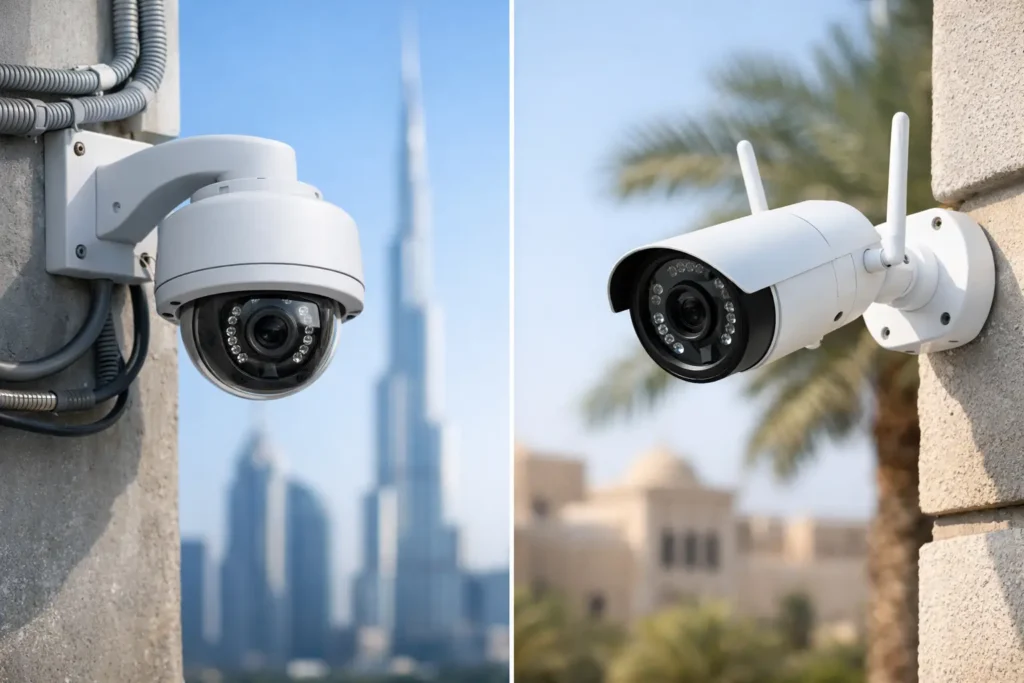
A camera system can look complete on a drawing and still fail where it matters most: during a power interruption, a network outage, an incident investigation, or a regulatory inspection. The wired vs wireless CCTV decision is therefore not simply about camera type. It affects recording continuity, installation scope, long-term maintenance, cybersecurity, and the ability to meet site-specific approval requirements.
For commercial, industrial, retail, logistics, hospitality, and residential projects, the right answer is usually based on the building, the operating environment, and the level of evidence the system must deliver. A well-designed system protects the site without creating avoidable risks later.
Wired vs Wireless CCTV: The Core Difference
A wired CCTV system connects cameras to the network and power infrastructure through structured cabling, most commonly Ethernet cable using Power over Ethernet (PoE). One cable supplies both data connectivity and power to each camera. Footage is sent to a network video recorder or approved recording platform through a stable, dedicated network path.
Wireless CCTV cameras transmit video through Wi-Fi or another wireless network. They may still require a nearby power outlet, unless they use batteries or solar power. Wireless is often chosen where running cable is difficult, disruptive, or disproportionate to the monitoring requirement.
The distinction sounds straightforward, but the practical difference is significant. Wired systems are designed around permanent infrastructure. Wireless systems depend on radio coverage, network capacity, signal quality, and careful device management.
Why Wired CCTV Is Usually the Commercial Standard
For permanent business premises, wired CCTV is typically the stronger choice. It provides consistent bandwidth, predictable video transmission, and a stable platform for high-resolution cameras, continuous recording, analytics, and long retention periods.
This matters in locations such as warehouses, loading bays, cash handling areas, jewelry stores, industrial sites, building entrances, parking areas, and perimeter zones. These environments often need clear footage at all times, not only when a camera has a strong wireless signal or a fully charged battery.
Reliability During Critical Events
A wired camera connected through PoE does not rely on Wi-Fi strength at the camera location. With properly designed switches, network cabinets, and backup power, the system can remain operational during short power disruptions. This is especially valuable where uninterrupted video evidence is required for incident review, claims, investigations, or authority inspections.
Wireless cameras can perform well in controlled environments, but their performance can change as conditions change. Concrete walls, metal racking, machinery, refrigeration units, parked vehicles, tenant Wi-Fi networks, and nearby access points can all affect signal quality. A camera that works well during installation may perform differently after a warehouse is fully stocked or a new partition wall is added.
Better Support for High-Resolution Recording
Modern business surveillance often requires high-resolution cameras, wide-area coverage, night vision, and clear identification at entrances or transaction points. These requirements place continuous demand on the network.
Wired connections handle this demand more consistently. They are better suited to multiple 4K cameras, high frame rates, continuous recording, and centralized video management. Wireless systems may need lower bitrates, reduced frame rates, or motion-based recording to prevent congestion, particularly when many cameras share the same access point.
Stronger Long-Term Control
A wired installation requires more work at the beginning, but it gives the site owner more control over the system. Cables can be labeled, tested, documented, and protected in containment. Camera locations can be mapped, switches can be secured in cabinets, and maintenance teams can troubleshoot faults methodically.
For compliance-driven projects, this level of control is valuable. Camera coverage, recording equipment, cable routes, power backup, signage, and access permissions can be designed as one coordinated system rather than assembled as separate devices.
Where Wireless CCTV Makes Sense
Wireless CCTV is not automatically a poor choice. It can be practical when it solves a real installation constraint and the security risk is suitable for wireless operation.
Temporary sites are a common example. Construction projects, short-term storage yards, events, remote gates, portable offices, and temporary access points may need monitoring before permanent infrastructure is available. Wireless cameras can also be useful in finished interiors where opening ceilings or walls would cause disruption and the camera serves a lower-risk area.
A wireless camera may be appropriate for supplementary visibility, such as monitoring a secondary corridor, a small office entrance, or a temporary delivery zone. The key is to treat it as part of a properly assessed system, not as a shortcut for locations that require guaranteed continuous evidence.
The Hidden Requirements of Wireless Systems
Wireless cameras still need planning. The installer must confirm signal strength at the exact camera position, capacity at peak usage, encryption settings, camera power source, recording method, and recovery behavior after a network or power interruption.
Battery-powered cameras deserve particular caution in commercial environments. They require regular charging or battery replacement, may record only on motion, and can be affected by heat, dust, or frequent activity. A busy entrance or loading area can trigger repeated recordings and reduce battery life faster than expected.
For outdoor wireless cameras, line of sight, weather exposure, mounting stability, and protected power arrangements also need consideration. Wireless does not mean maintenance-free.
Installation Cost: Initial Spend vs Operating Cost
Wireless CCTV can appear less expensive because it may reduce cabling and labor during installation. This can be true for one or two cameras in a difficult-to-reach area. However, the cost comparison changes as the system grows.
A larger wireless deployment may require additional access points, network upgrades, signal testing, electrical work, protective enclosures, and more ongoing maintenance. If a site later needs better coverage or higher-resolution footage, the wireless network may need redesigning.
Wired CCTV usually has a higher upfront installation cost due to cable routing, containment, drilling, network cabinets, and termination work. Yet it often delivers lower risk and better value over the life of a commercial system. It is easier to expand in an organized way when spare cable capacity, switch ports, and cabinet space are included in the original design.
The right question is not which option has the lowest first invoice. It is which option will continue to provide reliable coverage, usable evidence, and manageable maintenance after the site is occupied and operating at full capacity.
Compliance and Approval Considerations
In Dubai, Abu Dhabi, Sharjah, and other UAE jurisdictions, CCTV requirements may involve authority-approved system designs, camera coverage standards, retention requirements, equipment specifications, and inspection procedures. The exact requirements depend on the site category, location, and governing authority.
Neither wired nor wireless CCTV is automatically compliant simply because the cameras are high quality. Compliance depends on the complete solution. A system must provide the required coverage, recording reliability, storage duration, image quality, equipment placement, and access control arrangements. Poor wireless performance can create a practical compliance problem if footage drops, recordings are incomplete, or critical areas are not consistently visible.
For sites requiring SIRA, Abu Dhabi monitoring and control, or Sharjah Police-related approvals, system design should begin with the applicable requirements rather than with a preferred camera model. This prevents rework, failed inspections, and delays to opening or handover.
A Hybrid System Is Often the Best Answer
Many sites do not need to choose one method for every camera. A hybrid approach can provide the strongest outcome.
Use wired cameras for critical areas such as entrances, exits, cash points, loading bays, server rooms, perimeter gates, production zones, and high-value storage. Add wireless cameras only where cabling is genuinely impractical, temporary coverage is needed, or the camera supports a secondary monitoring purpose.
This approach keeps the core security system dependable while allowing flexibility where it is operationally justified. It also makes it easier to prioritize budget without compromising the areas that carry the highest security or compliance exposure.
How to Choose the Right CCTV Design
Start with the risk, not the camera. Consider what needs to be seen, how long footage must be retained, who will review it, and what happens if the camera loses connection at the wrong moment. Then assess the physical site: building materials, cable routes, network rooms, power availability, outdoor conditions, and future expansion plans.
A professional site survey should identify blind spots, required identification points, lighting challenges, network limitations, and approval obligations before installation begins. ALNAJAH ALAWAL designs and installs CCTV systems around these operational requirements, with the documentation, testing, commissioning, and ongoing support needed for regulated UAE projects.
Choose wired CCTV when the site requires permanent, high-reliability surveillance. Choose wireless CCTV when flexibility solves a defined problem and the location can tolerate its operational limits. A properly surveyed system makes that decision clear before installation, when it is still easy to get right.