

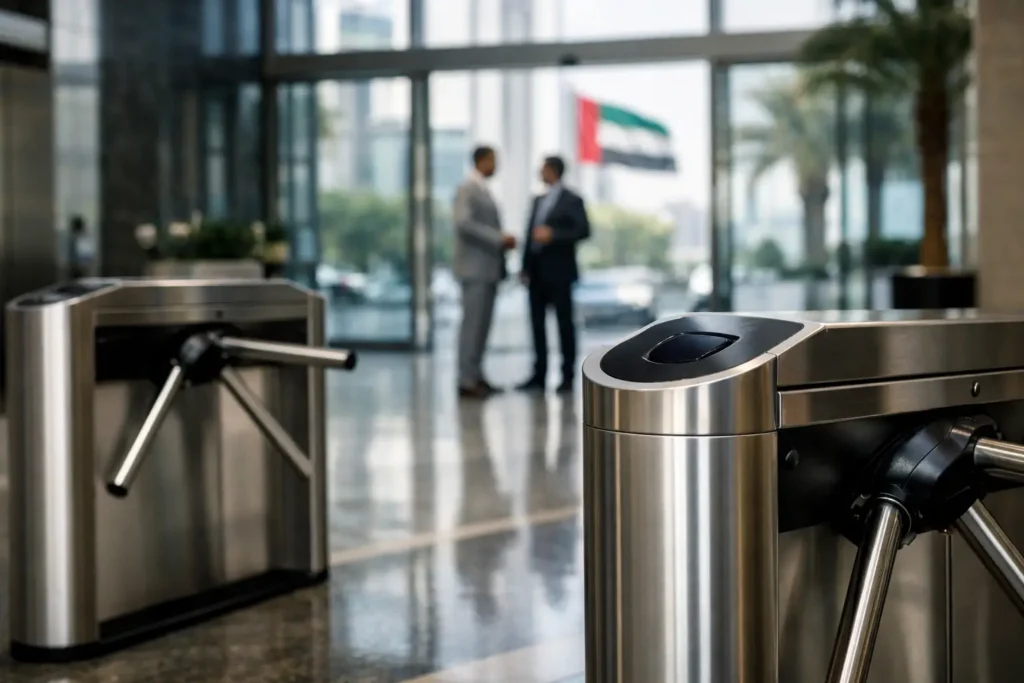
A turnstile is not simply a barrier at the door. For a warehouse, office tower, retail site, labor accommodation, clinic, or industrial facility, it becomes part of the building’s daily control system. A poorly planned installation creates queues, access gaps, emergency egress concerns, and expensive rework. This turnstile installation guide for UAE businesses explains how to plan the project correctly from the first site survey through commissioning.
The right result is practical: authorized people move through quickly, visitors follow a controlled process, facility teams can review access activity, and the system supports the site’s safety and operational requirements. Stay compliant. Stay protected.
Start With the Entry Process, Not the Turnstile Model
The first decision is not whether to buy a tripod turnstile, speed gate, swing barrier, or full-height turnstile. It is understanding who uses the entrance, when they use it, and what the entrance must prevent.
A staff-only office reception may need elegant speed gates integrated with employee cards and visitor credentials. A warehouse may require rugged tripod turnstiles that handle shift-change traffic and support time-attendance reporting. A high-security perimeter may call for full-height turnstiles, although this option must be assessed carefully for emergency escape routes and accessibility.
During a site survey, document the number of users per hour, peak entry periods, available floor space, door locations, reception layout, loading routes, and any existing access control hardware. Also identify whether the same entrance is used by employees, contractors, visitors, delivery personnel, or people of determination. One gate type rarely suits every user group.
Traffic capacity matters. A barrier that works for 30 employees arriving gradually can become a bottleneck when 300 workers arrive within 15 minutes. For busy locations, calculate peak throughput instead of relying on average daily headcount. This is where wider lanes, multiple lanes, or a separate visitor route may be necessary.
Confirm UAE Compliance and Life-Safety Requirements Early
Turnstiles sit at the intersection of security, building access, and life safety. They must never obstruct required emergency evacuation routes. The design should be reviewed against the building’s approved fire and life-safety strategy, authority requirements, and the requirements of the landlord or facility operator.
Where access control, CCTV, emergency systems, or wider security infrastructure are part of a regulated project, the applicable authority requirements must be confirmed at the design stage. In Dubai, Abu Dhabi, and Sharjah, requirements can differ depending on the site type, scope, and approval pathway. Do not assume that a turnstile installation is a standalone item with no impact on the wider security submission.
The emergency release method is a critical design point. Depending on the equipment and approved site design, gates may need to unlock, open, or allow free passage when a fire alarm is activated or power is lost. The exact behavior must be coordinated with the fire alarm contractor, access control system, and building management team. It should be tested under actual alarm conditions before handover.
Accessibility also needs practical attention. A standard tripod lane is not an accessible route. Most commercial sites need a wider controlled lane or gate arrangement for wheelchair users, strollers, service access, and managed visitor entry. The accessible route should be obvious, supervised where required, and included in the operating procedure.
Choose Equipment for the Site Environment
Turnstile selection should reflect how the facility operates, not only the appearance of the lobby. Indoor corporate entrances can prioritize finish, quiet movement, and integration with visitor management. Industrial sites should prioritize durability, stable operation, and resistance to heavy use.
Tripod turnstiles are a cost-effective choice for controlled staff access and attendance points. They are compact and familiar to users, but they are less suitable where a premium visitor experience, broad accessibility, or stronger tailgating control is required.
Speed gates offer faster throughput and a more professional reception environment. They can provide alarm functions for unauthorized passage and support wider lanes. However, they require more space, careful lane configuration, and a higher initial budget.
Swing barriers work well where accessibility and flexible passage are priorities. Full-height turnstiles provide a higher physical barrier for perimeter access but need thorough planning around escape routes, weather exposure, and service access. For external installations, verify the equipment’s environmental rating, corrosion resistance, drainage requirements, and suitability for UAE heat, dust, and humidity.
Plan the Turnstile Installation Layout
A successful layout gives people a clear path before they reach the barrier. Users should be able to approach, present a card or mobile credential, pass through, and continue without crossing paths with people exiting. Confusing circulation increases tailgating, false alarms, and frustration at busy times.
Leave adequate space before and after the gates. The entry side needs room for people to queue without blocking reception desks, elevators, corridors, or emergency exits. The exit side needs enough clearance for users to move away from the lane. If bags, visitor badges, or security screening are involved, position those functions before the turnstile rather than creating a stop-and-start process at the barrier.
The installation team should verify finished floor levels, slab condition, cable routes, ceiling access, network cabinet locations, and nearby fire alarm interfaces. Turnstiles require secure anchoring. Floor cores, conduits, and mounting points must be coordinated before finishes are damaged.
For sites with raised floors, marble, tiles, or post-tension slabs, investigate the fixing method early. A decorative finish can conceal serious structural limitations. Installing first and resolving anchors later is not a controlled approach.
Integrate Credentials, Access Rules, and Monitoring
The physical gate is only one part of the system. Its value comes from the access rules behind it. A properly configured controller determines who may enter, which lane they may use, and at what time. It can also record events for security investigations, attendance monitoring, and operational reporting.
Businesses can use cards, fobs, PINs, QR visitor credentials, mobile credentials, biometrics, or a combination of methods. The best choice depends on risk, user volume, privacy requirements, and existing infrastructure. For example, cards are practical for large workforces, while QR codes can simplify temporary visitor access. Biometric access may increase accountability, but it should be assessed against privacy policy, workforce acceptance, and enrollment procedures.
Integrate the turnstile with CCTV wherever possible. A camera covering the approach and passage area helps security teams investigate forced entry, tailgating alarms, and disputes over access events. Camera positioning should capture faces and lane activity without being blocked by gate cabinets, signage, or changing light conditions.
Define how the system handles exceptions. Reception and security teams need a clear process for lost cards, contractors, VIP visitors, disabled credentials, emergency access, and equipment faults. A turnstile system is only as controlled as the people managing its exceptions.
Install, Test, and Commission Before Opening the Lanes
Installation should follow approved drawings, manufacturer guidance, and coordinated cable schedules. Power, network, controller wiring, emergency release connections, and access readers must be labeled and tested. Poor cable management may not be visible to visitors, but it creates maintenance risk and slows down fault finding later.
Before the lanes go live, conduct functional testing with the client’s actual access rules. Test valid access, denied access, anti-passback where used, tailgating alarms, forced-entry alarms, fire alarm release, power-failure behavior, network loss, and manual override. Test each lane, not just one representative unit.
Commissioning should include a walk-through with the facility manager, security supervisor, reception team, and IT representative where applicable. Staff must know how to respond when a lane alarms, how to release a person safely, and who to call if the controller or network fails. Provide operating instructions, equipment records, warranty details, credentials administration guidance, and a maintenance schedule.
ALNAJAH ALAWAL SECURITY SYSTEMS & EQUIPMENT TRADING L.L.C. manages turnstile and access control projects from site survey and design through installation, testing, authority coordination where applicable, staff training, and maintenance support. This reduces the risk of disconnected contractors and unclear responsibility at handover.
Maintain the System Before a Small Fault Stops Entry
Turnstiles are moving equipment in a high-use location. They need scheduled inspection, cleaning, alignment checks, and functional tests. Dust buildup, loose anchors, worn mechanical parts, damaged reader covers, and unstable network connections can all lead to access delays.
Maintenance frequency depends on usage and environment. A polished office lobby with moderate traffic has different needs than a dusty industrial entrance operating through multiple shifts. Keep a log of recurring alarms and faults. Patterns often reveal a layout issue, user behavior problem, or configuration gap rather than a hardware failure.
The most effective turnstile installation is the one that staff barely notice during a busy day. Plan the traffic, verify the emergency behavior, integrate the system correctly, and test every scenario before the first shift arrives. That is how entry control supports operations without becoming an obstacle.