

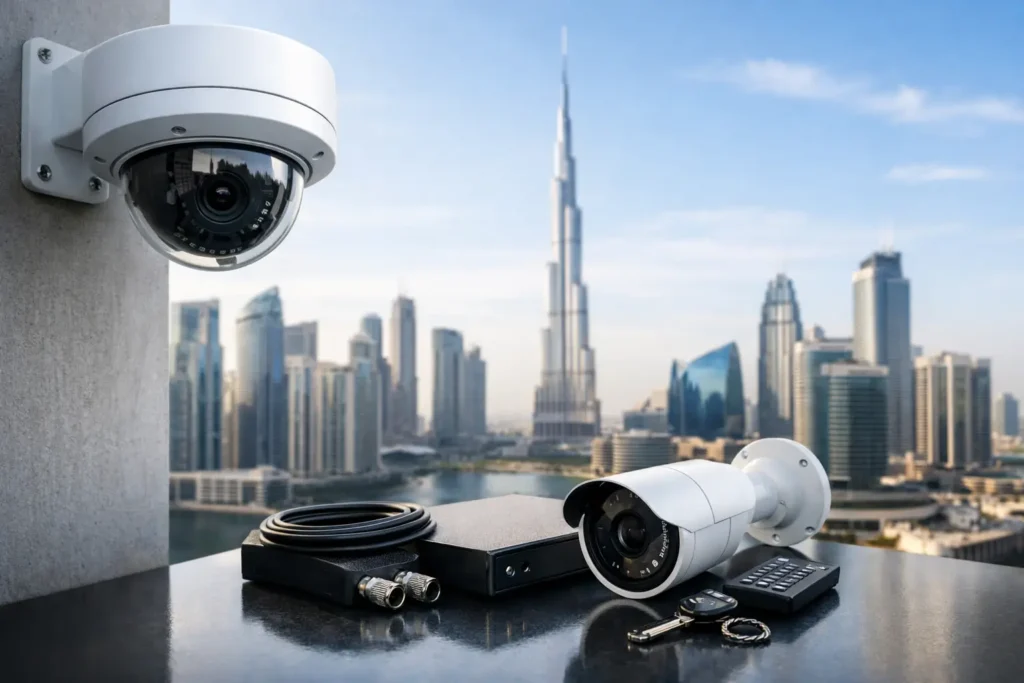
If you are comparing the best cctv companies in dubai, the wrong decision usually does not fail on camera quality alone. It fails at approval stage, during inspection, or months later when footage is missing, blind spots appear, or maintenance support disappears. For warehouses, retail stores, labor accommodation, commercial buildings, clinics, and industrial sites, the real question is not who can supply cameras. It is who can deliver a compliant system that works properly from day one and keeps working.
Dubai has no shortage of installers. That makes selection harder, not easier. Many providers can quote quickly. Far fewer can handle site survey, authority requirements, camera placement, recording design, testing, approval documentation, handover, and long-term service with the same level of control. If your business depends on passing inspection, protecting assets, and avoiding project delays, those differences matter.
How to evaluate the best CCTV companies in Dubai
The most reliable way to compare contractors is to look beyond product brochures. A strong CCTV company should be able to explain how it designs for your site, what approvals apply, how storage is calculated, how blind spots are prevented, and what happens after installation. If the conversation stays limited to camera brands and price per point, you are probably not getting the full picture.
A serious contractor starts with the operating environment. A jewelry store, warehouse loading area, school entrance, hotel corridor, and fuel station all have different surveillance risks. Lighting conditions, access patterns, perimeter exposure, retention requirements, and authority rules change the design. Good companies account for that early. Weak ones install a generic layout and hope it passes.
Approval capability is not optional
In Dubai, compliance is often the deciding factor. Businesses may need SIRA-approved CCTV systems and documentation that meets local authority requirements. In other emirates, separate rules and approval pathways apply. A contractor that understands only hardware but not compliance can create expensive delays, rework, or failed inspections.
This is why approval capability should sit near the top of your checklist. Ask whether the company regularly handles regulated installations, whether it prepares drawings and required submissions, and whether it supports the process through approval and commissioning. A provider that treats approval as an afterthought is taking a risk with your timeline.
Site survey quality tells you a lot
A proper site survey is where competent execution begins. During survey, the contractor should identify high-risk zones, access points, cash handling areas, perimeter gaps, low-light conditions, and infrastructure constraints. They should also review cable routes, recording room conditions, network requirements, and power backup needs.
If a company sends a quote without seeing the site, there is a good chance important details are being missed. That can lead to variation costs later or a system that technically works but performs poorly in real conditions. A dependable provider will prefer accuracy over speed when it affects system integrity.
What separates strong CCTV contractors from average installers
The best CCTV companies are not necessarily the cheapest, the largest, or the ones offering the longest equipment list. They are the companies that control risk well. They document properly, design carefully, install cleanly, and stay accountable after handover.
One clear difference is design discipline. Camera count alone does not make a site secure. Coverage angles, identification range, lighting balance, lens selection, storage duration, and recorder configuration all affect whether footage is actually useful. Businesses often discover this too late, after an incident reveals that the image quality was poor or the key area was not covered properly.
Another difference is execution consistency. Commercial and industrial clients usually need contractors who can coordinate with fit-out teams, civil contractors, MEP teams, IT personnel, facility managers, and operators without creating delays. A company that can manage those interfaces reduces disruption and keeps projects moving.
Maintenance support matters more than most buyers expect
A CCTV system is not a one-time purchase. Hard drives fail. Camera views shift. Dust, heat, and outdoor conditions affect performance. Network changes can interrupt recording. If there is no proper maintenance framework, the system may degrade quietly until a critical event exposes the problem.
That is why after-sales support should be part of your evaluation from the beginning. Ask what preventive maintenance includes, how faults are handled, whether remote diagnostics are available, and how fast on-site support can be arranged. For operational sites, response time can be more important than a small saving on installation cost.
Documentation and handover should be clear
Good contractors leave behind more than installed cameras. They provide test results, camera layouts, recorder details, user training, passwords under controlled process, and clear escalation points for support. This matters for internal teams, audits, future expansions, and compliance checks.
Without proper handover, clients often become dependent on one technician or end up unable to retrieve footage efficiently during an incident. A well-run company reduces that dependency by documenting the system properly and training the client team to operate it with confidence.
Price matters, but low price usually hides a trade-off
Every buyer compares quotations. That is reasonable. But CCTV pricing only makes sense when you understand what is included and what is missing. A low quote may exclude approval support, structured cabling quality, storage capacity, UPS requirements, mounting accessories, network configuration, testing, or maintenance coverage. On paper it looks competitive. In practice it can become more expensive.
There is also a difference between meeting minimum installation requirements and delivering a system that holds up under real use. Some businesses only need a straightforward compliant setup for a smaller site. Others need integrated surveillance across multiple buildings, parking, perimeter areas, and control rooms. The right choice depends on your risk profile, not just your budget.
For example, a retail outlet may prioritize entrance coverage, POS visibility, and storage retention. A warehouse operator may care more about loading bays, yard areas, and internal movement tracking. A property developer may need a contractor who can deliver surveillance as part of a wider ELV package and coordinate approval milestones around handover dates. The best company for each case may not be the same if the underlying needs are different.
Questions worth asking before you appoint a contractor
When you speak with CCTV companies, listen for how they handle practical details. Do they ask about authority requirements, footage retention, critical coverage zones, and business continuity? Do they explain their installation method and commissioning process clearly? Can they show experience with sites similar to yours?
It also helps to ask who owns each stage of the project. One vendor handling survey, design, supply, installation, approval support, testing, and maintenance usually gives the client tighter accountability. Split responsibility can work, but it often creates blame gaps when problems appear.
A strong contractor should be comfortable answering questions like these in plain terms:
- What approvals apply to this site, and who manages them?
- How is camera placement determined for identification, not just general viewing?
- How many days of storage will the system provide under actual recording conditions?
- What is included in testing, commissioning, and operator training?
- How will service calls and preventive maintenance be handled after handover?
If the answers are vague, generic, or overly sales-driven, keep looking.
A practical standard for choosing well
For most businesses, the best CCTV company is the one that can get the system approved right the first time, install it without disrupting operations, and support it properly afterward. That usually means choosing a compliance-led contractor rather than a basic equipment reseller.
In regulated environments, experience with authority-approved installations is especially valuable. A SIRA, MCC, and Sharjah Police approved contractor such as ALNAJAH ALAWAL SECURITY SYSTEMS & EQUIPMENT TRADING L.L.C. brings a different level of control because approval pathways, technical design, and execution are handled together. That reduces project risk and shortens the distance between quotation and working system.
For buyers, the main takeaway is simple. Do not judge CCTV providers only by brand names, camera megapixels, or headline price. Judge them by whether they understand your site, your compliance exposure, your operational needs, and your long-term support requirements. A camera system is only as good as the company behind it.
When you shortlist vendors, choose the one that gives you confidence in both approval and performance. The right partner helps you stay compliant, stay protected, and avoid fixing preventable mistakes later.