

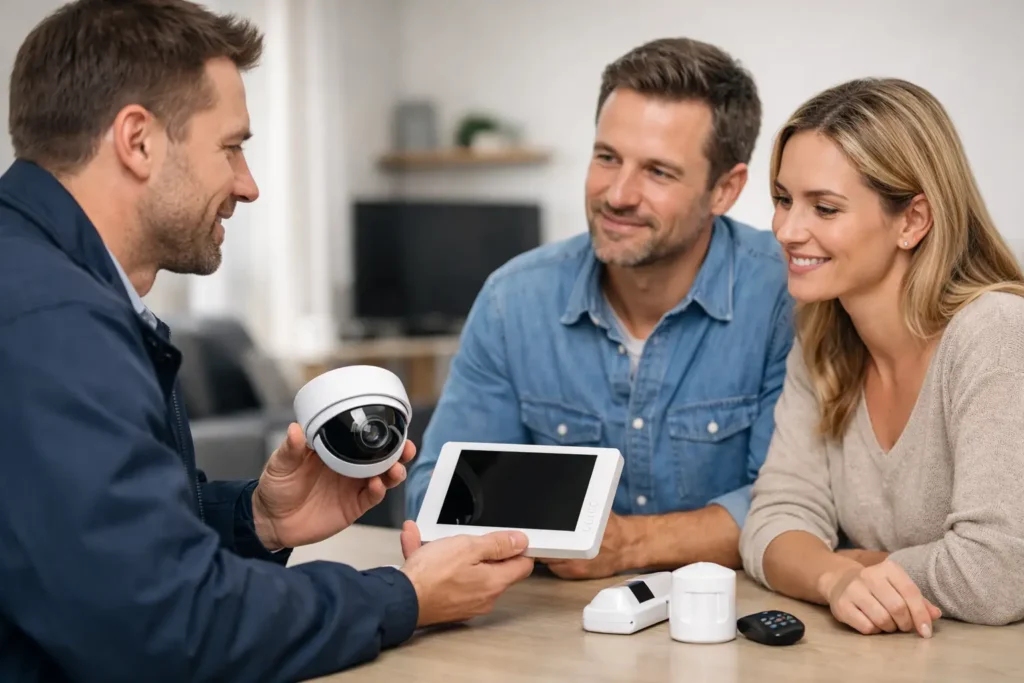
A security system contractor is not just there to mount cameras or wire devices. In the UAE, that contractor often determines whether your site gets approved on time, whether your system performs when needed, and whether your operation avoids costly rework.
For business owners, developers, warehouse operators, and facility teams, that difference matters. A low quote can become an expensive problem if the contractor misses authority requirements, installs the wrong specification, or leaves gaps between design, commissioning, and documentation.
What a security system contractor should actually deliver
The right contractor manages the full project, not only the visible installation work. That starts with a proper site survey, where camera coverage, blind spots, access points, network pathways, storage requirements, and authority expectations are assessed before any equipment is proposed.
From there, the work should move into design, equipment selection, installation, testing, commissioning, and handover. In regulated environments, the contractor also needs to manage approval submissions, coordinate with relevant authorities where required, and make sure documentation is complete and accurate.
That is especially important for CCTV, access control, and integrated ELV projects. These systems do not operate in isolation. Surveillance often depends on storage architecture, structured cabling, power availability, monitoring requirements, and access rules. If one part is poorly planned, the whole system suffers.
A dependable contractor also thinks beyond handover. Maintenance response times, warranty support, preventive service, software updates, and user training all affect long-term performance. A system that works well on day one but becomes unreliable six months later is not a successful project.
Why compliance should be the first filter
For many sites, compliance is not optional. It is tied directly to licensing, approvals, operational continuity, and risk exposure. That is why choosing a security system contractor based only on equipment brand or installation price is risky.
In Dubai, Abu Dhabi, and Sharjah, different sectors and premises may need to meet specific surveillance and security requirements. Retail, warehousing, industrial facilities, labor accommodation, fuel-related operations, and high-value commercial environments often face stricter oversight than standard office spaces.
A contractor with real compliance experience understands what approval bodies expect before installation begins. That affects camera placement, recording duration, control room setup, cabling routes, and even the format of submitted drawings and reports. If those details are missed early, delays usually appear late, when they are more expensive to fix.
This is where approved, compliance-led execution creates value. A contractor familiar with SIRA-approved CCTV requirements, Abu Dhabi compliance processes, or Sharjah Police expectations can help reduce rejection risk and keep projects moving. Approved right the first time is not just a slogan. It saves time, protects budgets, and prevents operational disruption.
Signs you are dealing with the wrong contractor
Some warning signs appear before the first cable is installed. If a contractor gives a price without a proper survey, treats approvals as your responsibility, or cannot clearly explain how the system meets site-specific requirements, that should raise concern.
Another common issue is fragmented delivery. One vendor handles supply, another does installation, and someone else is expected to deal with testing or authority coordination. That structure can work on simple jobs, but on compliance-driven projects it often creates delays and finger-pointing.
You should also be cautious if the proposal is vague. If there is no clear scope for recording capacity, coverage design, network integration, maintenance terms, or testing procedures, you are not looking at a controlled project. You are looking at a future variation order.
The same applies to post-installation support. Many businesses only discover the weakness of a contractor after handover, when a failed device, software issue, or inspection finding needs urgent action. If support is unclear before award, it will usually be worse after completion.
How to evaluate a security system contractor
Start with execution capability, not marketing claims. Ask how the contractor handles the project from survey to commissioning. The answer should be specific and operational, not broad and sales-led.
A serious contractor will explain how they assess risk areas, define technical scope, prepare drawings, select compliant equipment, manage installation teams, test the system, and support authority submissions where needed. They should also be able to explain how they handle changes during the project without losing schedule control.
Next, verify approval and sector experience. A contractor may be competent on residential or small office work but struggle with logistics facilities, industrial plants, retail networks, or regulated commercial properties. Experience in your type of environment matters because usage patterns, risk profiles, and compliance obligations are different.
Then look at integration capability. Many clients need more than CCTV. Access control, ANPR, intercom, gate barriers, structured cabling, GPS fleet tracking, and fuel monitoring may all sit within the same operational ecosystem. A contractor that understands those touchpoints can reduce coordination gaps and help you avoid multiple disconnected vendors.
Finally, examine support structure. Ask who handles preventive maintenance, emergency callouts, software support, replacement parts, and user training. Good support is planned, not improvised.
Price matters, but only in context
Every buyer has a budget. That is reasonable. But security and ELV projects should be judged on total delivery value, not line-item cost alone.
A cheaper proposal may exclude core items such as storage sizing, network accessories, conduit work, testing, authority resubmissions, as-built documentation, or maintenance coverage. It may also rely on substitutions that create approval issues later. On paper, the price looks attractive. In practice, the project becomes slower and more expensive.
A stronger proposal often looks more expensive because it reflects the real scope. It accounts for compliance, labor quality, testing, documentation, and after-sales support. For sites that cannot afford downtime or failed inspections, that difference is usually worth far more than the initial savings of a low-cost bid.
This does not mean the most expensive contractor is automatically the right one. It means the scope has to be compared carefully. If two prices are far apart, there is usually a reason.
The advantage of a single-vendor approach
For complex sites, a single-vendor model reduces risk. When one contractor manages survey, design, supply, installation, commissioning, approvals, training, and maintenance, accountability stays clear.
That matters on active commercial and industrial sites where access windows are limited and operational continuity is critical. Delays caused by coordination failures can affect fit-out schedules, opening dates, inspections, and internal resources. A contractor that owns the entire process can usually move faster and solve issues earlier.
This approach is especially useful for businesses that need both compliance and performance. ALNAJAH ALAWAL SECURITY SYSTEMS & EQUIPMENT TRADING L.L.C., for example, operates in this model by managing end-to-end security, fleet, and ELV delivery with compliance requirements built into execution rather than treated as an afterthought.
What the best contractor relationship looks like
The best projects usually share the same pattern. The contractor asks the right questions early, documents the site properly, identifies approval requirements before procurement, and communicates clearly during execution.
There is no confusion about who is responsible for drawings, material submittals, installation quality, testing, training, or support. The client knows the scope, the schedule, and the approval path. Problems still happen on some projects, but they are addressed quickly because ownership is clear.
That kind of relationship is not only about technical skill. It is about control, responsiveness, and accountability. For business owners and facility stakeholders, that is what creates confidence.
Choosing with the long term in mind
Security systems are not one-time purchases. They become part of how a facility operates every day. Cameras support investigations. Access control protects staff and assets. Fleet tracking shapes dispatch performance. Fuel monitoring affects cost control and loss prevention.
That is why the right contractor should be chosen as a long-term operational partner, not just an installer. You need a team that can keep the system compliant, maintain performance, and respond when business needs change.
If your site, fleet, or facility depends on security infrastructure to stay operational, choose a contractor that can do more than install equipment. Choose one that can carry the project from requirement to approval to reliable daily use – without leaving risk behind.