

A door that stays unlocked for deliveries, a shared PIN that never gets changed, a server room key passed between shifts – these are usually the weak points that cause the biggest problems. If you are working out how to choose access control, the right starting point is not the product catalog. It is the risk, the building layout, the approval requirements, and the way your team actually moves through the site every day.
For commercial properties, warehouses, retail branches, labor accommodation, clinics, and industrial facilities, access control is operational infrastructure. It affects security, staff accountability, visitor flow, emergency response, and compliance. A system that looks fine on paper can still fail in practice if it slows down entry, creates blind spots, or does not meet authority requirements.
How to choose access control for your site
The best access control system is the one that matches your site conditions, user volume, and compliance obligations without creating daily friction. That means asking a few hard questions early.
Start with the doors. Not every opening needs the same level of control. A main lobby entrance, a warehouse loading bay, a finance office, a data room, and a staff accommodation block all carry different risks. Treating them the same usually leads to overspending in low-risk areas and under-protecting the critical ones.
Then look at who needs access and when. Permanent staff, contractors, cleaning teams, drivers, visitors, and management often need different permissions. If your operation runs across multiple shifts, temporary staff cycles, or several branches, simple standalone locks can become difficult to manage very quickly.
A useful rule is this: choose the level of control your operation can realistically manage. Advanced features sound attractive, but if your team will not maintain user permissions, review audit logs, or replace lost credentials promptly, complexity becomes a security gap.
Match the system to the risk level
Low-risk internal doors may only need basic card or PIN access with event logs. High-risk spaces such as server rooms, cash offices, gold storage, medicine rooms, or restricted records areas may justify multi-factor authentication, anti-passback rules, and tighter reporting.
This is where many buyers make the wrong decision. They either buy a very basic system for a high-liability area, or they specify enterprise-level controls everywhere and create unnecessary cost. The right approach is layered control. Use stronger authentication where loss, theft, safety exposure, or compliance consequences are highest.
Think about traffic, not just security
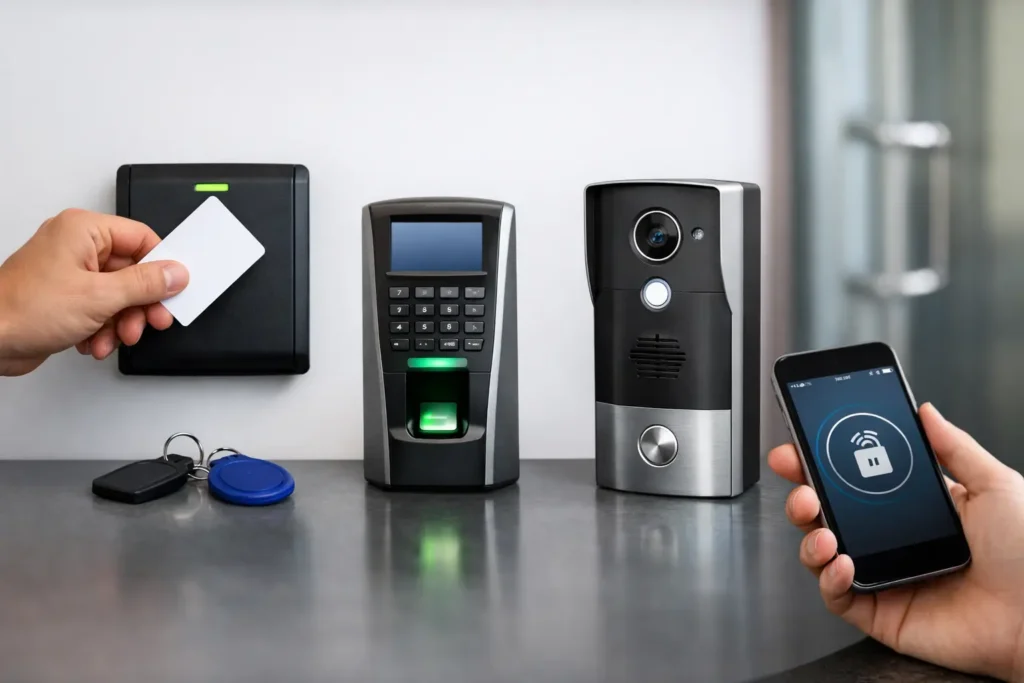
A secure door that causes queues at shift changes is still a bad design choice. High-volume entrances may need faster credentials such as RFID cards, mobile credentials, or biometric readers that can process users quickly. Smaller offices may be fine with simpler readers.
Biometric access can improve accountability because a fingerprint or face is harder to share than a card. But it is not automatically the best choice for every site. Dusty industrial areas, outdoor gates, gloves, moisture, or inconsistent lighting can affect performance depending on the technology. Privacy policies and user acceptance also matter.
Choose credentials based on real use
When clients ask how to choose access control, the credential type is usually the first thing they focus on. It matters, but only after you understand the operating environment.
Cards and fobs are common because they are fast, familiar, and cost-effective. They work well for offices, schools, clinics, and many commercial buildings. The trade-off is that they can be lost, shared, or not returned by former staff unless offboarding is tightly managed.
PIN-based access is simple and inexpensive, but shared codes are a recurring problem. It may suit low-risk internal doors or temporary situations, but it is rarely the strongest long-term answer for sensitive areas.
Biometric readers improve identity assurance. They are useful where you need stronger proof of who entered and when. That said, they require proper device selection, enrollment processes, and maintenance. In some cases, combining biometrics with a card gives a better balance of speed and control.
Mobile credentials are growing in popularity, especially where users already rely on company phones. They reduce card handling and can simplify remote credential management. The downside is dependence on device availability, battery life, and user behavior.
Decide between standalone and networked systems
This decision affects both budget and long-term control.
Standalone systems can work for a small office with one or two controlled doors and a stable user base. They are usually faster to deploy and less expensive upfront. But once a business grows, adds shifts, needs central reporting, or wants to manage multiple doors from one platform, standalone systems start to show their limits.
Networked access control gives you centralized administration, audit trails, user grouping, time schedules, and easier scaling across more doors or more sites. For warehouses, commercial buildings, retail chains, and industrial facilities, this is often the better fit because access permissions change regularly and reporting matters.
The trade-off is that networked systems need proper design from the start. Controller placement, power backup, door hardware compatibility, cabling, cybersecurity, and software licensing all need attention. Poor planning here creates expensive corrections later.
Do not separate software from hardware decisions
Many projects focus heavily on reader brands and door locks while giving too little attention to the software platform. That is a mistake. Your team will live with the software long after installation.
Check how users are added and removed, how access groups are structured, whether reports are easy to generate, and whether the system can integrate with CCTV, intercom, alarms, or time attendance if needed. If your business expects expansion, ask what happens when you move from five doors to fifty.
A system that is hard to administer often ends up poorly maintained. Permissions stay active too long, temporary users remain in the database, and logs go unread until there is an incident.
Compliance should shape the design early
In the UAE, access control decisions are not only about convenience or theft prevention. Depending on the site type and sector, regulatory and authority requirements can directly affect design, approvals, and installation methods.
That is why compliance should be built into the project at the survey and design stage, not treated as a final checklist. Door release logic, emergency egress, fire alarm interface, power backup, monitored points, and system documentation may all affect whether the installation is accepted without delay.
For businesses operating under strict approval environments, choosing an experienced contractor matters as much as choosing the equipment. A compliant design delivered correctly the first time reduces project risk, avoids rework, and protects opening schedules.
Plan for integration where it adds value
Not every access control system needs to connect to everything else. But some integrations create clear operational advantages.
When access control is tied to CCTV, security teams can verify who entered a door and review footage against event logs. In logistics and industrial environments, this can speed up investigations and reduce disputes. In commercial buildings, intercom and visitor management integration can improve front-desk control. In larger operations, connecting access control to attendance workflows may reduce duplicate administration.
The key is discipline. Add integrations that solve a real operational problem. Avoid adding features only because the platform allows it.
Support, maintenance, and response times matter
Access control is not a fit-and-forget system. Credentials are lost. Staff changes happen. Doors go out of alignment. Readers fail. Software needs updates. If support is slow, operations suffer.
Before choosing a provider, ask how maintenance is handled, what service response times look like, and whether spare parts and technical support are locally available. A low purchase price can become expensive if every fault takes too long to resolve.
This is especially important for sites with 24-hour operations, regulated facilities, or high staff turnover. In these environments, system uptime and fast user management are part of business continuity.
ALNAJAH ALAWAL SECURITY SYSTEMS & EQUIPMENT TRADING L.L.C. approaches access control the same way it handles wider security and ELV work – with site-led design, compliance awareness, proper execution, and long-term support built into the project from the start.
Common mistakes when choosing access control
The most common mistake is buying on device price instead of total suitability. The cheapest option may not include the reporting, scalability, approvals support, or door hardware performance your site needs.
Another mistake is underestimating door conditions. Glass doors, metal doors, outdoor gates, fire-rated doors, and high-traffic entry points all require the right locking method and installation approach. A good reader on the wrong door setup will still fail.
The third is ignoring future change. If you expect site expansion, tenant changes, more departments, or tighter compliance requirements, build for that now. Replacing a system early because it cannot scale is avoidable.
A practical way to make the final decision
Start with a proper site survey. Identify critical doors, user types, traffic patterns, operating hours, and any approval constraints. Then compare system options based on four factors: security level, ease of administration, compliance fit, and support reliability.
If two systems look similar, choose the one your team can manage confidently and your contractor can support consistently. Fancy features do not protect a facility if nobody uses them properly.
The right access control system should do three things well: restrict the right areas, keep movement efficient, and stand up to inspection and daily use. When those three line up, the system stops being just another security expense and starts working like it should – quietly, consistently, and without holding your operation back.
A good choice is not the system with the longest feature list. It is the one that fits your site, meets your obligations, and keeps control in the right hands from day one.