

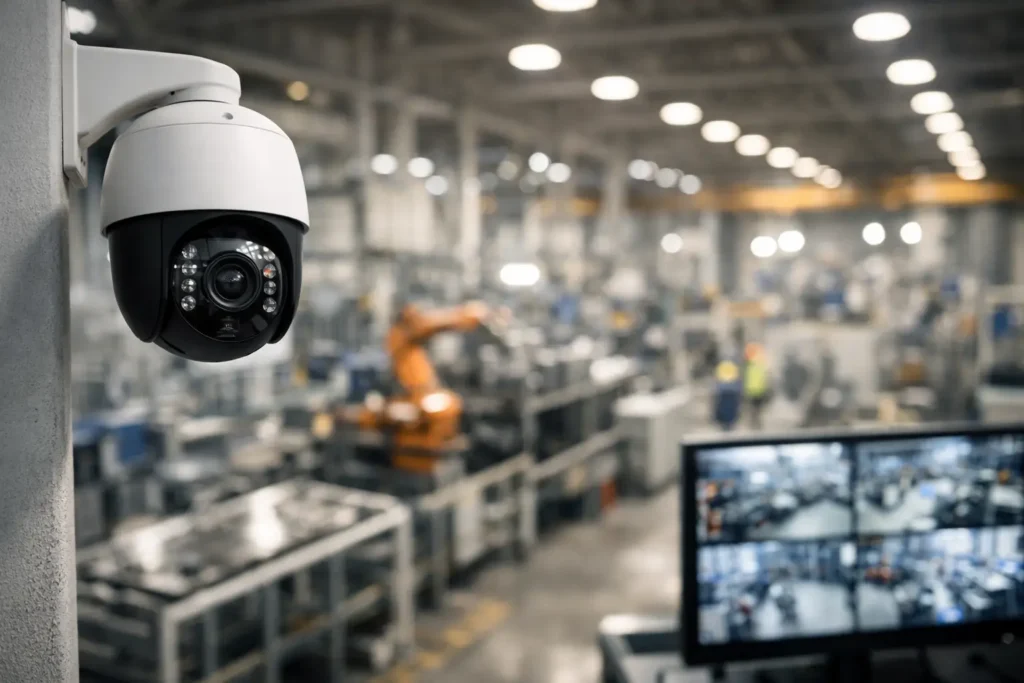
A factory can fail a CCTV inspection for reasons that look minor on paper – poor camera placement at loading bays, blind spots around raw material storage, missing retention capacity, or equipment that does not match local approval expectations. In practice, factory security camera requirements UAE are not just about putting cameras on walls. They affect approvals, insurance expectations, incident evidence, worker safety, and day-to-day operational control.
For factory owners, operations managers, and facility teams, the real issue is simple: the system must be compliant, usable, and built for an industrial environment. If any one of those three is missed, the project can become expensive very quickly.
What factory security camera requirements in the UAE usually involve
At the most basic level, a factory CCTV system is expected to monitor the site clearly enough to support security control, incident review, and authority compliance. That means full coverage of critical access and operational zones, recording quality that is actually useful, and storage that meets the required retention period.
But factories are not standard commercial units. They have perimeter walls, vehicle gates, loading docks, production floors, hazardous zones, worker movement, and often a mix of indoor and outdoor conditions. A camera plan that works for an office or small shop usually fails in a manufacturing environment because the risks are different.
In the UAE, requirements also depend on location and authority. A factory in Dubai may need CCTV planning that aligns with SIRA expectations. In Abu Dhabi, compliance may follow the applicable monitoring and control authority framework. In Sharjah, police approval requirements can shape installation standards. The details vary, which is why many industrial operators run into delays when they assume one camera design fits every emirate.
Coverage comes first, not camera count
One of the most common mistakes in factory projects is asking how many cameras are needed before defining what the cameras must see. Compliance and performance depend on coverage logic, not just quantity.
A factory system usually needs attention at the main gate, pedestrian entry points, perimeter fencing, parking and truck approach roads, loading and unloading areas, warehouse storage racks, dispatch zones, production halls, emergency exits, and any cash, server, or restricted technical rooms. If the site handles valuable goods, chemicals, fuel, or controlled materials, the design may need tighter monitoring at transfer points and storage zones.
This is where trade-offs matter. A wide-angle camera may reduce the number of devices installed, but it can also weaken detail at distance. A tighter lens gives better identification, but only over a narrower view. In factories, the right answer is usually a mix of both. You need overview coverage for movement tracking and focused coverage for identification.
Image quality has to match the risk
Factories do not need the same recording quality in every area. The front gate, loading bay, and dispatch area usually require stronger image detail than a low-risk utility corridor. Good design assigns the right resolution, lens type, and mounting height to the actual security objective.
If the goal is to identify faces at controlled entry points, the camera must be positioned for that purpose. If the goal is to monitor truck movement or pallet handling, the angle and focal length must support those events. If management wants to investigate shrinkage, production errors, or HSE incidents, image clarity at the relevant line or storage area becomes critical.
Lighting also changes everything. Many factories operate around the clock, and yards often have uneven lighting at night. A camera that performs well during a daytime site walk may produce weak evidence after dark unless the installer accounts for low-light performance, IR range, glare, headlight exposure, and dust in the environment.
Recording retention is a compliance issue, not a technical extra
Storage is often treated as a budget line to reduce, but in regulated CCTV projects it directly affects compliance. The system must retain recordings for the period required by the relevant authority or project condition, and it must do so without reducing footage quality below practical use.
This is where factory operators need realistic planning. Retention depends on camera count, resolution, frame rate, recording mode, and whether analytics or high-motion scenes increase data volume. A busy production and logistics site generates far more recording demand than a quiet office building.
If the storage estimate is wrong, the system may overwrite footage too early. That creates immediate risk when an incident is reported days later and the video is no longer available. For factories dealing with claims, disputes, safety investigations, or inventory loss, that is not a small issue.
Industrial conditions change equipment selection
A factory camera system has to work in heat, dust, vibration, moisture, and sometimes corrosive or hazardous conditions. That means equipment choice cannot be based only on brand or price.
Outdoor cameras may need weather-rated housings and strong night performance. Internal units near machinery may require stable mounting that can handle vibration. Dust-heavy sites, food processing environments, washdown areas, and hot production zones all change the specification. In some factories, explosion-risk or special-area standards may also affect what can be installed and where.
This is why low-cost substitutions create problems later. A camera may technically record, but if it fogs, overheats, shakes, or fails under site conditions, the installation is not doing its job. Approval is one part of the project. Long-term reliability is the other.
Network design and power planning are part of the requirement
Many compliance discussions focus only on cameras and recorders, but a factory CCTV system is only as stable as the network behind it. Industrial sites often cover large compounds with separate buildings, guard rooms, warehouses, and production blocks. That makes transmission design, switch capacity, fiber links, cabinet protection, and power backup essential.
Factories also need to think about failure points. If one switch fails, how much of the site loses coverage? If power is interrupted, does recording continue long enough to protect evidence? If remote viewing is required for management or security control rooms, does the network support that securely and reliably?
A weak network design can pass unnoticed until an incident happens. Then operators discover missing footage, dropped cameras, or recording gaps. At that stage, fixing the system is harder and more expensive than designing it correctly at the start.
Approvals and authority compliance should shape the project early
When businesses search for factory security camera requirements UAE, they are usually trying to avoid one specific problem – failing approval after installation. That is a valid concern. In regulated environments, redesigning after the fact costs time, money, and operational focus.
The safer approach is to treat compliance as a design input from day one. Site survey, camera layout, equipment selection, storage calculation, and documentation should all be prepared with the relevant authority framework in mind. That includes approved equipment where required, proper drawings, clear zone coverage, and installation practices that support inspection readiness.
For factories under active development or fit-out, timing also matters. CCTV is often delayed until late in the project, even though cable pathways, control room planning, and civil coordination should start earlier. The result is rushed installation, poor camera positions, and approval pressure close to opening dates.
A contractor with direct compliance experience can reduce that risk significantly. ALNAJAH ALAWAL SECURITY SYSTEMS & EQUIPMENT TRADING L.L.C. works on compliance-led CCTV projects where the goal is not just installation, but approval, handover, and ongoing operational support.
Factory security camera requirements UAE also depend on operations
Two factories with the same floor area may need very different CCTV designs. A packaging plant, metal workshop, cold storage site, pharmaceutical unit, and logistics-linked manufacturing facility each have different risk patterns.
A site with high-value inventory may need stronger identification coverage at storage aisles and dispatch points. A labor-intensive factory may prioritize employee access routes, time-sensitive incident review, and wide production floor visibility. A facility with regular truck movement may need better gatehouse, plate capture, and yard circulation monitoring.
That is why the best camera plan is rarely the cheapest on paper. It is the one that fits how the factory actually runs. The system should support security teams, plant management, HSE review, and audit requirements without creating blind spots or constant maintenance issues.
What factory managers should check before installation starts
Before approving any CCTV scope, factory stakeholders should ask a few direct questions. Does the layout cover all high-risk areas clearly, or just generally? Is the retention calculation documented? Are the cameras suitable for dust, heat, and outdoor exposure? Has the approval process been considered for the site’s emirate and use case? And if an incident happens at 2:00 a.m., will the footage be clear enough to act on?
Those questions sound basic, but they expose most weak designs very quickly. A contractor should be able to answer them with specifics, not sales language.
The right factory CCTV system does more than satisfy a checklist. It protects operations, supports investigations, and keeps the site ready for inspection without repeated rework. If you are planning a new facility, upgrading an existing one, or correcting a non-compliant installation, the smartest move is to design for approval and real operating conditions at the same time. That is how you stay compliant, stay protected, and avoid fixing the same problem twice.